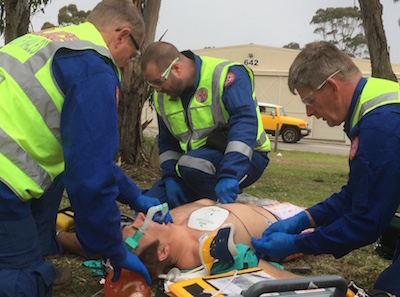
 Our Standard Operating Procedure for the management of traumatic cardiac arrest prioritises the rapid management of reversible causes (hypoxia, tension pneumothorax, hypovolaemia, and cardiac tamponade). Although it has been in operation for several years, it can still appear unfamiliar to ambulance crews and other rescuers as external chest compressions and intravenous adrenaline (epinephrine) are often omitted so that other proactive clinical interventions can be instituted.
ILCOR (the International Liaison Committee on Resuscitation) has now completed its five-yearly consensus review and the European Resuscitation Council (ERC) and American Heart Association (AHA) have published their updated 2015 guidelines on cardiac arrest management, including traumatic cardiac arrest. The Australian and New Zealand Resuscitation Councils usually publish their guidelines a bit later, which do not tend to differ significantly from the European & American versions.
The ERC guideline for traumatic cardiac arrest management1 is available for download here. It is reassuringly up-to-date and constitutes a bold step away from traditional approaches. For us, the heartening finding is that it is entirely consistent with our operating procedures on traumatic cardiac arrest and haemorrhage control. Here is the algorithm:

Examples from the accompanying text that support our existing operating procedures and approach include:
1. Absence of nihilism:
Traumatic cardiac arrest (TCA) carries a very high mortality, but in those where ROSC can be achieved, neurological outcome in survivors appears to be much better than in other causes of cardiac arrest. The response to TCA is time critical and success depends on a well-established chain of survival, including advanced prehospital and specialised trauma centre care.
2. Lack of priority given to chest compressions:
Immediate resuscitative efforts in TCA focus on simultaneous treatment of reversible causes, which takes priority over chest compressions.
3. Proactivity regarding commencing resuscitation, and discontinuing based on response and sonographic cardiac standstill:
The American College of Surgeons and the National Association of EMS physicians recommend withholding resuscitation in situations where death is inevitable or established and in trauma patients presenting with apnoea, pulselessness and without organised ECG activity. However, neurologically intact survivors initially presenting in this state have been reported. We therefore recommend the following approach: Consider withholding resuscitation in TCA in any of the following conditions:
• no signs of life within the preceeding 15 min;
• massive trauma incompatible with survival (e.g. decapitation, penetrating heart injury, loss of brain tissue).
We suggest termination of resuscitative efforts should be considered if there is:
• no ROSC after reversible causes have been addressed;
• no detectable ultrasonographic cardiac activity.
4. Application of aggressive interventions in the prehospital setting:
all interventions other than definitive (surgical/radiological) haemorrhage control appear prior to ‘transport to hospital’.
5. Haemorrhage control measures:
the use of tourniquets…, topical haemostatic agents.., splints…, blood products…, and tranexamic acid while moving the patient to surgical haemorrhage control
and
Give TXA in the prehospital setting when possible
6. Open thoracostomy in preference to needle methods or chest tube insertion:
Thirteen percent of all cases of TCA are caused by tension pneumothorax. To decompress the chest in TCA, perform bilateral thoracostomies in the 4th intercostal space, extending to a clamshell thoracotomy if required. In the presence of positive pressure ventilation, thoracostomies are likely to be more effective than needle thoracocentesis and quicker than inserting a chest tube.
7. Resuscitative thoracotomy in penetrating traumatic cardiac arrest:
Cardiac tamponade is the underlying cause of approximately 10% of cardiac arrest in trauma. Where there is TCA and penetrating trauma to the chest or epigastrium, immediate resuscitative thoracotomy (RT) via a clamshell incision can be life saving. The chance of survival is about 4 times higher in cardiac stab wounds than in gunshot wounds.
8. Prehospital ultrasound in the shocked patient:
Ultrasonography should be used in the evaluation of the compromised trauma patient to target life-saving interventions if the cause of shock cannot be established clinically. Haemoperitoneum, haemo- or pneumothorax and cardiac tamponade can be diagnosed reliably in minutes, even in the prehospital phase.
Our Traumatic Cardiac Arrest Operating Procedure was first approved in 2009, and was based on the best available evidence and experience of our HEMS clinicians who have trained in many services within Australia and overseas. The apparent deviation from ‘standard ACLS’ practiced on trauma patients did require some discussion and defence. Our literature review and recommendations published in 20132 remain pertinent and our operating procedure is now consistent with international guidelines, thanks to the evolution of evidence and the consensus process of ILCOR. Of course, it is still an evidence-light zone and some measure of the effectiveness of this approach is much needed. Survival is still very poor from traumatic cardiac arrest and we all need to collaborate on improving practice in a clinical sphere where small gains can mean massive differences to patients and their families.
1. Truhlář A, Deakin CD, Soar J, Khalifa GEA, Alfonzo A, Bierens JJLM, et al. European Resuscitation Council Guidelines for Resuscitation 2015. Resuscitation. 2015 Oct;95:148–201. (Full text)
2. Sherren PB, Reid C, Habig K, Burns BJ. Algorithm for the resuscitation of traumatic cardiac arrest patients in a physician-staffed helicopter emergency medical service. Crit Care. 2013;17(2):308. (Full text)






 Greater Sydney Area HEMS