With a theme of haemorrhage and trauma, it was always going to be a fun-filled day and it certainly didn’t disappoint. Arranged by Laura and Hannah, an excellent turnout of consultants, registrars, paramedics and medical students filled the room and were presented with a series of relevant and interesting teaching sessions.
Damage Control Resuscitation

Trauma Team Personnel
War, huh! what is it good for?
Some might say ‘absolutely nothing’ but others might argue that it has at least led to an advancement in the management of major trauma.
Through the wonders of Skype, we were able to listen to the excellent Damian Keene, anaesthetic registrar, major in the British army and PHEM trainee, talking about his extensive experience working in Camp Bastion, Afghanistan.
Damian took us through a typical case involving a severely injured soldier requiring resuscitation and damage control surgery. Through detailed documentation, it was possible to see the rapid and life-saving treatment that the patient received.
- Junctional wounds (e.g. axilla or groin) which are too proximal for tourniquet application are challenging to manage – Damian reported excellent results with topical haemostatic agents – in their case Celox gauze
- Intraosseous access would generally be gained prior to arrival in hospital. For rapid transfusion and resuscitation, large bore subclavian access was the route of choice in hospital with a second anaesthetist dedicated to the procedure
- Initial transfusion was in a 1:1 ratio, Packed Red cells:Plasma
- Once bleeding was controlled they immediately switched to individually tailored transfusion – based on clinical and laboratory assessment, including point of care thromboelastometry
What really came across was how refined and streamlined the entire process was – from time of injury to definitive surgery – with every facet of care optimised to ensure the patient received the best care possible – something which many civilian trauma centres could only aspire to.
A comprehensive review article detailing the defence forces approach to trauma was published in Anaesthesia in 2013 and is recommended reading
Acute Coagulopathy of Trauma
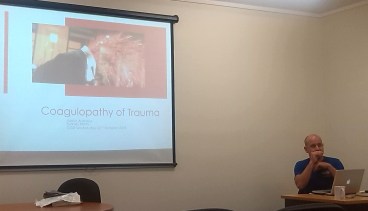
Coagulopathy of Trauma
Jamie channeled his inner Karim Brohi and talked us through the complicated and evolving subject of acute traumatic coagulopathy.
- Coagulopathy is present in up to 25% of major trauma patients on arrival in the Emergency Department and is associated with a significant increase in mortality.
- Conventional teaching has previously been that coagulopathy was a result of dysfunction (through acidosis and hypothermia), depletion and dilution of clotting factors.
- pH>7.1 is unlikely to adversely affect coagulation
- Minimising patient heat loss is important but temperature needs to be below 33°C to affect coagulation
- Inappropriate IV fluids can affect coagulation through dilution of clotting factors
Acute traumatic coagulopathy is currently thought to be far more complex than originally taught, with a dynamic imbalance of procoagulant and anticoagulant factors as well as impaired platelet function and hyperfibrinolysis
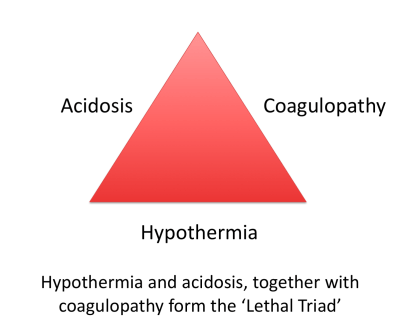
- ‘The Lethal Triad’ – it’s not just a Chinese organised crime syndicate
Europe’s Stance on Management of Bleeding and Coagulopathy
The Advanced Bleeding Care Group have recently published an updated consensus guideline on the management of bleeding and coagulopathy following major trauma. In a similar approach to the Surviving Sepsis Campaign, the group hope that the launch of the STOP the Bleeding Campaign will reduce the number of preventable deaths from haemorrhage following trauma
- S – Search for patients at risk of coagulopathic bleeding
- T – Treat bleeding and coagulopathy as they develop
- O – Observe response to interventions
- P – Prevent secondary bleeding and coagulopathy
, by standardising and improving the level of care that these patients receive.
While the group attending the CGD did not agree with all the recommendations (vasopressors in trauma), it was felt that this was a useful project, with the potential to standardise and improve the level of care that these patients receive.
An app is free to download and contains a useful summary of the recommendations. The full recommendations are also available.
Practical Haemorrhage Control

Maxillofacial haemorrhage control with Karel Habig
In a practical session looking at haemorrhage control, Karel walked us through the initial management of massive traumatic maxillo-facial haemorrhage.
There is a stepwise process to achieving haemostasis:
- Intubate
- Manually reduce and align mid-face fractures – this is crucial as without this subsequent steps can further distract a displaced facial fracture and worsen bleeding
- Insert bilateral nasal epistats (posteriorly, not superiorly) but do not inflate
- Cervical collar to splint the mandible
- Dental props – inserted bilaterally, the largest size which will comfortably fit
- Inflate epistats – firstly posterior balloons with water, followed by incremental filling of the anterior balloons until haemostasis achieved
Literature Review
Following lunch, Jamie and Laura facilitated a lively group discussion on two papers relevant to critical care and retrieval medicine.
In the first, a review article looking at delirium and sedation in ICU it was apparent that delirium is a significant problem in ICU which often goes unrecognised.
Evidence suggests that management of sedation and delirium can have an important effect on patients treated in ICU. While it did not appear that any sedative performed significantly better than another the take-home message appeared to be that good care required regular assessment of sedation in ICU while keeping it to the minimum necessary for patient comfort and safety, along with using a protocol to routinely monitor and treat pain and delirium.
The second paper which was reviewed was from the TRISS Trial Group, recently published in the NEJM. It was a multi-centre RCT investigating whether a higher (9g/dL) or lower (7g/dL) transfusion threshold had any effect on mortality in septic shock.
There was no significant difference in the primary outcome, which was mortality at 90 days. Not surprisingly, secondary outcomes showed that patients in the higher threshold group received significantly more blood transfusions.
It was felt to be a well designed study which although only partially blinded (full blinding would have been very difficult) had few flaws and good internal and external validity.
Amongst the group discussing the paper, it was felt that this generally supported their current practice rather than changing it. A review of this article, along with many others can be found on the excellent Wessex Intensive Care Society website
Next Clinical Governance Day is on 5th November