Prehospital Trauma Education

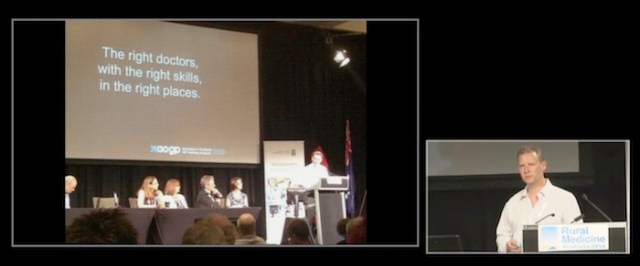
This talk was presented at the London Trauma Conference in December 2014, by Dr Cliff Reid, Director of Training for Greater Sydney Area HEMS.

Dr Reid explains how the HEMS induction program is crafted, and how it has evolved to include simulation, stress exposure training, perturbation training, and cross training. He reveals how the team has striven to increase the physical, psychological, and functional fidelity of the simulations. He also explains the approach to testing, in which the performance of teams in the focus of assessment, rather than the knowledge of individuals. The ‘educational laboratory’ of HEMS induction is continually a work in progress.

For further information check out the list of references.
Posted in simulation, training | Tagged , | Leave a comment

The Retrieval Medicine Environment

This 15 minute talk by HEMS Physician Karel Habig provides an introduction to our working environment for newcomers to prehospital & retrieval medicine

Posted in Presentations | Tagged , , | Leave a comment

Winch Operations

This presentation was given at the Retrieval 2014 conference in Glasgow.

Posted in Presentations, training | Tagged , , , | Leave a comment

Location location location

Do you know how to give the latitude and longitude of your location when calling emergency services?

Any smartphone can manage it, but you have to know how. Several free apps are available, but you don’t necessarily need them – the phone’s in-built apps can often do the job.

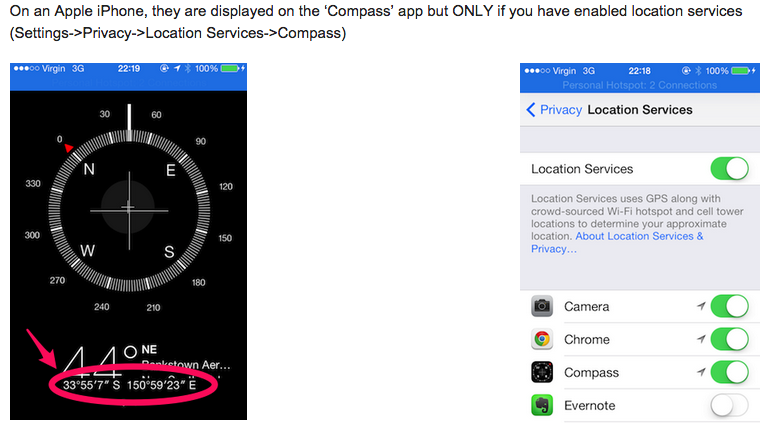
Here’s how to find the “lat and long” on an iPhone (as shown on resus.me, applicable at the time of writing in 2014):

compass

So the above coordinates would be read as:

My location is latitude thirty-three degrees, fifty-five minutes, seven seconds South, longitude one hundred fifty degrees, fifty-nine minutes, twenty-three seconds East‘.

Remember exact location is part of the METHANE message to be called in when declaring a major incident.

How precise is this?
A second of latitude is approximately 30 metres. A second of longitude varies in size. At the equator, it is approximately 30 metres, the same size as a second of latitude. The size gradually decreases to zero as the meridians converge at the poles.


Posted in Tips | Tagged , , , | Leave a comment

Clinical Governance Day 14th January 2015

CGD 14 Jan


See here for directions

Posted in training | Tagged | Leave a comment

Critical thinking in rural & remote medicine

This 30 minute talk by Sydney HEMS consultant Dr Brian Burns was delivered at a recent rural medicine conference

Critical thinking in rural & remote medicine

BBtalk

Posted in Presentations | Tagged | Leave a comment

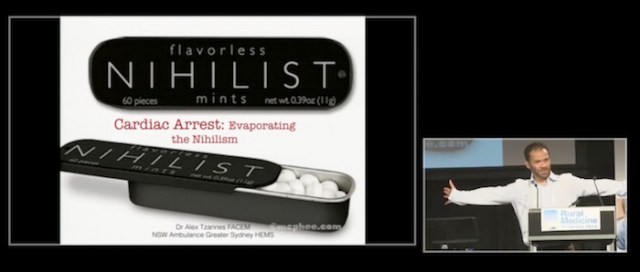
Evaporating the nihilism in cardiac arrest

This 44 minute talk by Sydney HEMS consultant Dr Alex Tzannes was delivered at a recent rural medicine conference

Evaporating the nihilism in cardiac arrest
ATNihilism

Posted in Presentations | Tagged | Leave a comment

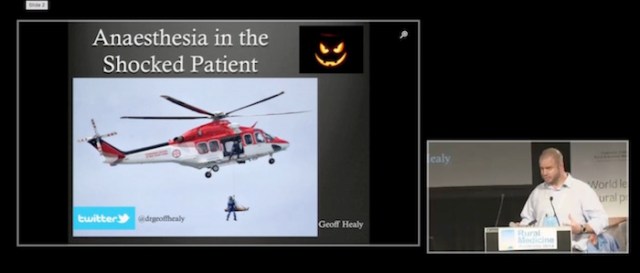
Anaesthesia in the shocked patient

This 31 minute talk by Sydney HEMS consultant Dr Geoff Healy was delivered at a recent rural medicine conference

Anaesthesia in the shocked patient

GHshock

Posted in Airway, Presentations | Tagged , , | Leave a comment

Cutting the edge of the trauma void

This 22 minute talk by Sydney HEMS consultant Dr Oran Rigby was delivered at a recent rural medicine conference

Cutting the edge of the trauma void

ORtrauma

Posted in Presentations | Tagged | Leave a comment

Essential components of pre-retrieval trauma care

This 22 minute talk by Dr Karel Habig was delivered at a recent rural medicine conference

Essential components of pre-retrieval trauma care

KHretrieval

Posted in Presentations | Tagged , , | 1 Comment