A monthly audit of our airway cases is done to evaluate our performance against key performance indicators and to identify and share learning points for the team.
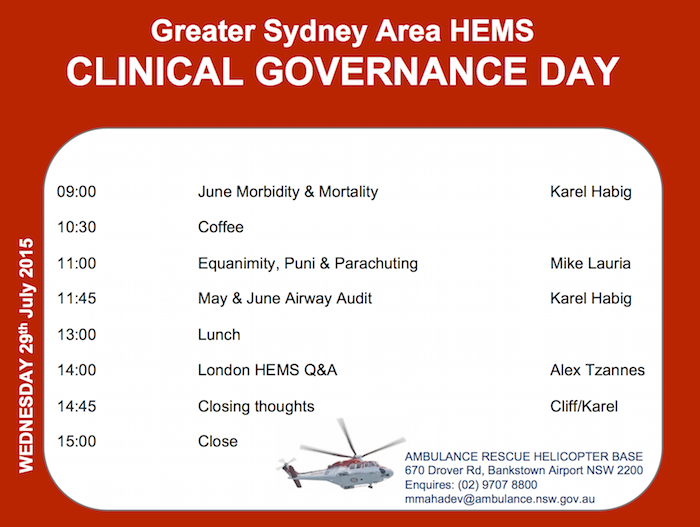
Here are some key points from the Clinical Governance Day on 20th May 2015:
1. Always ensure factual consistency between the written case-sheet record and the database computer entry. Discrepancies, if they ever occurred, could be confusing from a legal point of view.
2. After prehospital RSI patients should be connected to a mechanical ventilator as soon as practicable. In our case this is the Medumat ventilator.
Mechanical ventilation allows for greater CO2 control which is particularly important in traumatic brain injury(1). Secondly, compared to hand ventilation, the ventilator frees an operator to perform further prehospital interventions such as finger thoracostomy and blood transfusion, both of which could be required in a polytrauma case. Thirdly, in haemorrhagic shock an increasing ETCO2 in the presence of a set minute ventilation can indicate an improving cardiac output, and lastly, that in the presence of haemorrhagic shock as a cause of reduced cardiac output, a ventilator avoids the tendency to hyperventilation and high intrathoracic pressures from hand bagging that can further reduce cardiac output.
To ensure familiarity with the Medumat, post-intubation care including Medumat ventilator use will now be incorporated into RSI currency training for existing staff and some of the simulations at induction training.
3. Some tips for airway management in the bariatric patient were covered.
Active airway management during pre-oxygenation is essential in these patients, it was noted that airway patency is essential in order for the patient to gain benefit from the use of apneoic oxygenation. With this in mind the use of airway adjuncts as a minimum are encouraged(2).
Positioning, including ramping the obese patient prior to RSI is important in avoiding hypoxia. Risk/benefit analysis in trauma patients of a small amount of thoraco-lumbar flexion from putting the bed head up or sloping the stretcher is something that should be actively estimated.
Weight estimates are frequently wildly inaccurate. It is important to note that medical literature suggests that both Rocuronium and Ketamine dosing is done by Ideal Body Weight(3-6). (Easily remembered as RocKetamine is IDEAL for induction). Although in our setting there are few complications of overdosing of rocuronium, aside from prolonging neuromuscular blockade, this is not the case with ketamine dosing which may cause hypertension and tachycardia(6).
4. The term “Blind bougie” may mean different things to different people and perhaps a better description of placing a curved bougie posterior to the epiglottis in a Gd 3 (cords/arytenoids not seen) laryngoscopy attempt would be ‘guided placement of bougie’, Of course, regardless of terminology used, if the bougie has not been seen to go through the cords then one should not railroad a tube over it if hold up has not occurred and no clicks have been felt(7).
References
1. Davis DP. Early ventilation in traumatic brain injury.
Resuscitation. 2007;76(3):333-340.
2. Ramachandran SK. et al. 2010. Apneic oxygenation during prolonged laryngoscopy in obese patients: a randomized, controlled trial of nasal oxygen administration.
Journal of Clinical Anesthesia 22, 164–168
3. Meyhoff CS et al 2009. Should Dosing of Rocuronium in Obese Patients Be Based on Ideal or Corrected Body Weight?
Anesth Analg 109:787–92
4. Tomasz M. Gaszynski and Tomasz Szewczyk 2011. Rocuronium for rapid sequence induction in morbidly obese patients: a prospective study for evaluation of intubation conditions after administration 1.2mgkg ideal body weight of rocuronium.
European Journal of Anaesthesiology Vol 28 No 8 :609-611
5. Ingrande and H. J. M. Lemmens 2010. Dose adjustment of anaesthetics in the morbidly obese.
British Journal of Anaesthesia 105 (S1): i16–i23
6. Wulfsohn NL. 1972. Ketamine Dosage for Induction Based on Lean Body Mass.
Anesthesia & Analgesia. 51(2): 299-305
7. Kidd JF, Dyson A, Latto IP. Successful difficult intubation. Use of the gum elastic bougie.
Anaesthesia. 1988 Jun;43(6):437–8.


 AiR Videos
 Greater Sydney Area HEMS