Passive leg raising during CPR

Measuring end-tidal carbon dioxide (ET CO2 ) is a practical non-invasive method for detecting pulmonary blood flow, reflecting cardiac output and thereby the quality of CPR. It has also been shown to rise before clinically detectable return of spontaneous circulation (ROSC).

Passive leg raising (PLR) increases venous return and may therefore augment cardiac output and in a cardiac arrest this may be reflected by an elevation in ETCO2.

A Swedish observational study of 126 patients with out of hospital cardiac arrest due to a likely cardiac aetiology underwent tracheal intubation with standardised ventilation and chest compressions (either manually or using the LUCAS device, as part of larger study of mechanical chest compressions according to a cluster design). Patients were stratified to receive either PLR to 20 degrees or no PLR. ETCO2 was measured during CPR, either for 15min, or until the detection of ROSC.

Hang on I think that's overdoing it a bit

During PLR, an increase in ETCO2 was found in all 44 patients who received PLR within 15s (p=0.003), 45s (p = 0.002) and 75 s (p = 0.0001). Survival to hospital discharge was 7% among patients with PLR and 1% among those without PLR (p = 0.12). Among patients experiencing ROSC (60 of 126), there was a marked increase in ETCO2 1 min before the detection of a palpable pulse.

Passive leg raising during cardiopulmonary resuscitation in out-of-hospital cardiac arrest—Does it improve circulation and outcome?
Resuscitation. 2010 Dec;81(12):1615-20

Posted in General PH&RM | Tagged , , , | Leave a comment

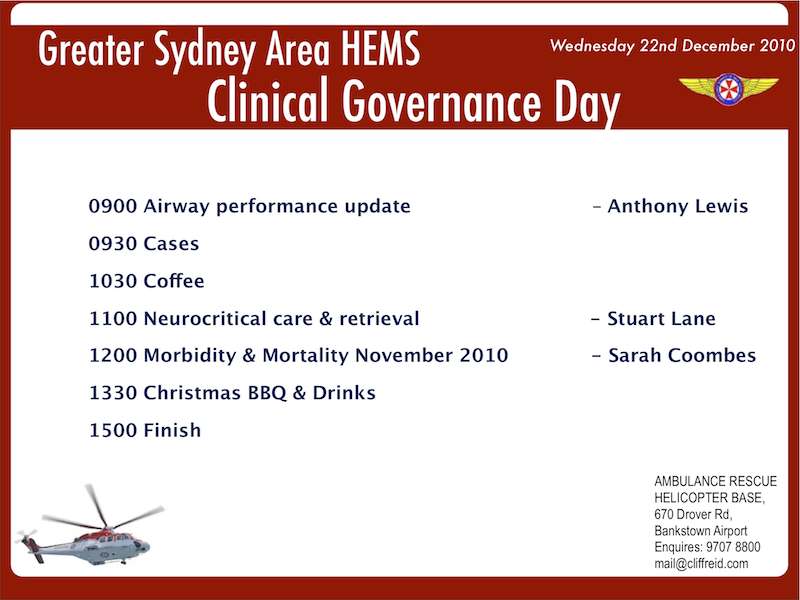
Clinical Governance Day

The next GSA-HEMS Clinical Governance Day will take place at Bankstown Airport on Wednesday 22nd December 2010

Posted in General PH&RM | Leave a comment

Clinical currencies

Clinical currency assessments are now underway for GSA-HEMS consultants. All SRCs will go through the process first as we refine it. The components are:

  • written test (online via the VLE)
  • practical assessment
  • to be repeated every three months

At the moment the only clinical currency is RSI. See Karel, Cliff, or Anthony for more info.

Enjoy!

Posted in General PH&RM | Leave a comment

UK Military Clinical Guidelines

In the United Kingdom, The Academic Department of Military Emergency Medicine at the Royal Centre for Defence Medicine produces Clinical Guidelines for Operations on behalf of Surgeon General under the direction of Defence Professor of Emergency Medicine.

These guidelines, last updated in May 2010, are available on line here:

Posted in General PH&RM | Tagged , , , , | Leave a comment

Needle crike: low rate and allow exhalation

Two dedicated devices for transtracheal oxygen delivery through a cricothyroidotomy needle are available, the ENK Oxygen Flow Modulator (ENK) and the Manujet. Both maintain oxygenation, but the ENK is thought to achieve better ventilation (as previously shown in a pig model) because of a continuous flow that provides CO2 washout between insufflations. Very little is known concerning the lung pressures generated with these 2 devices, so a study using a simulated trachea and artificial lung model sought to determine oxygen flow, tidal volumes, and airway pressures at different occlusion rates and during both simulated partial and complete upper airway obstruction.

Manujet

Gas flow and tidal volume were 3 times greater with the Manujet than the ENK (approximately 37 vs 14 L/min and 700 vs 250 mL, respectively) and were not dependent on the respiratory rate. In the absence of ventilation, the ENK delivered a 0.6+/-0.1 L/min constant gas flow. In the totally occluded airway, lung pressures increased to 136 cm H2O after 3 insufflations with the Manujet, whereas the ENK, which has a pressure release vent, generated acceptable pressures at a low respiratory rate (4 breaths/min) (peak pressure at 27.7 +/-0.7 and end-expiratory pressure at 18.8+/- 3.8 cm H2O). When used at a respiratory rate of 12 breaths/min, the ENK generated higher pressures (peak pressure at 95.9 +/- 21.2 and end-expiratory pressure at 51.4+/- 21.4 cm H2O). In the partially occluded airway, lung pressures were significantly greater with the Manujet compared with the ENK, and pressures increased with the respiratory rate with both devices. Finally, the gas flow and tidal volume generated by the Manujet varied proportionally with the driving pressure.

The authors asset that this study confirms:

  • the absolute necessity of allowing gas exhalation between 2 insufflations and
  • maintaining low respiratory rates during transtracheal oxygenation.

In the case of total airway obstruction, the ENK may be less deleterious because it has a pressure release vent. Using a Manujet at lower driving pressures may decrease the risk of barotrauma and allow the safe use of higher respiratory rates

ENK

Oxygen delivery during transtracheal oxygenation: a comparison of two manual devices
Anesth Analg. 2010 Oct;111(4):922-4

Posted in General PH&RM | Tagged , , , , | Leave a comment

LMA to stoma ventilation

Level 1 evidence is great, but for useful tips that can add options to your resuscitation toolbox there are some great finds in journal letters pages.

Try this one: An apneoic patient requires assisted ventilation in your resuscitation room. Bag-mask ventilation is ineffective. You then notice a mature tracheostomy at the same time that you’re told he had a laryngectomy. How would you ventilate him?

The obvious answer is to intubate the stoma with a size 6.0 tracheal tube or a tracheostomy tube if you have one. However prior to that you could bag-‘mask’ ventilate with a size 2 laryngeal mask airway applied to the stoma, holding the cuff in place with pressure through an index finger.

Such a technique is desribed in the context of an elective anaesthesia case in this month’s Anaesthesia. The LMA cuff provided an effective seal around the stoma, thereby allowing leak-free ventilation.

Stoma ventilation using a paediatric facemask is another option.

Tracheostomy ventilation using a laryngeal mask as a ‘bridge to extubation’
Anaesthesia 2010;65(12):1232–1233

Posted in General PH&RM | Tagged , , , | Leave a comment

Fetal monitoring during EMS transport

Can cardiotocography be applied in the pre-hospital setting? French physicians assessed its feasibility in 145 patients enrolled during 119 interhospital transfers and 26 primary prehospital missions.
Their physician-staffed ambulance teams included 19 emergency physicians and one anaesthetist.

Interpretable tracings were obtained for 81% of the patients during the initial examination, but this rate decreased to 66% during handling and transfer procedures. Only ground EMS transportations were included in the study. For 17 patients (12%), the monitoring led to a change in the patient’s management: an acceleration of chronology of prehospital management in 5 cases, a decision to directly admit the patient to the operating room for immediate cesarean section in three cases, a change in hospital admission in three cases, an adaptation or implementation of tocolytic treatment in six cases, and placing the patient in the left lateral decubitus position or oxygen administration in three cases.

Fetal monitoring in the prehospital setting
J Emerg Med. 2010 Nov;39(5):623-8

Posted in General PH&RM | Tagged , , , , | Leave a comment

Pre-hospital amputation

British trauma surgeon and pre-hospital pioneer Professor Keith Porter describes how to do a pre-hospital amputation in this months EMJ. Thankfully the procedure is only rarely necessary and often only requires cutting remaining skin bridges with scissors. The indications are:

  • An immediate and real risk to the patient’s life due to a scene safety emergency
  • A deteriorating patient physically trapped by a limb when they will almost certainly die during the time taken to secure extrication
  • A completely mutilated non-survivable limb retaining minimal attachment, which is delaying extrication and evacuation from the scene in a non-immediate life-threatening situation
  • The patient is dead and their limbs are blocking access to potentially live casualties

simple equipment for amputation

The recommended procedure is:

  1. Ketamine anaesthesia
  2. Apply an effective proximal tourniquet
  3. Amputate as distally as possible
  4. Perform a guillotine amputation
  5. Apply haemostats to large blood vessels
  6. Leave the tourniquet in situ
  7. Apply a padded dressing and transport to hospital

Remember: the requirement for prehospital amputation other than cutting minimal soft tissue bridges is rare. However pre-hospital critical care physicians should be trained and equipped to amputate limbs in order to save life. Probably good to have a Gigli saw in your pack and to familiarise yourself with its use, as shown here:

Sydney HEMS doctors training in amputation

Prehospital amputation
Emerg Med J 2010 27: 940-942

Posted in General PH&RM | Tagged , , , , | Leave a comment

Pelvic splint improved shock

Splinted any pelvises lately? Karim Brohi’s excellent trauma.org article outlines the strengths and weaknesses of the different devices on the market. One such is the T-POD, which has now been described in a small series in which its application to patients with unstable pelvic injury was associated with improved haemodynamics and decreased symphyseal diastasis.

Here’s a video demonstrating application of the device.

http://www.youtube.com/v/UuMMi3D9iyM?fs=1&hl=en_US

Effect of a new pelvic stabilizer (T-POD1) on reduction of pelvic volume and haemodynamic stability in unstable pelvic fractures
Injury Volume 41, Issue 12, December 2010, Pages 1239-1243 (Full text)

Posted in General PH&RM | Tagged , , , | Leave a comment

LMA not always successful; needle crike fails often

A meta-analysis of pre-hospital airway control techniques evaluated alternative techniques to tracheal intubation. The outcome was placement success; there were no data on effectiveness of ventilation or other clinical outcomes. Although limited by poor quality studies, there are some interesting findings.

The pooled placement success rates for Combitube and LMA, were similar but unimpressive, with nonphysician placement success rates of 83.0% and 82.7%, respectively. The authors point out that while these devices might offer potential advantages over conventional tracheal intubation in terms of reduced training requirements, or perhaps fewer or less severe complications, they should not be expected to provide higher airway management success rates than conventional tracheal intubation.

Low success rates for this 'rescue procedure'. Just get your scalpel...

They identified only four studies reporting the success rates of needle cricothyroidotomy (NC). Regardless of patient circumstances or clinician credentials, the NC success rate was ubiquitously low, ranging from 25.0% to 76.9%. The pooled results for the 18 surgical cricothyroidotomy (SC) studies produced substantially higher success rates, although the success rate for all nonphysician clinicians was still only 90.4%. The authors state: “EMS systems that choose to incorporate a percutaneous airway procedure into their airway management protocols should recognize that the success rate of SC far exceeds that of NC”.

A meta-analysis of prehospital airway control techniques part II: alternative airway devices and cricothyrotomy success rates
Prehosp Emerg Care. 2010 Oct-Dec;14(4):515-30

Posted in General PH&RM | Tagged , , | Leave a comment