The lead -in
3-year-old child collapsed in respiratory distress following bee-sting.
Scene
000 call by father who is the sole individual with the patient in a park. Easy access to the patient who is on the ground with father anxiously trying to rouse the patient. Upon initial assessment, another paramedic has responded and presents himself.
The patient
Initial assessment performed by the doctor while paramedic attached monitoring and unsuccessfully attempted IV access. ICP (intensive care paramedic) was preparing equipment for kit dump.
A – Tongue swelling, wheeze and stridor
B – Spontaneously ventilating, poor gas-flow, SpO2 89% on high-flow oxygen, improved with insertion of an oropharyngeal airway, equal chest rise
C – BP 65/42 mmHg, HR 150-165 bpm sinus tachycardic, no bleeding seen
D – GCS 5/15, pupils equal
E – Diffuse urticarial rash throughout
Questions to ask yourself at this point:
What are the immediate priorities in paediatric anaphylaxis?
What are the complications of our potential interventions?
Where is the most appropriate location to manage this patient?
Scenario Progress
IV line tissued, IO inserted, difficulty locating 1mL syringe, adrenaline 0.1mL 1 in 1,000 (100 micrograms) IM given, IV fluids bolus of 20ml/kg given and patient transferred on to stretcher.
Patient deterioration with bradycardia and reduced ETCO2, thus further dose of adrenaline given of 0.1mL of 1 in 1,000 (100 micrograms).
RSI performed, intubation by doctor as risk of difficult intubation. Initial attempt to use a bougie but size 4.0 mm endotracheal tube wouldn’t fit over the bougie, thus direct intubation without bougie.
Post-intubation, patient developed tachycardia, high airway pressures and reduced right-sided chest movement. Suspected right pneumothorax, therefore needle decompression performed followed by right thoracostomy – immediately improved the clinical picture.
Uneventful onward transfer.
Learning points
- Bougies are too big for size 4.0 ETT
- The location of 1 mL syringes: in the interhospital pack with the mucosal atomizing device
- Hydrocortisone is not kept in our primary packs, but in the interhospital pack medication pouch – the paediatric dose is 4 mg/kg IV
- IN ANAPHYLAXIS GIVE IM ADRENALINE ASAP:
- IM adrenaline 1:1000 (1 mg/mL) 0.01 mg/kg to a maximum of 0.3-0.5 mg IM [i.e. 0.01 mL/kg of 1:1000 adrenaline]
- IV adrenaline if no response to repeated IM adrenaline: 0.1-5.0 micrograms/kg/min
An excellent summary on the management of paediatric anaphylaxis can be found on the highly recommended Life in the Fast Lane blog here.

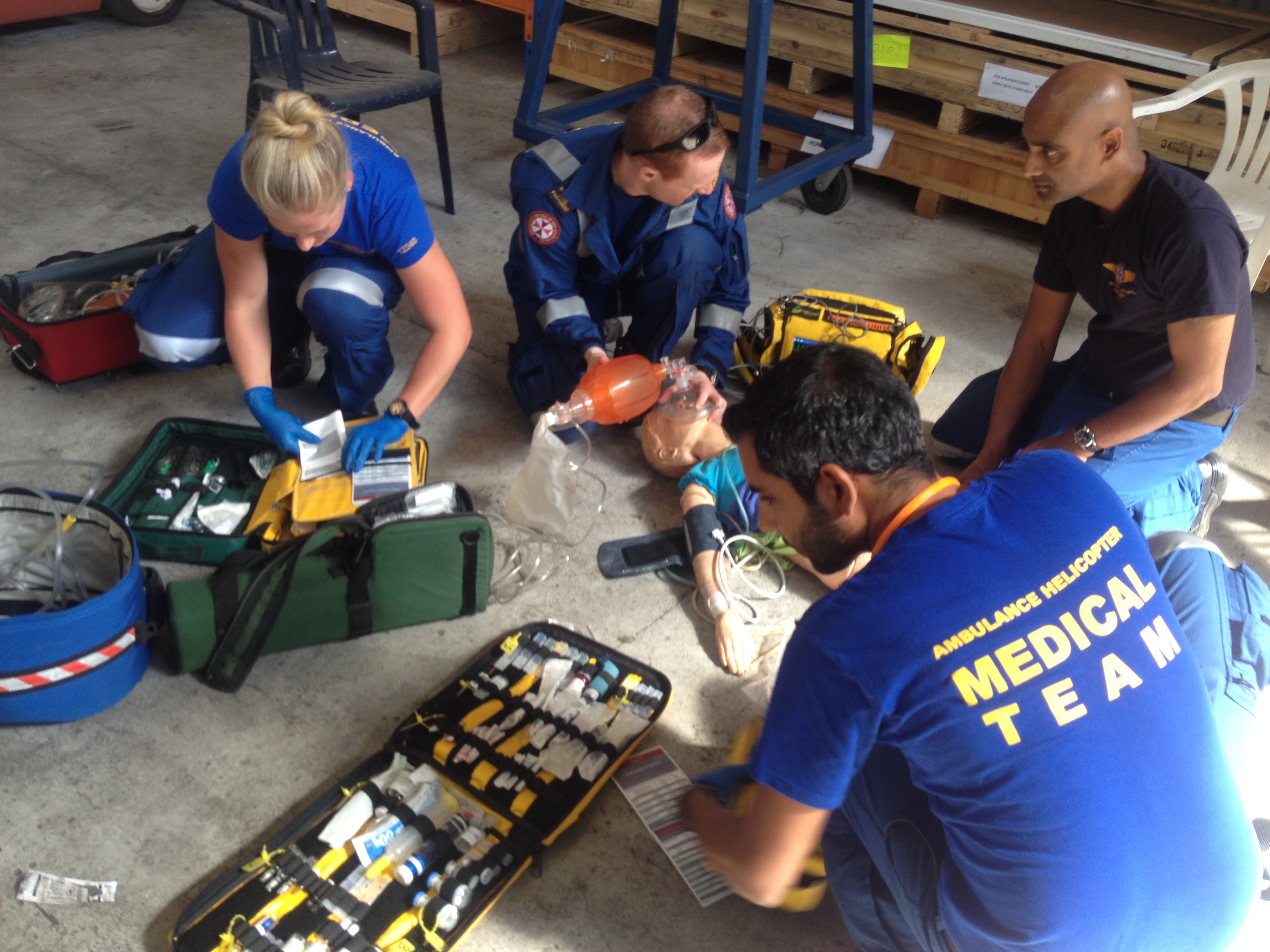
The kit dump and the drug perusal.
Thanks to Kariem (Doctor), Libby (ICP), Ben (Paramedic), Sanj (SRC, Patients father), Marty (Drip stand, Sim Controller) and Carla (STAR).







 AiR Videos
 Greater Sydney Area HEMS