Clinical Governance Day 26/3: The Morning After The Week Before

All of the attendees at this CGD were treated to a brilliant post-smaccGOLD desert, with an incredible guest speaker, a statistical review of one of the most important publications of the year, a fierce SIMWARS battle, and answers to the age old question: “what the smacc is FOAM?!?!”


Motorcycles: Cases from the Races – John Hinds

John Hinds is not only a fantastic speaker, but also an extremely experienced motorcycle racing doctor. He provided a fantastic insight in to the instantaneous care of trauma at high-speed motorcycle races.

“With average speeds of 135mph* and maximum speeds beyond 200mph*, when they crash, they crash big”

*That’s 217 and 321 km/h in new money

The key crash mechanisms and injuries to really be concerned about include:

  1. “Hitting the kerb” – they’ve either come to a dead stop or have been launched
  2. “Broken feet and a low GCS” – think neck and base of skull
  3. “Head-on collision with an apparently isolated femoral fracture” – The pelvis is probably being held together by the leathers
  4. “Beware the boot lying in the road” – riders are likely to have realised they are about to crash and put their foot down, leading to lower limb spiraling. Gruesome photos.

Interesting point for all to bear in mind: helmet removal is quite safe. In thousands of cases of helmet removal, John stated they have never had any deterioration due to the removal. Note that there might be significant CO2 buildup within the helmet thus high-flow O2 should be delivered if there is any delay in helmet removal.


The Death of EGDT – Sandra Ware

We were walked through a critical appraisal of what may be one of the biggest studies published this year so far by the hugely experienced Sandra Ware. The American ProCESS study is the first of three publications expected to answer the 13-year-old question: Is early goal-directed therapy (EGDT) superior to protocolised standard care (PSC) or unstandardised ‘usual care’ (UC).

The study was a multicentre, open label (i.e. both the researchers and participants know which treatment is being administered), randomised controlled trial in 31 EDs in the USA of 1,351 patients admitted between March 2008 and May 2013. The primary end-point was hospital mortality prior to discharge or 60 days, whichever came first. Secondary mortality outcomes included the rate of death from any cause at 90 days and cumulative mortality at 90 days and 1 year, while a range of morbidity outcomes were also assessed.

There were no significant differences between any of the primary or secondary outcome measures, although IV fluid administration was higher in the first six hours in the PSC group and vasopressor use in the same time period was higher in the EGDT and PSC group.

What are we to think? Perhaps the simple measures are the most important in the initial phases of sepsis management. This may be the start of a shift away from EGDT and early vasopressor with invasive monitoring to a more clinically directed, pragmatic approach to management of septic patients.

Excellent podcast by Scott Weingart interviewing ProCESS study author Derek Angus can be found here.


Social Media – Ed Burns

For all of us social media numpties, Ed gave a great talk introducing all things we need to know about how to maximise our knowledge, learning and development online:


What The SMACC is FOAM by Ed Burns on Prezi


SIMWARS

There was a highly dynamic and exciting SIMWARS battle held where the key learning points related to resuscitation of traumatic cardiac arrest (TCA) patients include:

  • Resuscitation of these patients is not always futile with up to a 7.5% survival to hospital discharge
  • Once successfully intubated, achieve adequate ventilation while minimising minute ventilation and high intrathoracic pressures
  • All TCA patients should have bilateral open thoracostomies
  • Early haemorrhage control with early blood transfusion through large-bore vascular access in sites above the diaphragm
  • Consider clamshell thoracotomy in penetrating TCA within 10 minutes of arrest
  • Consider perimortem caesarean delivery in gravid patients of greater than 20 weeks gestation in TCA within 4 minutes of arrest
  • Chest compressions may be omitted until pre-load and obstructive causes of TCA

Great article with rationale for management decisions by Peter Sherren & the team can be found here.SIMWARS 26th March 2014

Posted in General PH&RM, Presentations, simulation, training | Tagged , , , , , , | Leave a comment

Clinical Governance Day 26th March 2014

CGD Flyer (1)

For directions click the ‘Contact’ tab above

Posted in training | Tagged | Leave a comment

Simulation 18/3/14: The Paediatric Bee-Sting

The lead -in

3-year-old child collapsed in respiratory distress following bee-sting.

Scene

000 call by father who is the sole individual with the patient in a park. Easy access to the patient who is on the ground with father anxiously trying to rouse the patient. Upon initial assessment, another paramedic has responded and presents himself.

The patient

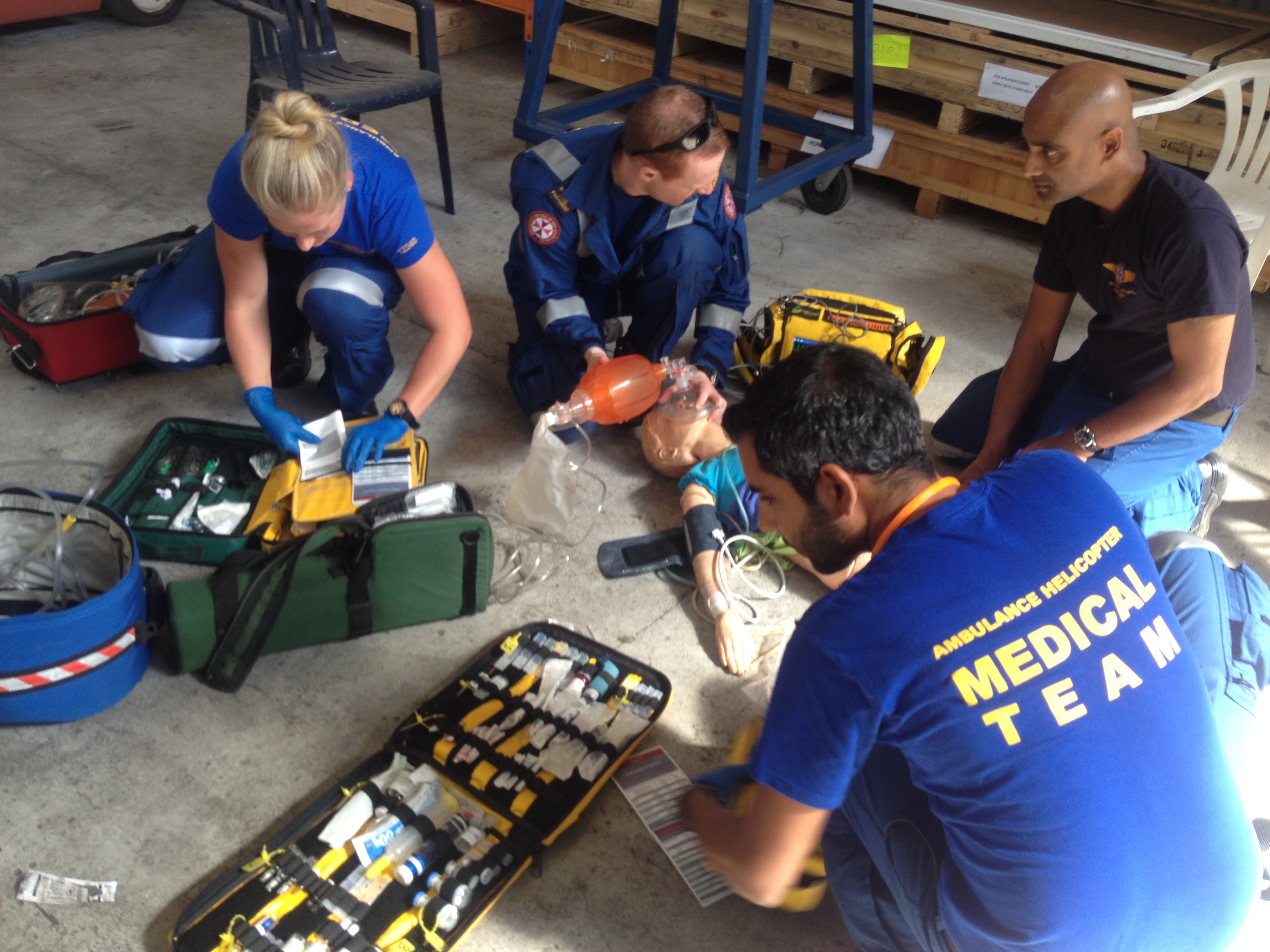
Initial assessment performed by the doctor while paramedic attached monitoring and unsuccessfully attempted IV access. ICP (intensive care paramedic) was preparing equipment for kit dump.

A – Tongue swelling, wheeze and stridor

B – Spontaneously ventilating, poor gas-flow, SpO2 89% on high-flow oxygen, improved with insertion of an oropharyngeal airway, equal chest rise

C – BP 65/42 mmHg, HR 150-165 bpm sinus tachycardic, no bleeding seen

D – GCS 5/15, pupils equal

E – Diffuse urticarial rash throughout

Questions to ask yourself at this point:

What are the immediate priorities in paediatric anaphylaxis?

What are the complications of our potential interventions?

Where is the most appropriate location to manage this patient?

Scenario Progress

IV line tissued, IO inserted, difficulty locating 1mL syringe, adrenaline 0.1mL 1 in 1,000 (100 micrograms) IM given, IV fluids bolus of 20ml/kg given and patient transferred on to stretcher.

Patient deterioration with bradycardia and reduced ETCO2, thus further dose of adrenaline given of 0.1mL of 1 in 1,000 (100 micrograms).

RSI performed, intubation by doctor as risk of difficult intubation. Initial attempt to use a bougie but size 4.0 mm endotracheal tube wouldn’t fit over the bougie, thus direct intubation without bougie.

Post-intubation, patient developed tachycardia, high airway pressures and reduced right-sided chest movement. Suspected right pneumothorax, therefore needle decompression performed followed by right thoracostomy – immediately improved the clinical picture.

Uneventful onward transfer.

Learning points

  1. Bougies are too big for size 4.0 ETT
  2. The location of 1 mL syringes: in the interhospital pack with the mucosal atomizing device
  3. Hydrocortisone is not kept in our primary packs, but in the interhospital pack medication pouch – the paediatric dose is 4 mg/kg IV
  4. IN ANAPHYLAXIS GIVE IM ADRENALINE ASAP:
    1. IM adrenaline 1:1000 (1 mg/mL) 0.01 mg/kg to a maximum of 0.3-0.5 mg IM [i.e. 0.01 mL/kg of 1:1000 adrenaline]
    2. IV adrenaline if no response to repeated IM adrenaline: 0.1-5.0 micrograms/kg/min

An excellent summary on the management of paediatric anaphylaxis can be found on the highly recommended Life in the Fast Lane blog here.

The kit dump and the drug perusal.

The kit dump and the drug perusal.

Thanks to Kariem (Doctor), Libby (ICP), Ben (Paramedic), Sanj (SRC, Patients father), Marty (Drip stand, Sim Controller) and Carla (STAR).

Posted in simulation, Tips, training | 1 Comment

CGD 12th March 2014 – A day to remember, and what we all should remember…

The lucky Sydney HEMS attendees to this Clinical Governance Day got a taster of some brilliant lectures to be delivered at smaccGOLD on the 19th-21st of March 2014. Not wanting to give the game away, here are the key learning points from the ever-essential Morbidity & Mortality review and Airway Audit:

Airway Audit – Anthony Lewis

Great cases to learn from this month, things to remember:

  • Always have a Plan A, B, C and D. Verbalise them to your team.
  • Senior clinicians at referring hospitals can be invaluable
  • Think about your doses of induction drugs: not too high, nor too low, aim for the Goldilocks dose.


Morbidity & Mortality – Karel Habig

Reviewed some difficult cases that people had in January, and the key learning points for the month include:

  • Never forget your Lifepak. Anywhere.
  • Cardiac arrest in trauma may be medical in nature: never assume it is purely traumatic
  • In septic interhospital transfers, consider USS to guide fluid therapy before transporting patients
  • If you’ve made a conscious decision to do or not to do something, document why! It may make your life much easier in the future.
  • In patients with ventilation difficulties, it is probable a good idea to document the ventilator settings, this may impact the patients clinical course and your legal course!
  • In alcoholics with a high lactacte, give thiamine – it will assist metabolism of lactate
  • Finally, remember: if you will use advanced airway then talk to SRC. There is a reason you are using it, so there is another person to talk to if you need to use it!

Look out for our review of smaccGOLD soon!

Posted in training | Tagged , | Leave a comment

Clinical Governance Day 12th March 2014

CGD Flyer

For directions click the ‘Contact’ tab above

Posted in training | Tagged | Leave a comment

Simulation Video

Several of our paramedics, registrars, and consultants will be attending the SmaccGOLD conference this month.
Here’s the video we submitted to allow us to compete in the Sim Wars competition.

Posted in General PH&RM | 1 Comment

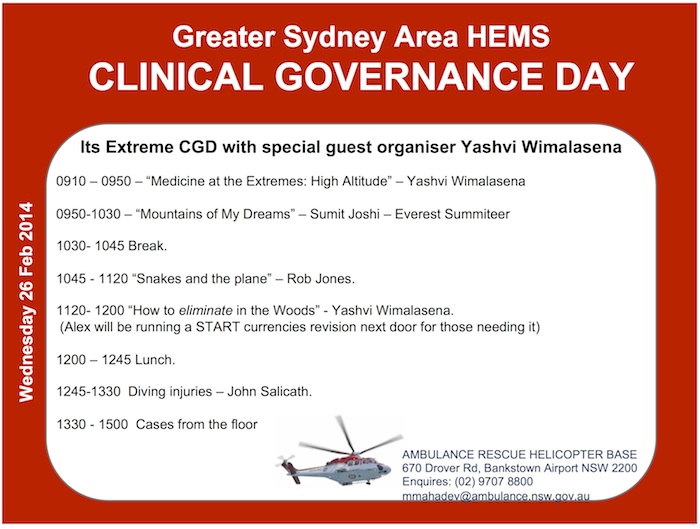
Clinical Governance Day 26 February 2014

CGD_Flyer 26 Feb

Posted in General PH&RM | Leave a comment

Towards A Universal Prehospital RSI SOP?

Mainland European countries have a long history of sending physicians out with emergency medical services to provide prehospital critical care.

It is interesting to note an almost universal standard in the conduct of prehospital emergency anaesthesia by prehospital critical care services. Take a look at many services in the UK, Australasia, and Scandinavia, and you’ll see many more similarities than differences in the way they prepare roles and equipment, position the patient, brief the team, and manage a failed laryngoscopy drill. This is not coincidence. There is likely an element of convergent evolution – an optimal way of doing something is reached by different routes in different places – but a more likely factor is the shared experience and cross-pollination of ideas between services facilitated by specialists and trainees who have worked across the different systems in different countries.

This collective experience of many thousands of prehospital RSIs by hundreds of clinicians over tens of years in several countries is available to anyone to tap into through the free availability of YouTube videos and downloadable standard operating procedures. This wonderful sharing of information allows us to witness Scandinavians applaud Brits for demonstrating the safety of prehospital RSI using a standardised system.

Another common theme is the RSI checklist.

RSI checklists have been around in physician-based HEMS systems for over a decade, and since the powerful NAP4 national airway audit in the UK published three years ago, they have been a key recommendation for emergency airway management in hospital too. Anyone not convinced of the role of checklists might want to read Atul Gawande’s The Checklist Manifesto: How To Get Things Right, about which you can hear more here. Examples of emergency intubation checklists are freely available from the UK, the US, and Australia.

Here we can see an example from Budapest, where the team demonstrates a recognisable approach to prehospital RSI. Enjoy hearing the RSI checklist in Hungarian at around 7 minutes and 50 seconds:

Posted in General PH&RM | Tagged , , , | 2 Comments

Escharotomy

Sydney HEMS retrieval specialist and intensivist (and emergency physician, by the way) Dr Craig Hore covered a workshop on escharotomy for severe burns at the Bedside Critical Care Conference in 2013

EXPLAINED: Emergency Escharotomy from Oliver Flower on Vimeo.

Posted in Presentations, training | Tagged , | Leave a comment

Second Tier Arrest Response Trial

Dr Karel Habig discusses cardiac arrest and introduces the START Project – Second Tier Arrest Response Trial, commenced in February 2014.

This video is from a presentation at Aus-ROC 2013 Mechanical Cardiopulmonary Resuscitation Seminar

Posted in Presentations | Tagged | Leave a comment