Alternative toothless mask position

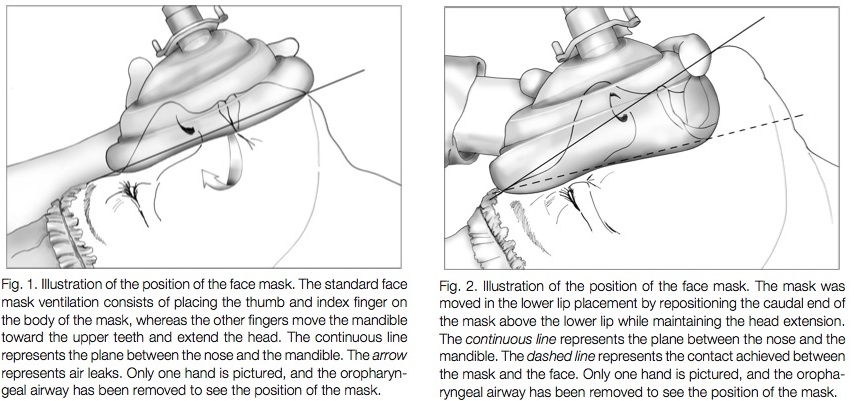
An alternative position for holding the facemask when bag-mask ventilating edentulous patients is described and evaluated. 49 patients with inadequate seal and air leak during two-hand positive-pressure ventilation had significantly improved ventilation as measured by reduced air leak and increased expiratory volume when the caudal end of the mask was repositioned above the lower lip while maintaining neck extension.

Face mask ventilation in edentulous patients: a comparison of mandibular groove and lower lip placement
Anesthesiology. 2010 May;112(5):1190-3

Posted in General PH&RM | Tagged , , | Leave a comment

Taming the Ketamine Tiger

A paper of great interest for those of us who spend a lot of time teaching the use of ketamine describes its history from initial synthesis in the early 1960s. Ketamine pioneer Edward F. Domino, M.D describes how it was first given to humans in 1964: ‘Our findings were remarkable! The overall incidence of side effects was about one out of three volunteers. Frank emergence delirium was minimal. Most of our subjects described strange experiences like a feeling of floating in outer space and having no feeling in their arms or legs.

Domino goes on to list interesting anecdotes in ketamine’s history, like how his wife came up with the term ‘dissociative anaesthetic’ and how physicians and their partners experimenting with ketamine in the 1970s tried communicating with dolphins, fell in love, and froze to death in a forest. The pharmacology of ketamine is described along with its effects on pain and even depression.

Taming the ketamine tiger.
Anesthesiology. 2010 Sep;113(3):678-84 Free Full Text

Posted in General PH&RM | Tagged , , , , | Leave a comment

Unexpected survivors after pre-hospital intubation

Data on patients with moderate to severe traumatic brain injury from the San Diego Trauma Registry were analysed using modified TRISS methodology to determine predicted survival, from which an observed-predicted survival differential (OPSD) was calculated. The mean OPSD was calculated as the primary outcome for the following comparisons: intubated versus nonintubated, air versus ground transport, eucapnia (PCO2 30–50 mm Hg) versus noneucapnia, and hypoxemia (PO<90 mm Hg) versus nonhypoxemia. Of note in this region is that ground EMS staff intubate without drugs, whereas air medical services use rapid sequence intubation with suxamethonium plus either etomidate or midazolam.

The rationale behind this methodology was to eliminate the possible selection bias present in previous studies linking pre-hospital intubation with mortality (sicker patients are able to be intubated without drugs).

A total of 9,018 TBI patients had complete data to allow calculation of probability of survival using TRISS. A total of 16.7% of patients were intubated in the field; 49.6% of these were transported by air medical providers. Patients undergoing prehospital intubation, transported by ground, with arrival eucapnia, and without arrival hypoxemia had higher mean OPSD values.

Intubated patients were more likely to be “unexpected survivors” and live to hospital discharge despite low predicted survival values; patients transported by air medical personnel had higher OPSD values and had a higher proportion of unexpected survivors. No statistically significant differences were observed between air- and ground-transported patients with regard to arrival PCO2 values arrival PO2 values.

Prehospital Airway and Ventilation Management: A Trauma Score and Injury Severity Score-Based Analysis
J Trauma. 2010 Aug;69(2):294-301

Posted in General PH&RM | Tagged , , , , | Leave a comment

Weight formula for kids

The traditional ‘APLS formula’ for weight estimation in children based on age (wt in kg = [age+4] x 2) is recognised as underestimating weight in ‘developed’ countries, with the degree of underestimation increasing with increasing age.

Several authors have attempted to derive a more accurate formula.

In the UK, the measured weights of over 93 000 children aged 1-16 who attended a paediatric emergency department were used to compare a previously derived formula (wt=3[age]+7) with the APLS formula.
The formula ‘Weight=2(age+4)’ underestimated children’s weights by a mean of 33.4% (95% CI 33.2% to 33.6%) over the age range 1–16 years whereas the formula ‘Weight=3(age)+7’ provided a mean underestimate of 6.9% (95% CI 6.8% to 7.1%); this latter formula remained applicable from 1 to 13 years inclusive.

The authors state: ‘The APLS formula has clearly become a victim of better nourished children. With a mean underestimate of more than 20% (nearly 40% at age 10 years), its place as a weight estimation tool is questionable…. To continue with an inaccurate formula with no evidence base cannot be considered good medical practice.’

Weight estimation in paediatrics: a comparison of the APLS formula and the formula ‘Weight=3(age)+7’
Emerg Med J. 2010 Jul 20. [Epub ahead of print]

A previous retrospective Australian study on over 70 000 paediatric ED attendances derived formulae for three different age ranges:

  • For Infants < 12 months: Weight (kg) = (age in months + 9)/2
  • For Children aged 1-5 years: Weight (kg) = 2 x (age in years + 5)
  • For Children aged 5-14 years: Weight (kg) = 4 x age in years.

Make your Best Guess: An updated method for paediatric weight estimation in emergencies
Emerg Med Australas. 2007 Dec;19(6):528-34

Posted in General PH&RM | Tagged , , | Leave a comment

ETCO2 and ROSC

One for the ‘hardly surprising’ category….

A study of end-tidal CO2 during out-of-hospital adult and child cardiac arrest resuscitation showed a sudden rise in CO2 was associated with return of spontaneous circulation (ROSC), suggesting that witnessing this would be a good time for a pulse check. Data from the 59 patients who achieved ROSC are shown below, time zero being time of ROSC. There was no such observed rise in the 49 patients who did not achieve ROSC.

A Sudden Increase in Partial Pressure End-Tidal Carbon Dioxide (PETCO2) at the Moment of Return of Spontaneous Circulation
The Journal of Emergency Medicine, Vol. 38, No. 5, pp. 614–621, 2010

Posted in General PH&RM | Tagged , , , , | Leave a comment

Etomidate in RSI – systematic review

A systematic review of 20 included studies comparing a bolus dose of etomidate for rapid sequence induction with other induction agents resulted in the following conclusion:

“The available evidence suggests that etomidate suppresses adrenal function transiently without demonstrating a significant effect on mortality. However, no studies to date have been powered to detect a difference in hospital, ventilator, or ICU length of stay or in mortality”

The Effect of a Bolus Dose of Etomidate on Cortisol Levels, Mortality, and Health Services Utilization: A Systematic Review
Ann Emerg Med. 2010 Aug;56(2):105-13

Posted in General PH&RM | Tagged , , | Leave a comment

Tracheal tube cuff pressure in flight

Tracheal tube cuff pressures increased from a mean 28.7 cm H2O pre-flight to 62.6 cm H2O in flight (mean altitude increase 2260 feet) in a Swiss helicopter-based study.
At cruising altitude, 98% of patients had intracuff pressure >30 cm H2O, 72% had intracuff pressure>50 cm H2O, and 20% even had intracuff pressure>80 cm H2O.
Multiple different referring hospitals meant the type of tracheal tube was not controlled for.

Endotracheal Tube Intracuff Pressure During Helicopter Transport
Ann Emerg Med. 2010 Aug;56(2):89-93

Posted in General PH&RM | Tagged , , , | Leave a comment

Tactical Combat Casualty Care

The brave men and women of the military not only risk their lives for us – they also provide a wealth of trauma experience and publish interesting stuff.
This month’s Journal of Trauma contains a military trauma supplement. One of the articles describes the latest guidelines on Tactical Combat Casualty Care. These include:

  • tourniquet use
  • Quikclot Combat Gauze as the haemostatic agent which has replaced Quikclot powder and HemCon. This preference is based on field experience that powder and granular agents do not work well in wounds in which the bleeding vessel is at the bottom of a narrow wound tract or in windy environments. WoundStat was a backup agent but this has been removed because of concerns over possible embolic and thrombotic complications.
    http://www.youtube.com/v/C3TUKKx0cus&hl=en_US&fs=1
  • longer catheters for decompression of tension pneumothorax (Harcke et al. found a mean chest wall thickness of 5.36 cm in 100 autopsy computed tomography studies of military fatalities. Several of the cases in their autopsy series were noted to have had unsuccessful attempts at needle thoracostomy because the needle/catheter units used for the procedure were too short to reach the pleural space*.)
  • close open chest wounds immediately with an occlusive material, such as Vaseline gauze, plastic wrap, foil, or defibrillator pads
  • a rigid eye shield and antibiotics for penetrating eye injury

Tactical Combat Casualty Care: Update 2009
The Journal of TRAUMA 2010;69(1):S10-13 (no abstract available)
Full text of guidelines in PDF at itstactical.com

*Harcke HT, Pearse LA, Levy AD, Getz JM, Robinson SR. Chest wall thickness in military personnel: implications for needle thoracentesis in tension pneumothorax. Mil Med. 2007;172:1260 –1263

Posted in General PH&RM | Tagged , , , | Leave a comment

Less RSI desaturation with Roc

Some of my pre-hospital critical care colleagues in the UK exclusively use rocuronium in preference to suxamethonium for rapid sequence induction (RSI) of anaesthesia in critically ill patients. I couldn’t see a good reason to switch although now there’s some evidence that adds to the argument.

The muscle fasciculations caused by the depolarising effect of suxamethonium may increase oxygen consumption, which may shorten the apnoea time before desaturation. Non-depolarising neuromuscular blockers such as rocuronium should allow a longer apnoea time after RSI. In addition, drugs which reduce fasciculations (such as lidocaine and fentanyl) should delay the the onset of desaturation when given prior to suxamethonium.

A large dose of Roc

These hypotheses were tested in a blinded, randomised controlled trial in 60 ASA-1 or -2 patients, who were scheduled for elective surgery under general anaesthesia. All patients received 2mg/kg propofol. One group was randomised to receive suxamethonium 1.5 mg/kg, a second group received rocuronium 1mg/kg plus lidocaine 1.5mg/kg and fentanyl 2mcg/kg, and a third group was given suxamethonium 1.5 mg/kg plus lidocaine 1.5mg/kg and fentanyl 2mcg/kg. The facemask was removed 50 seconds after the neuromuscular blocker was given and patients were intubated; the tube was then left open to air until desaturation to 95% occurred, which was timed.

Desaturation occurred significantly sooner in the suxamethonium-only group, followed by the sux/lido/fentanyl group, followed by the roc/lido/fentanyl group.

Of course these results are not necessarily directly applicable to the critically ill patient, and in this study there was no direct comparison between induction agent + rocuronium only and induction agent + suxamethonium only. Nevertheless the argument that suxamethonium-induced muscle fasciculations contribute to an avoidable increase in oxygen consumption is persuasive.

Effect of suxamethonium vs rocuronium on onset of oxygen desaturation during apnoea following rapid sequence induction
Anaesthesia. 2010 Apr;65(4):358-61
Posted in General PH&RM | Tagged , | Leave a comment

Pre-hospital RSI successes

A couple of papers in Prehospital Emergency Care this month contribute to the pre-hospital airway management / rapid sequence intubation (RSI) literature.

Intensive physician oversight of a pre-hospital RSI program increased the prescription of post-intubation morphine and midazolam, and decreased vecuronium use, although did not significantly increase the successful intubation rate in a before-and-after study. There was also an improvement in patient selection for RSI.

Effect of intensive physician oversight on a prehospital rapid-sequence intubation program
Prehosp Emerg Care. 2010 Jul-Sep;14(3):310-6

A prospective study examined intubation success rates and peri-intubation hypoxaemia in critical care transport (CCT) services in North America, whose services are mainly crewed by registered nurses (RNs) and emergency medical technicians–paramedic (EMT-Ps).

There was a mixture of pre-hospital and interhospital work: 51.9% of the 603 patients studied were intubated at the trauma scene, 27% were intubated inside a hospital, and interestingly 21.1% were intubated inside a vehicle (most of which were helicopters).

Neuromuscular blockade was used to facilitate intubation in only 428 patients (71%). Endotracheal intubation (ETI) was successful in 582 patients (96.5% of 603, 95% CI 94.7-97.8%). There was a greater need (p < 0.001) for multiple attempts at ETI when CCT crews performed the procedure in transport (37.3%) as compared with rate of requirement for multiple ETI attempts while in hospital (16.6%) or on scene (19.4%). Logistic regression identified a three-fold increase in the odds of requiring multiple attempts for intratransport ETI as compared with in-hospital ETI (OR 3.0, 95 CI 1.7–5.2, p < 0.001). 21 patients (3.5%) could not be intubated by the CCT crews resulting in a number of different rescue modalities including 3 cricothyroidotomies. At least there were no unrecognised oesophageal intubations. There were low rates of new hypoxaemia but peri-ETI SpO2 was only recorded for 494 patients (82%).

Airway management success and hypoxemia rates in air and ground critical care transport: a prospective multicenter study
Prehosp Emerg Care. 2010 Jul-Sep;14(3):283

Posted in General PH&RM | Tagged , , | Leave a comment