Interhospital patient assessment

bridgeThis third podcast provides an overview of our approach to the assessment of a critical care patient that we’re going to move from one site to another. It covers the ABCDE assessment of a ventilated patient.

For further information on the practicalities of transferring a patient on vasoactive infusions, check out this video

Posted in Podcasts | Tagged , | 1 Comment

The trapped patient

trappediconThis second podcast gives a rapid overview of the approach to a patient trapped in a vehicle. This is explored further in the Virtual Learning Environment Module on Prehospital Scene Management and in the induction course.

Concepts covered include:

The SCATTT approach: Safety, Communication, Assessment, Triage, Treatment, Transport

The COMIC acronym for tidying up your patient during the in-vehicle primary survey: Collar, Oxygen, Monitoring, IV access, Control of pain

Posted in Podcasts | Leave a comment

Introductory podcast

Podcasts will be available for new and prospective GSA-HEMS team members to access.

The first, introductory podcast is a five-minute overview of our service.

Posted in Podcasts | 4 Comments

Rapid Sequence Intubation in Retrieval Medicine

This 22 minute talk by Dr Karel Habig is aimed at new members of the Greater Sydney Area HEMS team. It covers the standardised approach we use for prehospital RSI to minimise the risks of hypoxia and hypotension. Many of the aspects of this system are also applicable to hospital-based practice.


The RSI Manual is here

The RSI Operating Procedure is here

Posted in General PH&RM | 6 Comments

PRVC isn’t a communist country in South East Asia…

Screen Shot 2012-12-30 at 11.19.30 AM

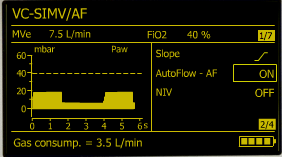
With the arrival of the flash new Oxylog 3000+ there’s been quite a bit of discussion around the base recently about modes ventilation.  There still seems to be quite a bit of confusion about Autoflow.  In my humble opinion, mechanical ventilation is rarely particularly well taught.  For most doctors, the only formal training on modes of ventilation is a hastily delivered tutorial from the flustered registrar during their first week as an ICU resident, perhaps with some random graphs scribbled on a napkin.  Hardly quality clinical education.  As a result ventilators continue to be scary machines for many docs.  There have been plenty of opportunities in the past to own the oxylog, and I don’t want to reinvent the wheel.  I think it’s worth reviewing autoflow though.

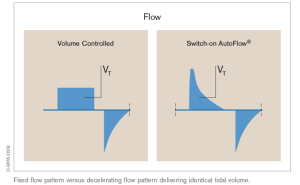
Autoflow is Drager’s method of delivering a mode of ventilation otherwise known as volume assured pressure control, or pressure regulated volume control (PRVC – Maquet’s version).  Essentially its a type of ventilation that seems like volume control, in that you dial up a tidal volume, but delivers a decelerating ramp pattern inspiratory flow, so behaves like pressure control.  So you get the simplicity of volume control with the benefits of pressure control.
Screen Shot 2012-12-30 at 11.23.42 AM

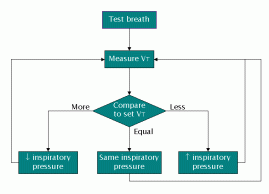
So how does it work?  Well let’s say you have a 70kg patient and you want to deliver 6mL/kg (as you always should…) so you dial up a Vt of 420mL.  The ventilator will deliver a standard volume control breath of 420mL using the minimum possible flow (for a RR of 20 and an I:E ratio of 1:2 that would be 1 second Insp time and therefore a flow of 25L/min) and measure the end insp pressure.  This pressure will then be used to deliver a pressure control breath as the next breath.  The Vt delivered by the pressure control breath will then be compared to the set Vt, and the insp pressure adjusted up or down by 3cmH2O pre breath until the desired Vt is consistently delivered.  This means that if there are dynamic changes in pulmonary compliance, the insp pressure will also change in order to deliver a constant Vt at the lowest possible Insp pressure.

Maquet’s PRVC is very similar, except that the first breath is PC, at an arbitrary Pressure, which is then adjusted over subsequent breaths to meet the set Vt.  This diagram from the Chinese University of Hong Kong’s excellent Basic Assessment and Support in Intensive Care (BASIC) course sums it up pretty well
prvc

One thing to note is the Autoflow/PRVC isn’t a mode of ventilation as such.  It’s just a way of delivering the breath.  You still select SIMV, CMV etc as the mode of ventilation.  Remember that in general you should only use CMV in curarised or very heavily sedated patients.

So why bother?  Well, pressure control ventilation limits peak airway pressure and thus avoids barotrauma which may help prevent ARDS.  It’s also beneficial in traumatic brain injury, as high airway pressures may be transmitted to the brain via increased venous pressure.  It may also improve oxygenation in patients with poor compliance or with lung units of differing compliance. Pressure control may also be more comfortable for less heavily sedated patients.

Sounds good, what’s the catch?  Well, while avoiding the main disadvantage of PCV – the inability to deliver a constant minute volume in the face of dynamic changes in pulmonary compliance – Autoflow will limit the volume delivered once the preset pressure limit is reached.  In fact it will cease inspiratory flow 5cmH20 before the pressure limit is reached.  The alarm “Vt low, pressure limit” will appear on the screen and the high priority alarm will sound.

I think Autoflow and it’s cousins are a good thing and together with low tidal volumes will be good for our patients, but like all new toys, we just have to have a play with them and get used to them.  Don’t just take it from me though, here are some great resources that explain Autoflow and mechanical ventilation in general.
Screen Shot 2012-12-30 at 11.26.06 AM

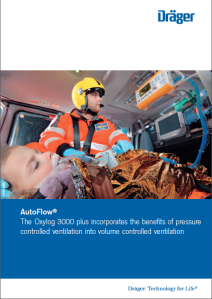
Drager Autoflow tutorial booklet

BASIC course PRVC tutorial
 

Posted in General PH&RM | 6 Comments

NKOTB

Hanging tough ... New Kids on the Block.

Our HEMS colleagues across the ditch in Auckland, NZ have started a website that looks like it will be a great source of information on prehospital care ad medical education.  The Auckland Rescue Helicopter Trust (AHRT) is the latest addition to the Australasian HEMS family, with a 2 year feasibility study of adding full HEMS capability with medical crewing using a joint physician/intensive care paramedic (ICP) to their existing ICP only platform.  It will be interesting to see what they show, as ICPs in NZ are already very highly trained with quite liberal protocols including ketamine and RSI without direct medical oversight.

westpac-trust-helicopter1

Of note, AHRT were the first civilian surf rescue helicopter service in theHiller_UH-12_(H-23)_bw world and carried out the first recorded surf rescue by helicopter in 1970 using a Hiller 12E. They’ve moved on a bit and currently operate 2 BK-117s but rumour has it they’re soon to move to the shiny new AW-169.  Who knows, maybe we’ll see them at smacc…?  Check out their site at http://aucklandhems.com

Auckland_Rescue

Posted in General PH&RM | 1 Comment

Christmas Clinical Governance Day 19th December 2012

CGD 191212.001

Posted in General PH&RM | Leave a comment

Spinal Dogma Part 3

philips_ct2_pwkt

My last rant for a while.  The patient from scenario 2 is now in the resuscitation room of a trauma center.  He was intubated successfully by the retrieval physician after in line stabilization was removed, changing a grade 4 view to a grade 3a view and allowing blind passage of a bougie.  The collar was then reapplied and the patient transferred to the trauma center uneventfully.  A CT “pan scan” reveals some small cerebral contusions that don’t require operative intervention, some broken ribs and bilateral pulmonary contusions, with a left penumothorax which is drained, a grade 2 liver laceration that can be observed and no other injuries.  The femur fracture is will require fixation at some stage.  The CT of the cervical spine is reported as showing no bony injury, with all soft tissue spaces within normal limits.  You ring your friendly neurosurgical registrar (or perhaps orthopaedic registrar, depending on who does spines where you are) with this news, expecting to be given the go-ahead to take the collar off and relax spinal precautions.  Alas the neurosurgeon tells you that a CT scan isn’t sufficient to rule out a significant injury, and that you should “just keep the collar on” and he’ll review the patient on Monday morning, maybe after an MRI.  It’s currently Friday and the neurosurgeon has obviously never accompanied an intubated patient to the MRI scanner.


So here we have the final spinal conundrum.  Now that the collar’s on, it’s very difficult to take off.  So let’s look at the evidence supporting clearing the C-Spine based on CT alone.  Conveniently this was reviewed in  this month’s Annals of Emergency Medicine (and apparently it’s open access – well it was when I downloaded it.)  Kirschner and Seupaul from Indianapolis do what they called a “Systematic Review Snapshot” which I quite liked.  They essentially critique an article that’s been spoken about a bit lately – a systematic review and meta-analysis of the research comparing CT clearance with clinical clearance (it also seems to be freely available).  They note that the research is mostly observational (and therefor prone to bias).  The meta analysis that they discussed included 14,327 patients.  Of these 14,327 patients with a negative CT scan, 7 had a clinically significant injury, 3 of which were unstable. Thats 0.02%.  Let me say that again. 3 out more than 14,000 patients had an unstable injury.  This gives CT a sensitivity and specificity of 99.9%.  I don’t know of any other test that has a sensitivity and a specificity that high.   The authors of the original meta-analysis pit it even more succinctly – Clearance based on CT alone will result in one missed injury every 14 years in a moderately busy trauma centre, compared with hundreds of complications from prolonged immobilisation. Yet the reviewers in the Annals come to a vague and safe conclusion that CT “may reliably exclude unstable injuries” in obtunded patients.  May?  Well in their defence, the reviewers didn’t think very highly of the papers that went into the meta-analysis, commenting on flawed study designed and a high degree of heterogeneity.  They do, however, point out that the soft tissue injuries found on MRI are often of uncertain clinical significance, and there can be lots of false positives on MRI.


So where does this leave us? Is 99.9% sensitive and specific good enough?  Or is paraplegia such a devastating complication that we need a test that’s 100% specific (I would argue that clinical examination certainly isn’t).  What about the complications of leaving the collar on?  Bedsores, airway compromise, possibly increased VAP rates through being supine. The list goes on.  I’ll be willing to bet that the rate of serious complications from keeping an ICU patient in a collar is > 0.02%.  So does that put the risk benefit ratio in favour of taking the collar off?


As devastating as the possibility of paraplegia may be, people seem to lose sight of the fact that spinal immobilization in an intubated patient carries a not-insignificant harm.  Bedsores cause sepsis which kills.  What if the patient is ready to be extubated before the spine in cleared?  Do you keep them intubated until then, increased the risks associated with prolonged intubation? Or do you extubate them in a supine or reverse Trendellenburg position, with all the risks that brings? Is our lack of trust in a very large, but possibly not very good, meta-analysis just a convenient way for us to say that we don’t want to risk a less than 0.02% chance of missing a ligamentous injury that may or may not cause future harm to the patient while blissfully ignoring the very real risks of lying flat on you back in a collar in the ICU.  I encourage you all to make up your own minds by reading at least the short review in the Annals, if not the full paper from the Journal of Neurosurgery.

Posted in General PH&RM | 4 Comments

Trauma Resuscitation – An Update for 2012

This is a video of a talk I gave to the docs and paramedics at the Sydney HEMS Clinical Governance Day recently.  It’s based around a couple of recent review articles unearthed by the ever searching, apparently never sleeping, Cliff Reid (@cliffreid).

Here are links to some of the articles mentioned in the talk.  It’s just over 30 mins, so a bit longer than a podcast should be, sorry.   On the upside I took care not to include a single bullet point, as we all know bullets are for killing people you don’t like, and I have enough of those, so I don’t need to be wasting bullets on keynote presentations.

http://www.sjtrem.com/content/pdf/1757-7241-20-68.pdf

http://www.ncbi.nlm.nih.gov/pubmed?term=22763906

1. Scand J Trauma Resusc Emerg Med. 2012 Sep 18;20(1):68. [Epub ahead of print]

Critical care considerations in the management of the trauma patient following
initial resuscitation.

Shere-Wolfe RF, Galvagno SM Jr, Grissom TE.

ABSTRACT: 
BACKGROUND: Care of the polytrauma patient does not end in the
operating room or resuscitation bay. The patient presenting to the intensive care
unit following initial resuscitation and damage control surgery may be far from stable with ongoing hemorrhage, resuscitation needs, and injuries still requiring definitive repair. The intensive care physician must understand the respiratory,  cardiovascular, metabolic, and immunologic consequences of trauma resuscitation and massive transfusion in order to evaluate and adjust the ongoing resuscitative needs of the patient and address potential complications. In this review, we address ongoing resuscitation in the intensive care unit along with potential complications in the trauma patient after initial resuscitation. Complications such as abdominal compartment syndrome, transfusion related patterns of acute lung injury and metabolic consequences subsequent to post-trauma resuscitation are presented. 
METHODS: A non-systematic literature search was conducted using
PubMed and the Cochrane Database of Systematic Reviews up to May 2012. RESULTS AND CONCLUSION: Polytrauma patients with severe shock from hemorrhage and massive
tissue injury present major challenges for management and resuscitation in the intensive care setting. Many of the current recommendations for "damage control
resuscitation" including the use of fixed ratios in the treatment of trauma
induced coagulopathy remain controversial. A lack of large, randomized,
controlled trials leaves most recommendations at the level of consensus, expert opinion. Ongoing trials and improvements in monitoring and resuscitation technologies will further influence how we manage these complex and challenging
patients.

PMID: 22989116  [PubMed - as supplied by publisher]

1. Anesth Analg. 2012 Dec;115(6):1326-33. doi: 10.1213/ANE.0b013e3182639f20. Epub 2012 Jul 4. 
Review article: update in trauma anesthesiology: perioperative resuscitation management. Tobin JM, Varon AJ. University of Maryland/R Adams Cowley Shock Trauma Center, 22 South Greene St., T1R77, Baltimore, MD 21201. josh_tobin@hotmail.co. 
The management of trauma patients has matured significantly since a systematic approach to trauma care was introduced nearly a half century ago. The resuscitation continuum emphasizes the effect that initial therapy has on the outcome of the trauma patient. The initiation of this continuum begins with prompt field medical care and efficient transportation to designated trauma centers, where lifesaving procedures are immediately undertaken. Resuscitation with packed red blood cells and plasma, in parallel with surgical or interventional radiologic source control of bleeding, are the cornerstones of trauma management. Adjunctive pharmacologic therapy can assist with resuscitation. Tranexamic acid is used in Europe with good results, but the drug is slowly being added to the pharmacy formulary of trauma centers in United States. Recombinant factor VIIa can correct abnormal coagulation values, but its outcome benefit is less clear. Vasopressin shows promise in animal studies and case reports, but has not been subjected to a large clinical trial. The concept of "early goal-directed therapy" used in sepsis may be applicable in trauma as well. An early, appropriately aggressive resuscitation with blood products, as well as adjunctive pharmacologic therapy, may attenuate the systemic inflammatory response of trauma. Future investigations will need to determine whether this approach offers a similar survival benefit. 
PMID: 22763906 [PubMed - in process]
Posted in General PH&RM | Leave a comment

Clinical Governance Day 5th December 2012

Posted in General PH&RM | Leave a comment