Education Day 25th July

Posted in General PH&RM | Leave a comment

Clinical Governance Day – July 11th 2018

Slide1

Posted in General PH&RM | Leave a comment

AiR – Learning from the Airway Registry [March 2018]

Intubations this month:          21

Airway Registry learning points reflect the challenges described and wisdom shared by Sydney HEMS personnel and guests at the Clinical Governance Airway Registry presentation for March 2018. Cases are discussed non-contemporaneously, anonymised and amalgamated over a time period to draw together unifying take-home messages. Details of specific cases are removed and/or changed, such that any similarity to real-life patients or scenarios is coincidental.

All CMAC videos are shared under a Creative Commons Licence: Attribution 2.0 Generic. Please familiarise yourself with the terms of the licence before reusing our videos.

To view these videos, you will need this password: AiRblogVideos

Focus on: Airway Management in the Septic, Hypotensive Patient

We have previously discussed the guidelines for intubation of the critically ill from December 2017.

The authors suggest that peri-intubation haemodynamic management and the prevention of hypotension/cardiac arrest at induction can include:

  • Addressing causes of hypotension in the patient
  • Drug choices – Ketamine & Rocuronium
  • Rapid volume replacement available with institution of IPPV
  • Vasopressor/inotrope boluses available
  • Vasopressor infusion before induction

It is prudent to increase the noradrenaline infusion rate on any septic, hypotensive patient with noradrenaline running before RSI drugs are administered. Likewise, adrenaline boluses (10mcg/ml & 100mcg/ml) should be prepared before RSI drugs are given. A rapidly flowing IV access line is useful to ensure drugs reach the circulation but also to be able to offset the physiology change of reduced preload with IPPV.

Video Focus: Other Things You Might See in the Airway

Burns

These two videos [password: AiRblogVideos] show some laryngoscopy findings in burns patients.

The first (very short!) shows soot, on the face as the CMAC is inserted and on the cords at laryngoscopy.

The second shows very mildly sooty snot in the airway of a patient with 35% TBSA burns just before the epiglottis is visualised. Sooty snot on nose-blowing was part of the rationale for intubation in this patient.

Other Things You Might See

This video shows the appearance of a single (right sided) NPA during passage of the CMAC laryngoscope through the oropharynx.

This video shows the appearance of bilateral NPAs during passage of the CMAC laryngoscope through the oropharynx.

This video shows the appearance of a denture plate during passage of the CMAC laryngoscope through the oropharynx. This is not secured and should be removed; it’s easy to see how it could cause a complete airway obstruction.

In this video, the presence of blood in the airway in combination with the use of the LUCAS device to provide CPR means that the view is totally lost when the blood hits the camera.

You can see all the AiR videos here on our Vimeo page or here on the blog.

Posted in Airway, Airway Registry, General PH&RM | Tagged , , , , , , , | Leave a comment

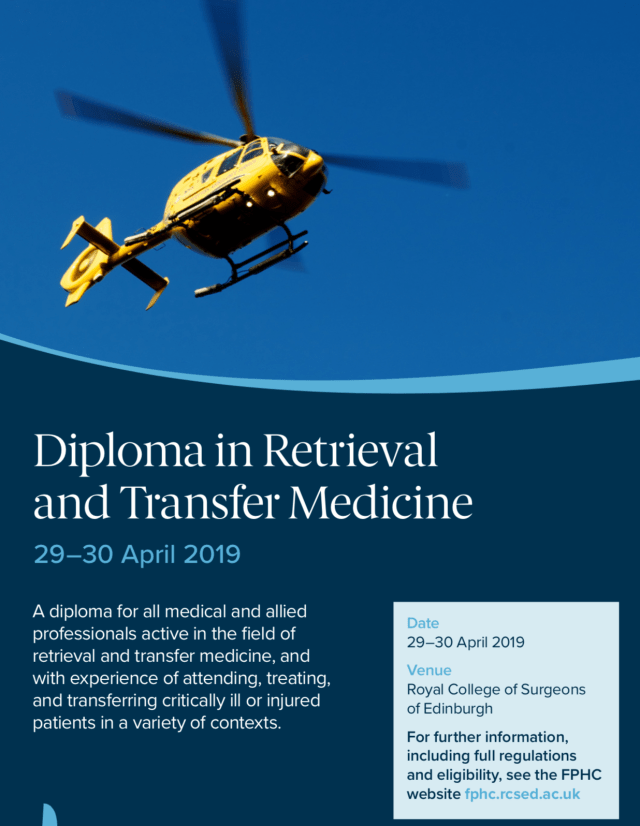
Diploma in Retrieval and Transfer Medicine

Posted in General PH&RM | Leave a comment

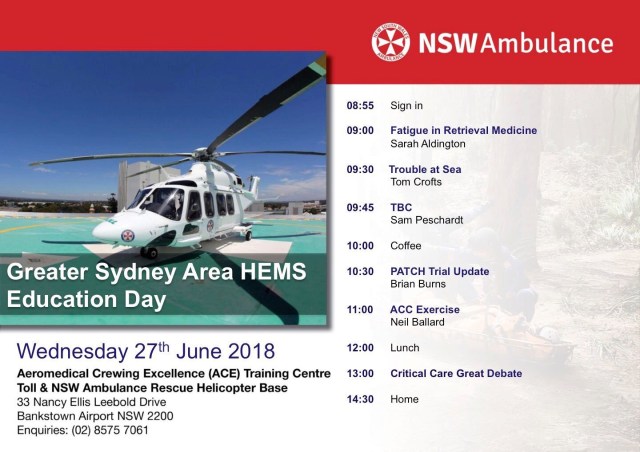
GSA HEMS Education Day Wed 27th June

PHOTO-2018-06-14-14-35-21

Posted in General PH&RM | Leave a comment

Institute of Trauma & Injury Management (ITIM) Trauma Education Evening

itim-logo

It’s just one week til Sydney HEMS will proudly host the ITIM Trauma Education Evening at the ACE Training Centre at our Bankstown Base.

How Much?

It’s FREE but places are limited so you must register – do so here. Do not turn up without registering, we won’t be able to let you in!

When & Where

Wed. 20 June 2018, 4:30 pm – 9:00 pm AEST (that’s Sydney time)

Auditorium, ACE Training Centre (Bankstown Airport)

33 Nancy Ellis Leebold Dr

Condell Park, NSW 2200

What’s On?

1630 – Registration and coffee

1700 – Welcome and opening – Clare Richmond (Retrieval Consultant, Sydney HEMS & ED Staff Specialist)

1705 – Statewide Aeromedical Retrieval – speaker TBC

1725 – Code Crimson – Karel Habig (Medical Director, GSA HEMS)

1740 – The role of RLTC – Andrew MacDougall (RLTC & Aeromedical Operations Officer)

1755 – Paediatric trauma – Natalie May (Staff Specialist, Sydney HEMS & Emergency Medicine)

1815 – Straight to theatre – Geoff Healy (Staff Specialist, Sydney HEMS & Anaesthetist)

1835 – On the ground – packaging – Sam Immens (Critical Care Paramedic, NSW Ambulance)

1850 – Supper break & ACE/Toll facility video

1940 – The hospital primary – Simulation and Panel Discussion – Clare Richmond and Rob Scott (Retrieval Consultant, Sydney HEMS)

2045 – Close

What If I Can’t Make It?

You’re in luck! ITIM events are livestreamed for free too. You’ll be able to find the livestream here on the night, or here in the archive if you’ve come across this after the event.
Posted in General PH&RM, Presentations, Trauma | Tagged , , | Leave a comment

Clinical Governance Day, June 13th 2018

Slide1

Posted in General PH&RM | Leave a comment

Prehospital Regional Anaesthesia

At the HEMS Education Day on 30th May 2018, we had two great presentations on regional anaesthesia from guest speakers Andrew Lansdown and Ananth Kumar.

Ex-Sydney HEMS registrar and current consultant anaesthetist Andrew Lansdown gave us an excellent presentation on regional anaesthesia of the hip, thigh and knee. He has kindly shared his slides below.


Fellow anesthetist Dr Ananth Kumar then covered the Serratus Anterior Plane (SAP) block, perfect for anterior / lateral rib fractures. First described in 2013, this ultrasound-guided approach is simple, safe, and very effective, although its exact mechanism of action is still somewhat mysterious.


Here’s a video of the SAP block being done:

 
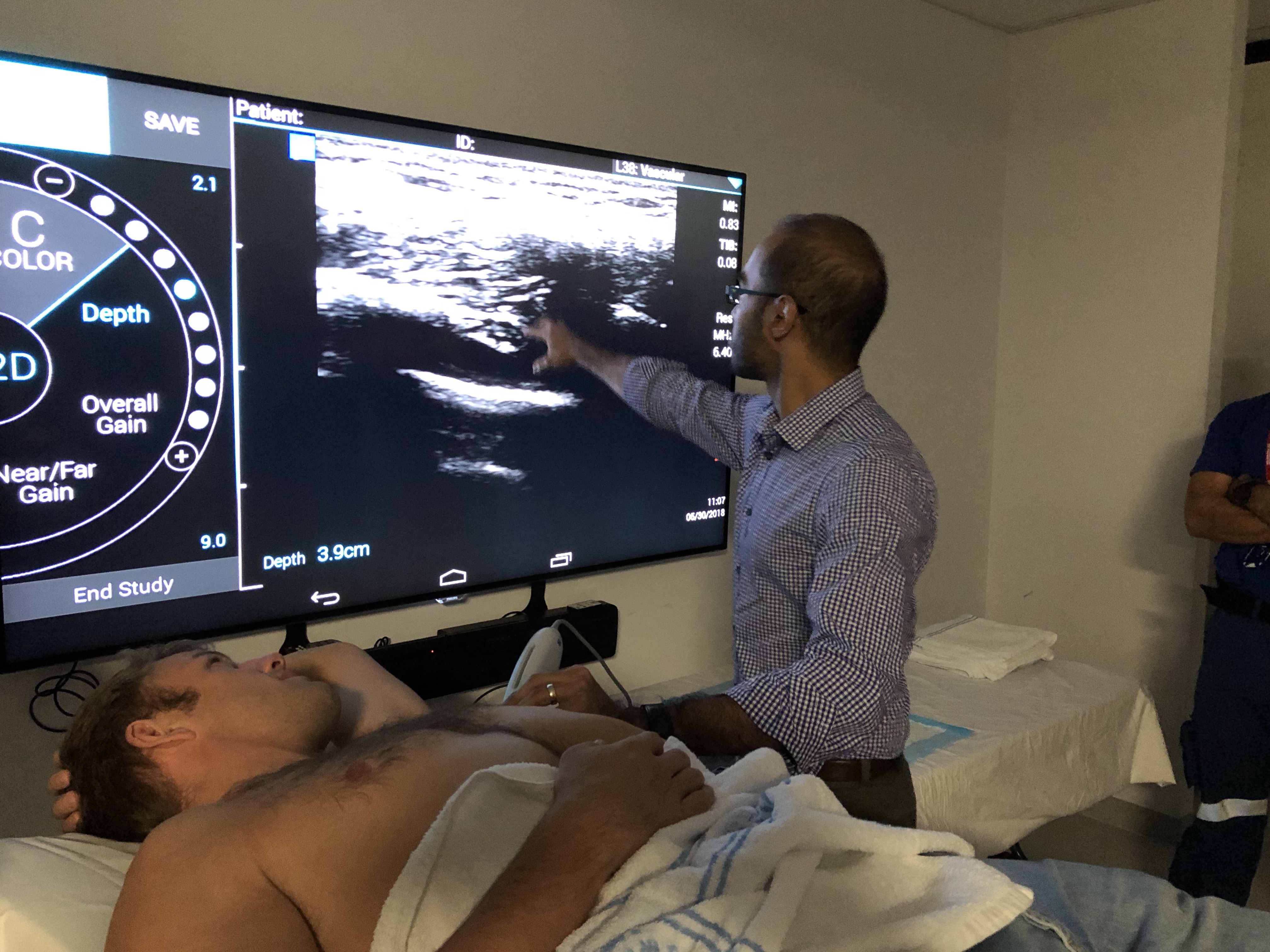
The talks were followed by practical stations, in which the retrieval Sonosite iViz devices were used to identify sonoanatomy in volunteers.

Posted in General PH&RM, Presentations | Tagged , , , , | Comments Off on Prehospital Regional Anaesthesia

Sydney HEMS Education Day 30th May 2018

CGD - Education Day Flyer Final

Posted in General PH&RM | Leave a comment

AiR – Learning from the Airway Registry [February 2018]

Intubations this month:          22

Airway Registry learning points reflect the challenges described and wisdom shared by Sydney HEMS personnel and guests at the Clinical Governance Airway Registry presentation for January 2018. Cases are discussed non-contemporaneously, anonymised and amalgamated over a time period to draw together unifying take-home messages. Details of specific cases are removed and/or changed, such that any similarity to real-life patients or scenarios is coincidental.

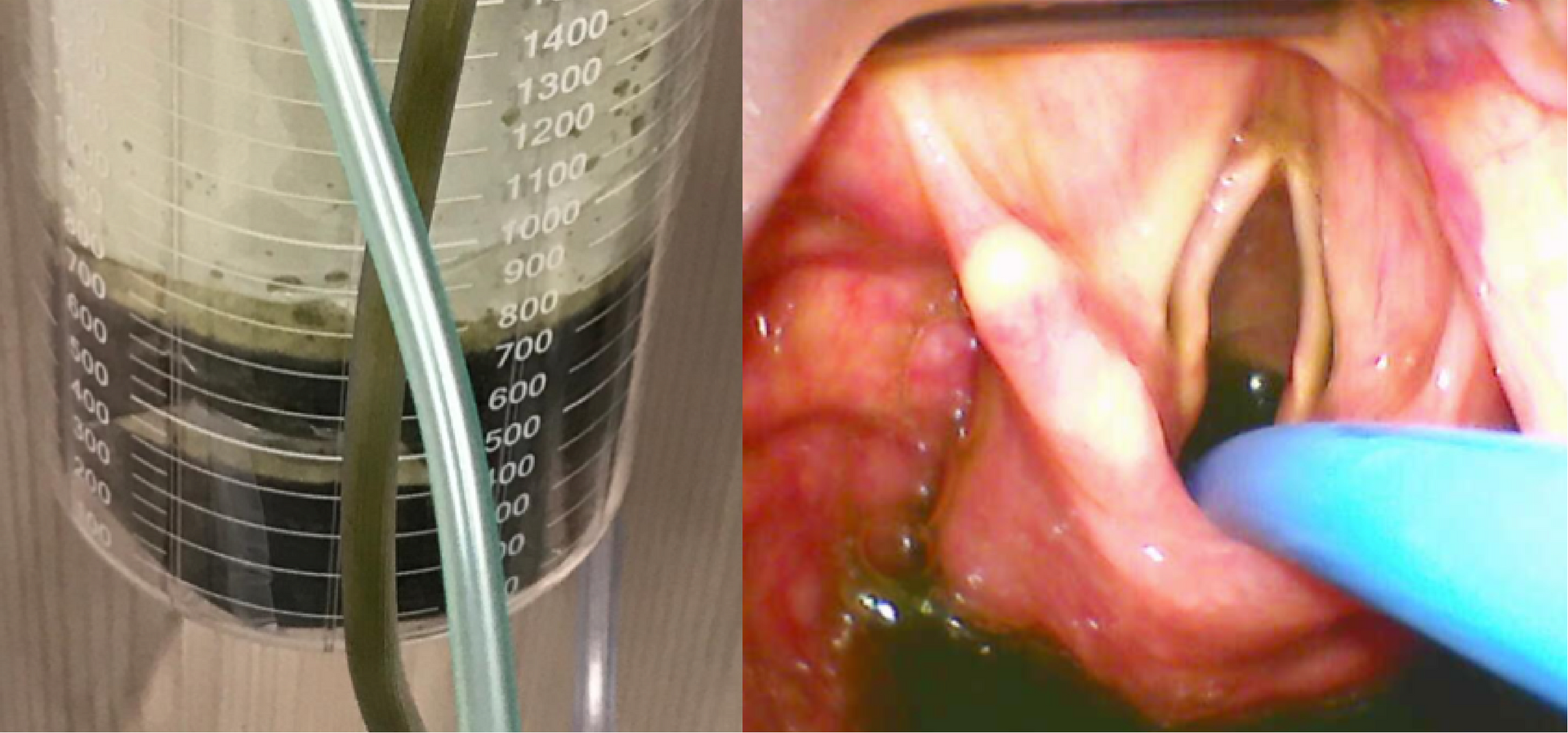
Focus on: Soiled Airway

The threat of massive airway soiling at laryngoscopy and intubation has troubled airway practitioners for decades; and yet, in 2018 we still don’t have a great evidence based plan of how to approach such threats.

To view this video you will need this password: AiRblogVideos

Discussion points around this challenge include:

  • Predictability – in addition to history & examination – could bedside gastric ultrasound assist us with risk assessments when feasible?
  • Preparation – practising a ‘SALAD’ sim at the base, and talking through your actions in your airway plan with your team before starting
  • Drainage – does a gastric tube, when feasible, drain sufficient volume to reduce risk?
  • Positioning – but some patients aspirate when fully awake and sitting up
  • Awake intubations – very difficult/nigh impossible in the hypoxic and critically ill
  • Cricoid pressure – recommended in the ‘Guidelines for the management of tracheal intubation in the critically ill adults’ found here http://bjanaesthesia.org/article/S0007-0912(17)54060-X/fulltext, which states ‘cricoid force advocated, with prompt removal if necessary’.

Other Airway soundbites this month

Laryngospasm after Ketamine

Laryngospasm or apnoea occurring after ketamine sedation can be frightening for the practitioner and is one of the reasons why other prehospital services have ketamine sedation ‘protocols’. Symptoms and signs of laryngospasm witnessed by our service following a small sub-dissociative (<0.5mg/kg) dose for agitation were:

    • Continuing respiratory effort with see-saw respiratory movements
    • Absolute airway obstruction (complete loss of ETCO2 trace from Bag Mask device, loss of fogging and subsequent desaturation).

Actions of 2 person Bag valve mask, Larson’s manoeuvre and increasing sedation resulted in successful ventilation. The subject is further discussed here: http://resus.me/laryngospasm-after-ketamine/

Reoxygenating

Reoxygenating between laryngoscopy attempts can be difficult – OPAs, NPAs and two-person-technique for bag mask ventilation is generally recommended but is challenging for those patients sporting a beard. Solutions suggested have included “plasticising” the beard with tegaderm, but this is rarely practical in the Retrieval setting where airway management is rarely elective.

One alternative to reoxygenate between laryngoscopy attempts is to use our iGel SGA which is not affected by the presence (or absence) of facial hair.

CMAC Caution

Our CMAC pocket monitor laryngoscopes have a built-in ability to turn themselves off (blade light and screen). Manufacturer advice is that this will happen after 10 minutes of no use detected by no change in light intensity at the camera. The device turns on again very quickly by closing and opening the screen. Should this occur during a laryngoscopy, it may be prudent to open and close the screen in situ.

Blade Tip Positioning

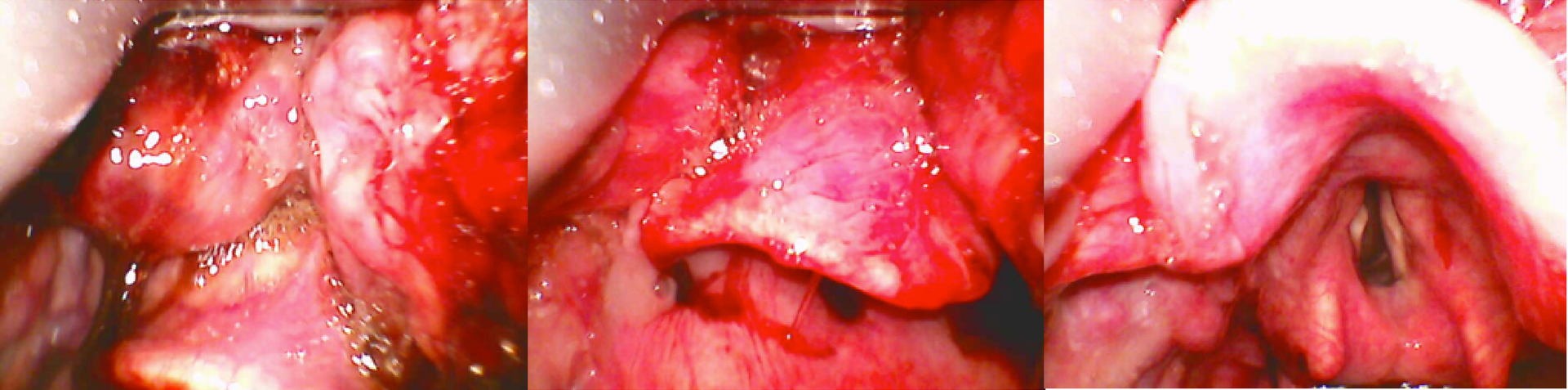
Laryngoscope blade tip position is critical to successful laryngoscopy. The following still shots from CMAC Pocket Mac 4 blade videolaryngoscopy show this in action.

The first image shows the tip sitting high of the vallecula (where the smooth shiny epiglottis mucosa meets the lumpy bumpy tongue). Efforts to lift the epiglottis by lifting the laryngoscope here are unsuccessful resulting in no view of the larynx (Grade 3 view as epiglottis only seen). The middle image shows the tip sitting in the vallecula where indirect epiglottic lift with the laryngoscope is successful revealing the laryngeal inlet (Grade 1 view = POGO 100%).

Posted in Airway, Airway Registry, General PH&RM | Tagged , , , , | Leave a comment