To Air is Human

In this 25 minute audio podcast recorded at the SMACC conference in 2013 Sydney HEMS physician Dr Karel Habig talks about reducing (and trapping) error in retrieval medicine, and whether we can really apply lessons from aviation to our complex medical environment.

You can download the podcast by right-clicking here

Here are the accompanying slides:

Further talks from SMACC are available for free download on iTunes.

Posted in Podcasts, Presentations | Tagged , | Leave a comment

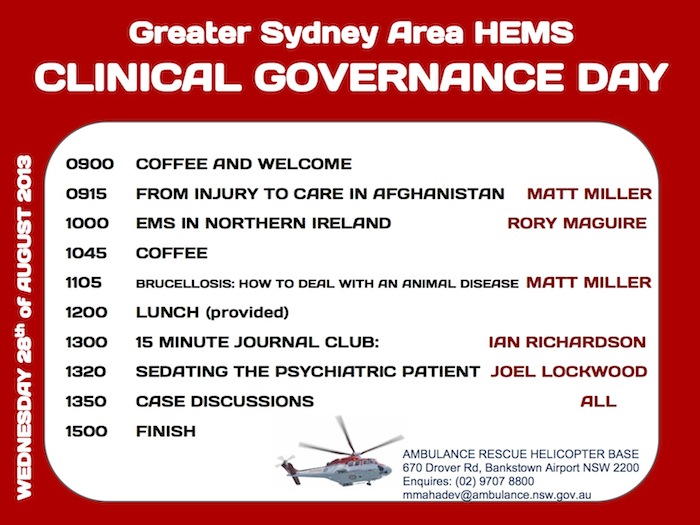
Clinical Governance Day 28th August 2013

CGD Flyer 280813
See here for directions

Posted in General PH&RM | Tagged | Leave a comment

CGD 17th July – Its the end of the world as we know it

cgd last-page-0

Posted in General PH&RM | Leave a comment

Trauma before & beyond the hospital

Sydney HEMS physician Dr Brian Burns talks about the prehospital care of trauma in this 20 minute audio podcast recorded at SMACC 2013

You can download the podcast by right-clicking here

Here are the accompanying slides:

Further talks from the SMACC conference are available for free download on iTunes.

Posted in Podcasts, Presentations | Tagged , , | Leave a comment

Making Things Happen

One of the toughest aspects of prehospital & retrieval medicine is managing the environment and people around you. In this 25 minute audio podcast recorded at the SMACC conference in 2013 Sydney HEMS physician Dr Cliff Reid talks about some strategies to gain control in a high pressure critical care situation.

You can download the podcast by right-clicking here

Here’s a video of the talk:

And here are the slides as not all of them are shown in the video:

References from the talk are here

Further talks from SMACC are available for free download on iTunes.

Posted in Podcasts, Presentations | Tagged , | Leave a comment

Simulation Debrief 27/6/13 – Blame the cook

Scenario – A 34 year old male has suffered injuries to his face following an explosion from a BBQ gas cannister in a difficult to access location some hours drive from the nearest hospital.
 
Scene – Team winched in due to poor access. Arrived with stretcher, primary packs, monitoring and O2 cylinder. Single road crew had accessed patient c.5mins prior to our arrival. Single male casualty lying semi-recumbant near an unlit BBQ with debris strewn nearby. The incident occured more than an hour ago. Paramedic is applying cool water dressings and O2 via a NRB mask.
IMG_5586 
Patient – GCS 15, in pain, agitated. Extensive full thickness and partial thickness burns to face, neck and upper chest covering c.40% BSA. Dysphonia, stridor and wheeze audible. Soot, singing and erythema in evidence to face and mucosal surfaces. RR 20, sO2 90% on 8L oxygen, HR 140, BP 165/85. Poor chest expansion.
 
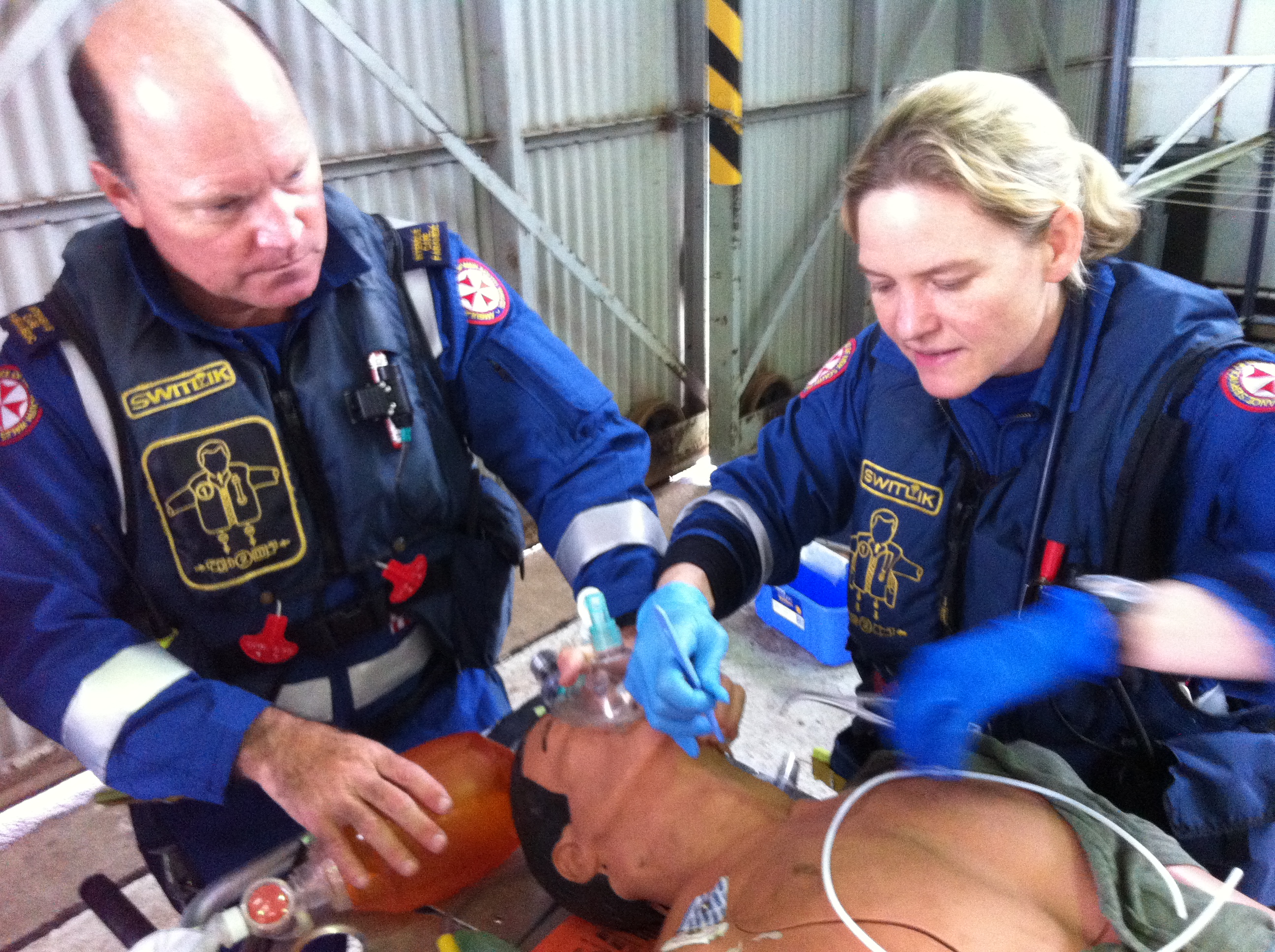
Challenges – Pain management. Patient desaturates if laid flat. Need for airway securing recognised but with recognition of both potential difficult anatomy due to oedema and soiling and liklihood of rapid desaturation on induction. Briefing of Plans A, B and C with marking of airway and both LMA and surgical airway kit opened and laid ready. Intubation impossible orally, LMA failing to ventilate, patient becomes bradycardic and hypoxic before airway secured with scalpel-finger-bougie-cricothyroidotomy technique performed.

 img5596

Learning points from debrief for clinical practice :

The rare but significant population of patients in whom a surgical airway is both likely to be more difficult AND more likely to be required due to progressing pathology, distance to hospital and austere location devoid of additional help/resource.

IMG_5607

The decision to use a depolarising relaxant may lead to problems following a failed oral intubation. Consideration given to primary use of non-depolarising relaxant at induction when there is no timely alternative to tracheal intubation before transporting the patient.

Communicate early with all involved the likely trajectory of your patient and what your plans and alternate plans will be as the airway management progresses.

Discussion given to eventual need for escharotomies but in this patient the airway presenting the single most important threat of ventilatory failure, and the unlikelihood of performing an escharotomy on the awake patient!

Thanks to Chloe(doc), Hugh(para), Andrew(actor), Brian (SRC), Luke (STAR)

Posted in General PH&RM | Leave a comment

Simulation Debrief 26/6/13 – Trial of new employee Lucas

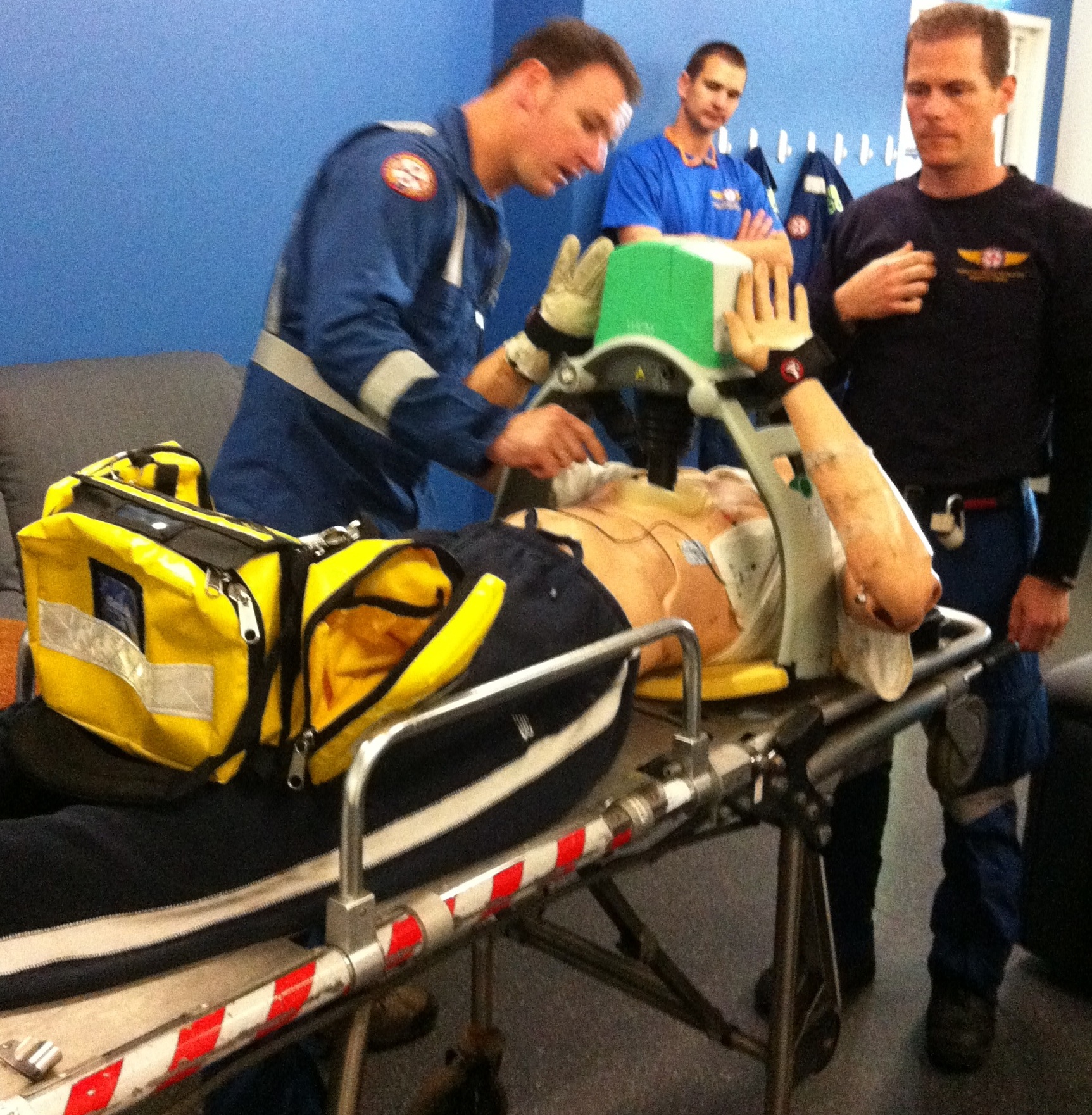
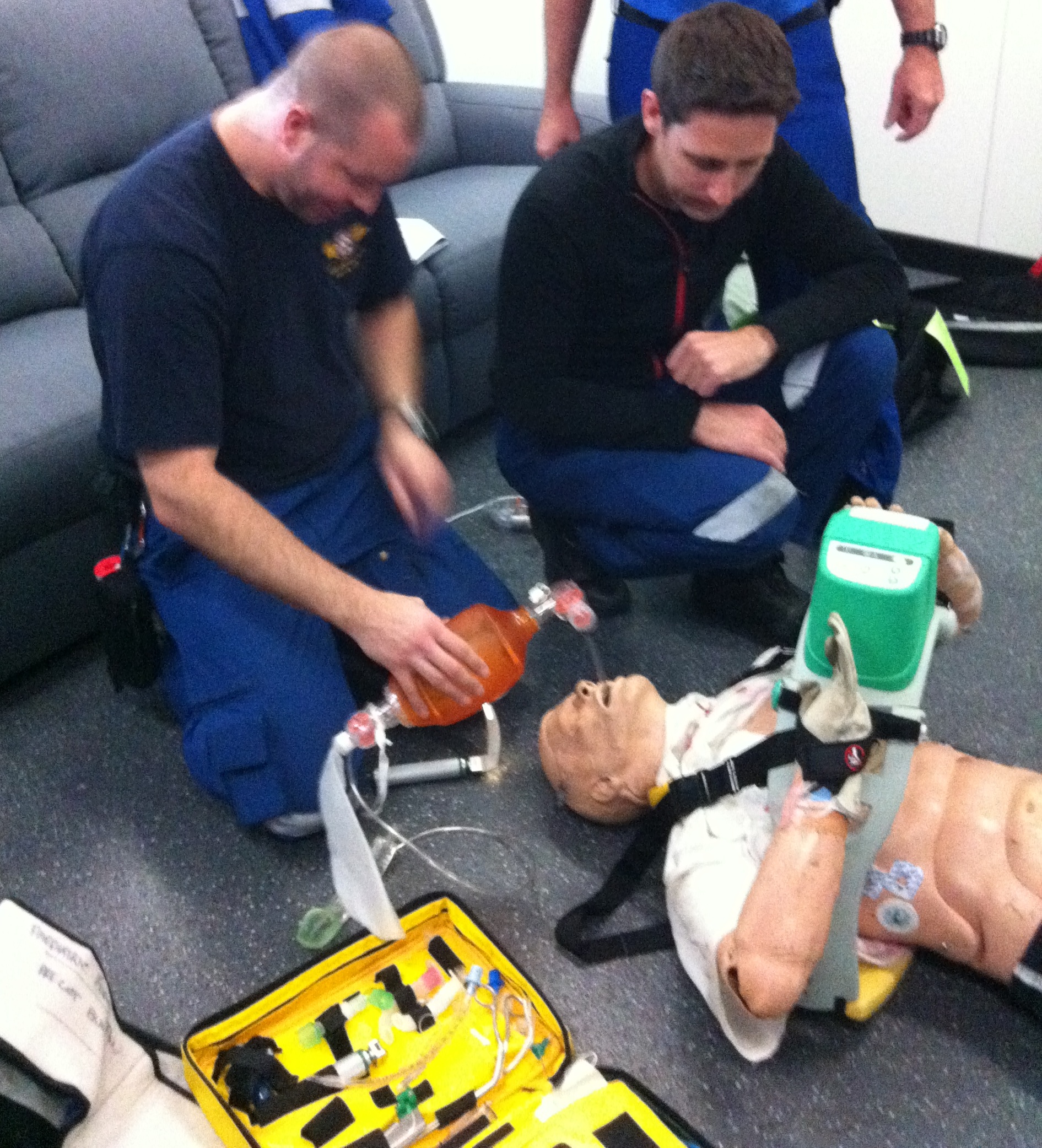
Today we commenced trialling and training with the Lucas 2 automatic chest compressor device. 

lucas on lucas he1

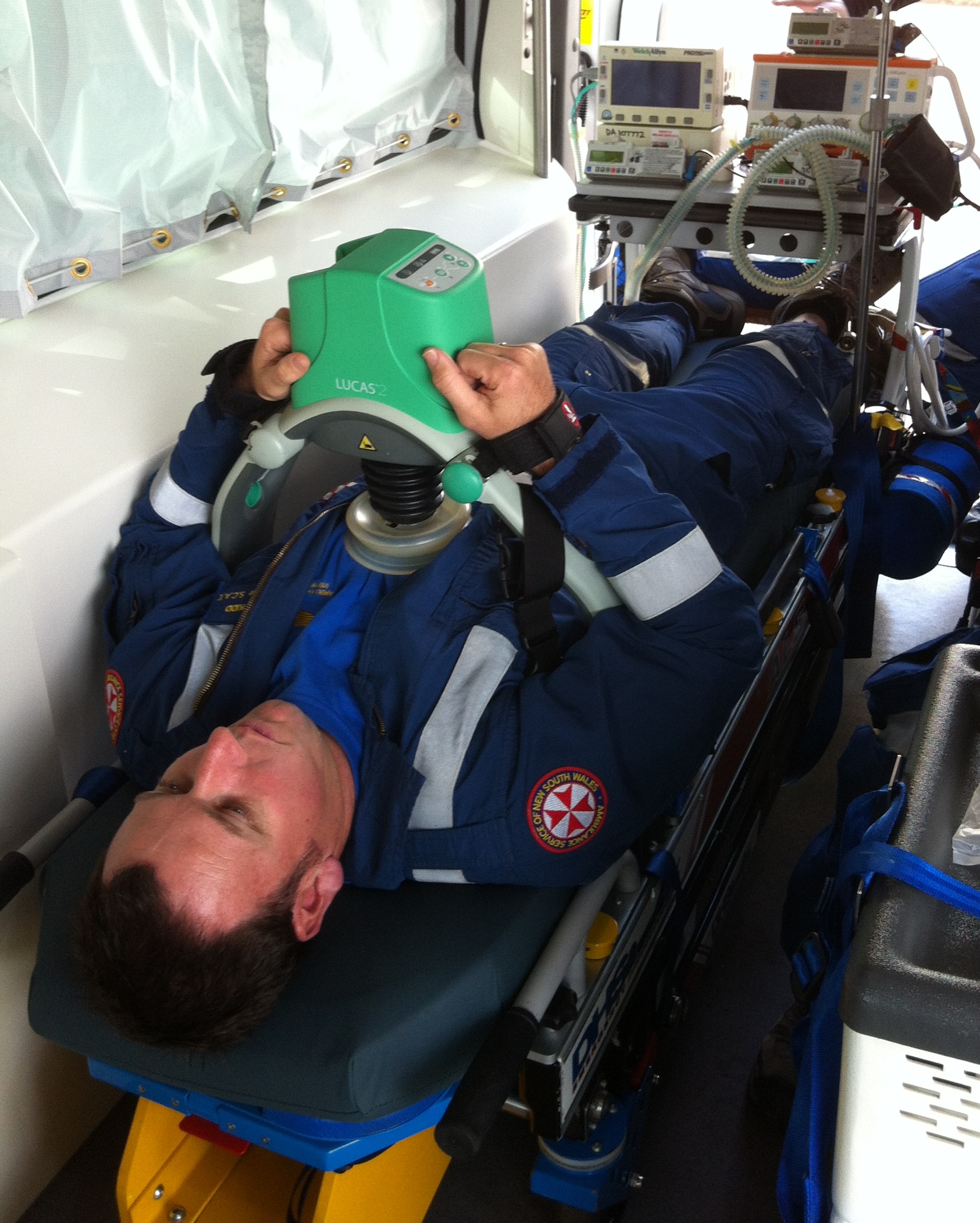
First it was formally introduced to our consultant Lucas Fox who had been concerned at talk around the base that ‘Lucas’ would be involved in a lot more jobs from now on…then we ascertained its fit both within our retrieval road vehicles and around the chests of our most thoracically gifted paramedics.

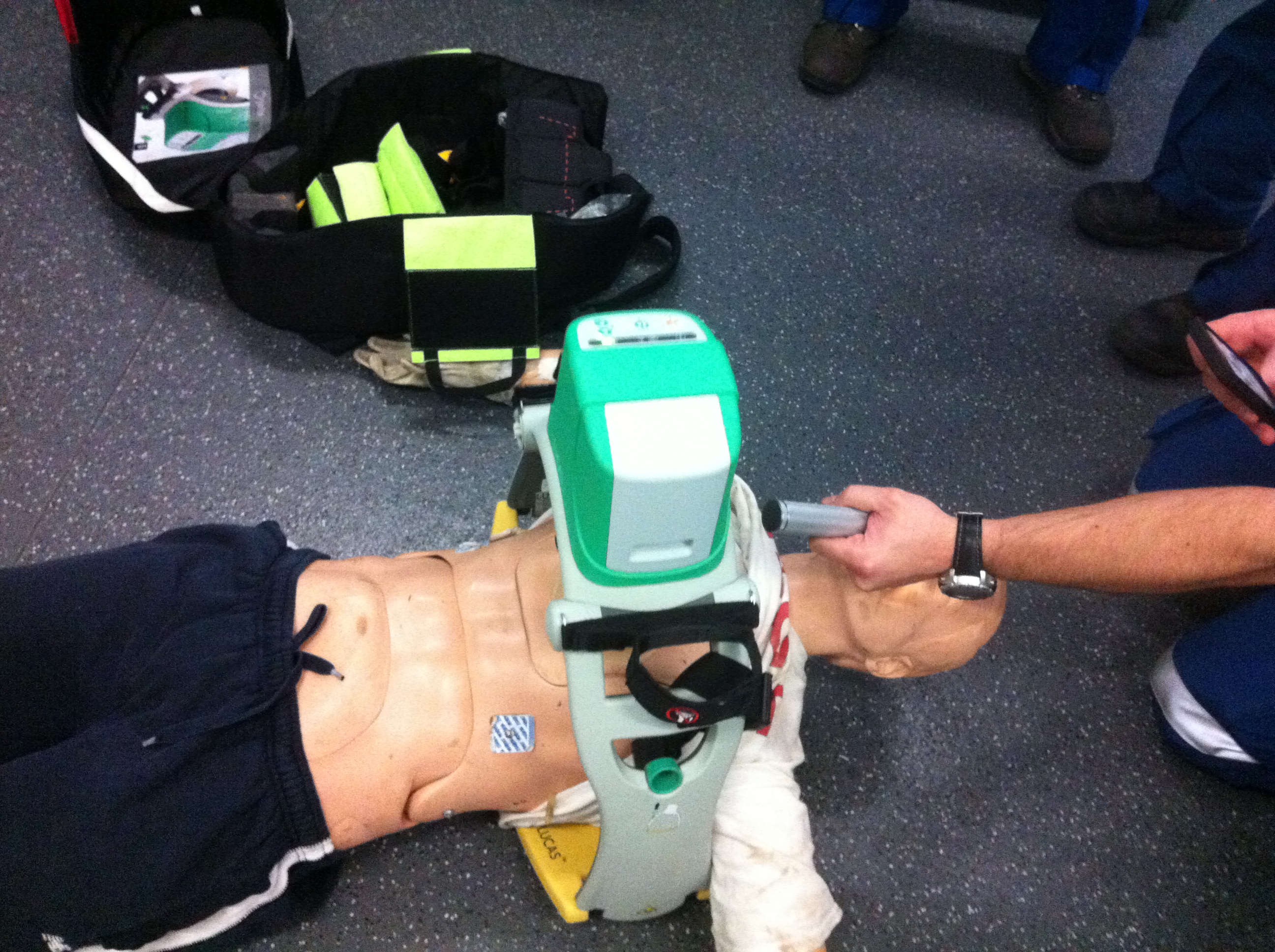
he3hs2

Now to see if it works as a helpful adjunct to our regular resuscitation of the arrested heart.

Scenario – 57 yr old man, collapsed on road whilst walking his dog. Road crew in attendance, patient in VF arrest, no pads on yet, CPR and being bagged with BVM.

Scene/Patient/Challenge – Team arrived, confirmed VF arrest and instigated defibrillation. Paramedic applied Lucas 2 while doc secured airway and instructed road crew to obtain IV access and administer drugs. Lucas paused at 2 minutes to observe rhythm and patient defibrillated back into NSR.

he4 he5
  
Learning points from debrief for clinical practice

1. Effectiveness of Lucas 2 in providing cerebral and pulmonary perfusion. Patients have been known to regain consciousness and require sedation despite having no intrinsic cardiac output. It also renders ETCO2 as a prognostic tool in cardiac arrest useless.

2. Who should do what? It was generally felt that the paramedic should be the one applying the device whilst the doctor takes handover, attends the airway etc but this may need to be protocolled.

3. Dimensions/practicality: it was possible to intubate the mannequin without the laryngoscope handle butting the device. The device also fits into the road ambulance as long as the back board sits above the stretcher sides. 

Team: Geoff Healy (doc), Bob Lisle (para), Dave Kidd (road crew), Digby Horne (road crew), Helen Ellis (STAR), Brian Burns (SRC), Cameron Marks.

Posted in General PH&RM | 2 Comments

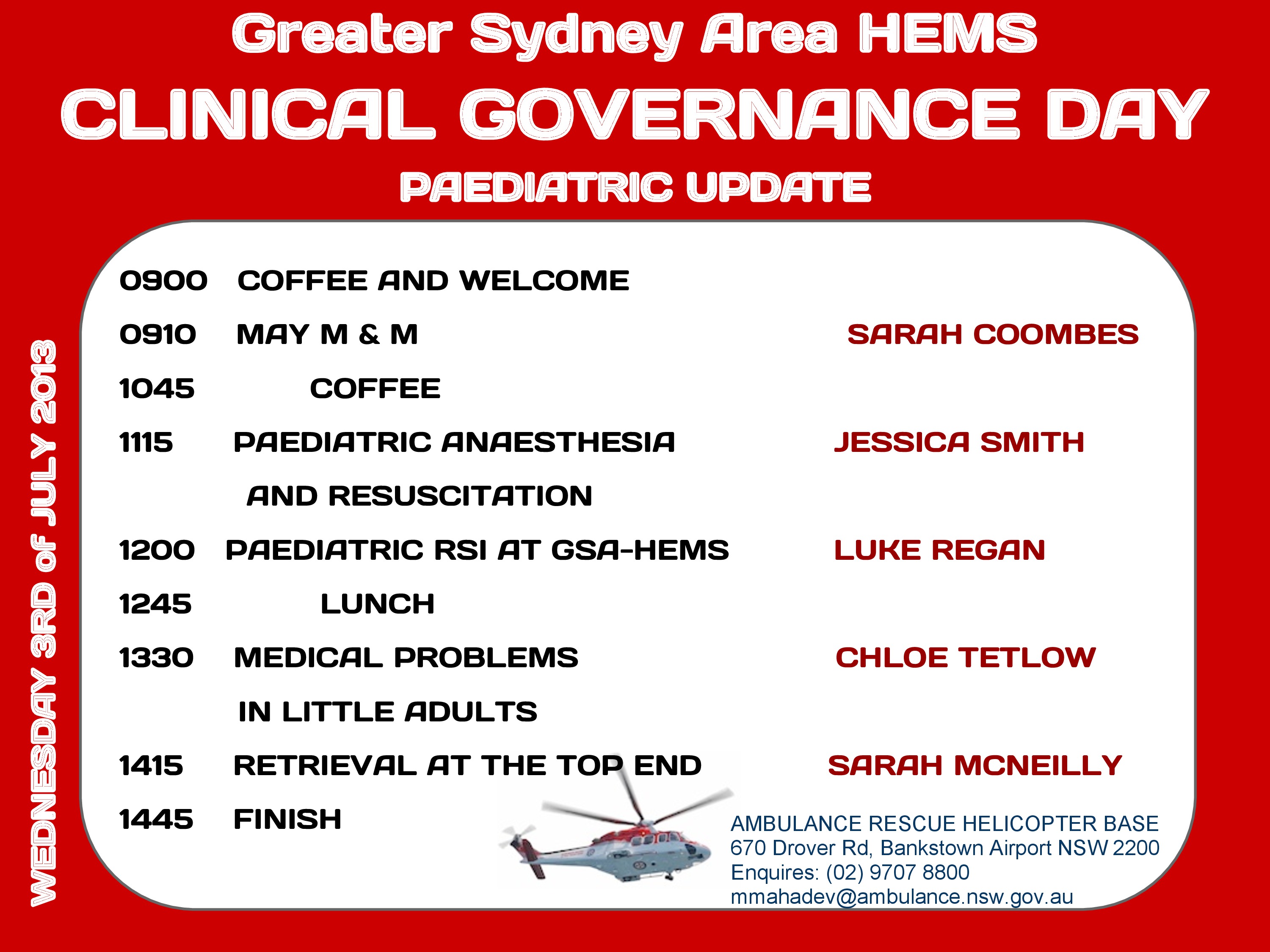
Clinical Governance Day 3rd July 2013 – for the little ones

CGDFlyer-030713-page-0

Posted in General PH&RM | Leave a comment

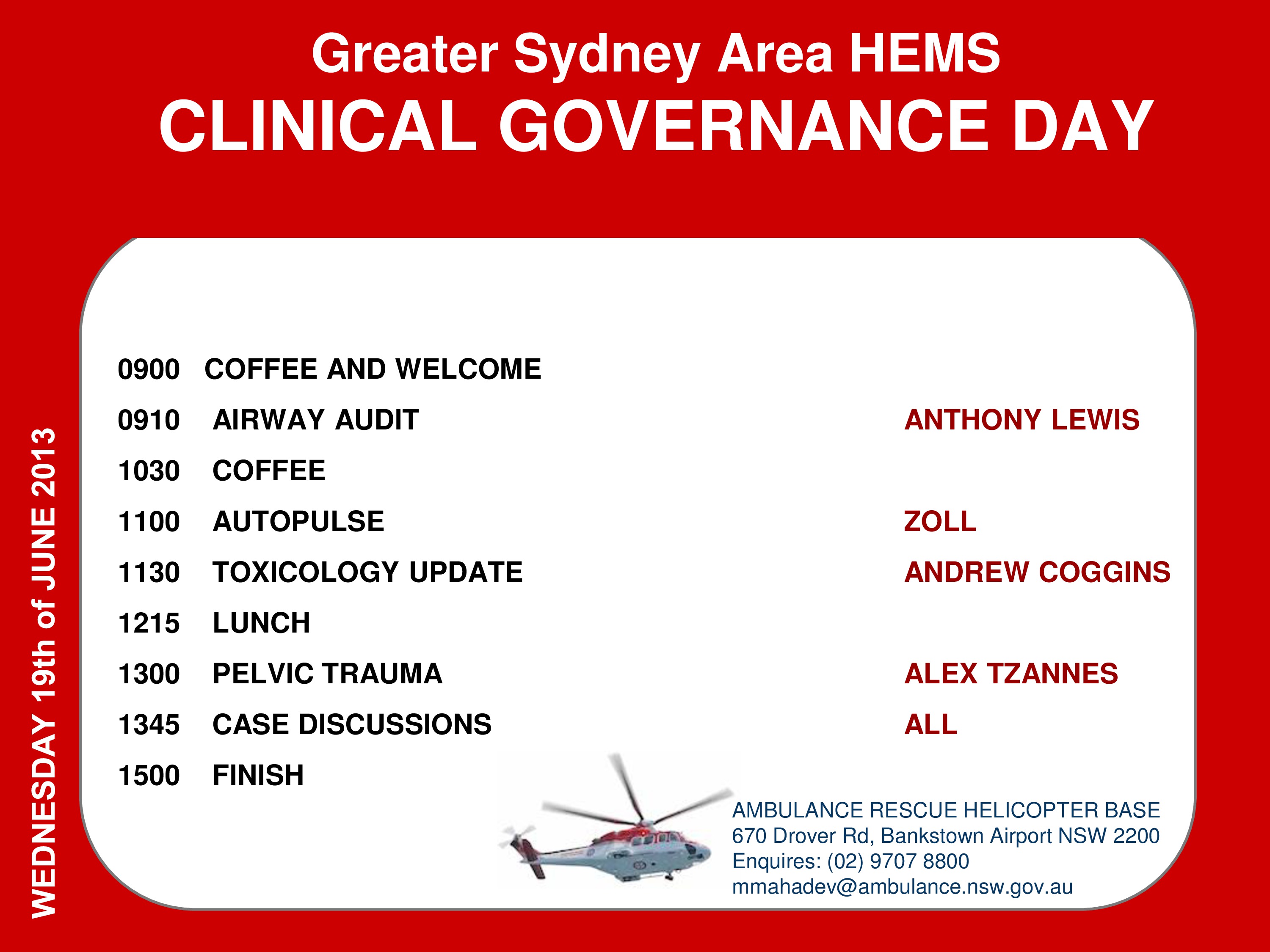
Clinical Governance Day 19th June 2013

CGDFlyer-19.6.13-page-0

Posted in General PH&RM | Leave a comment

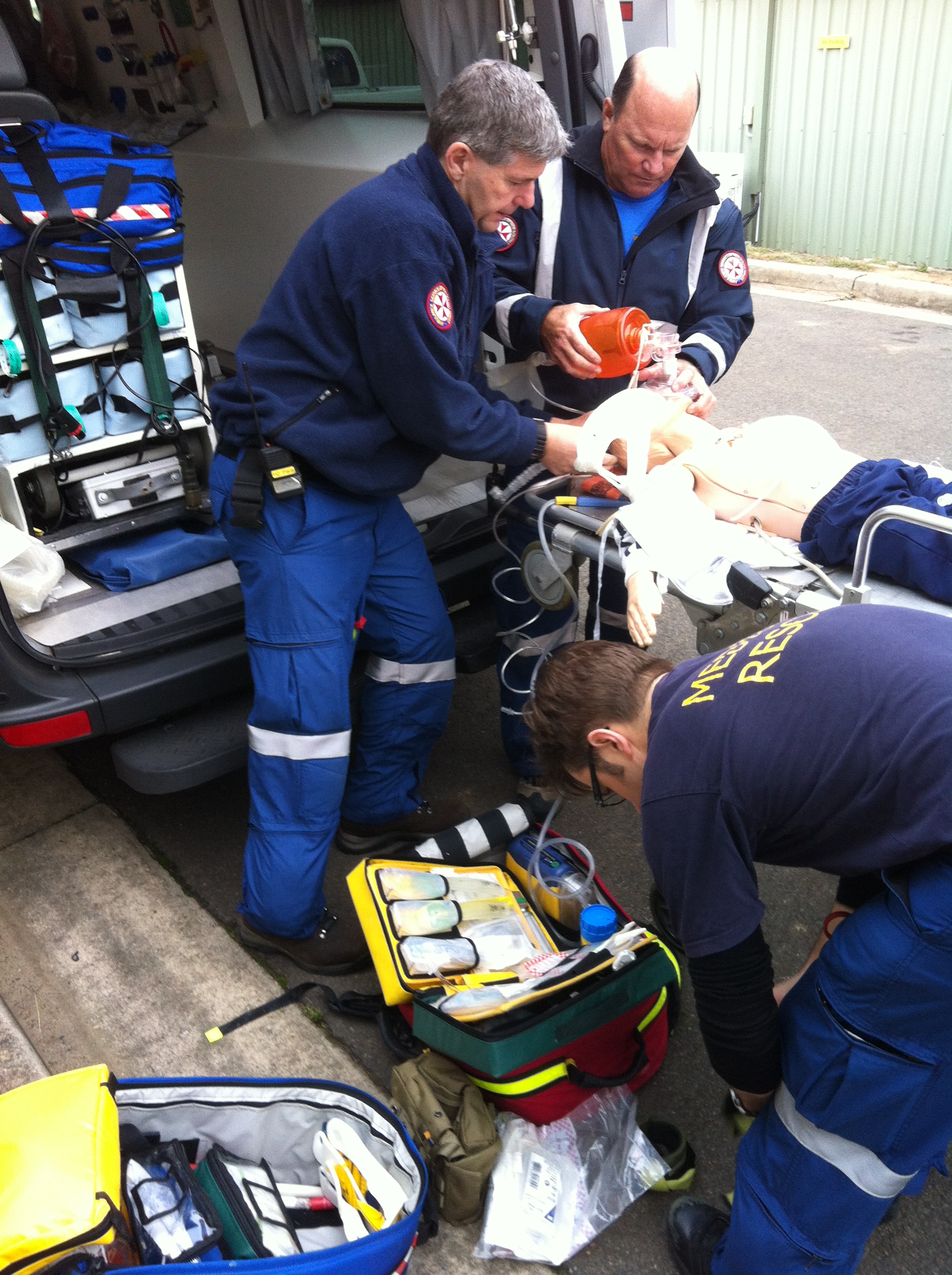
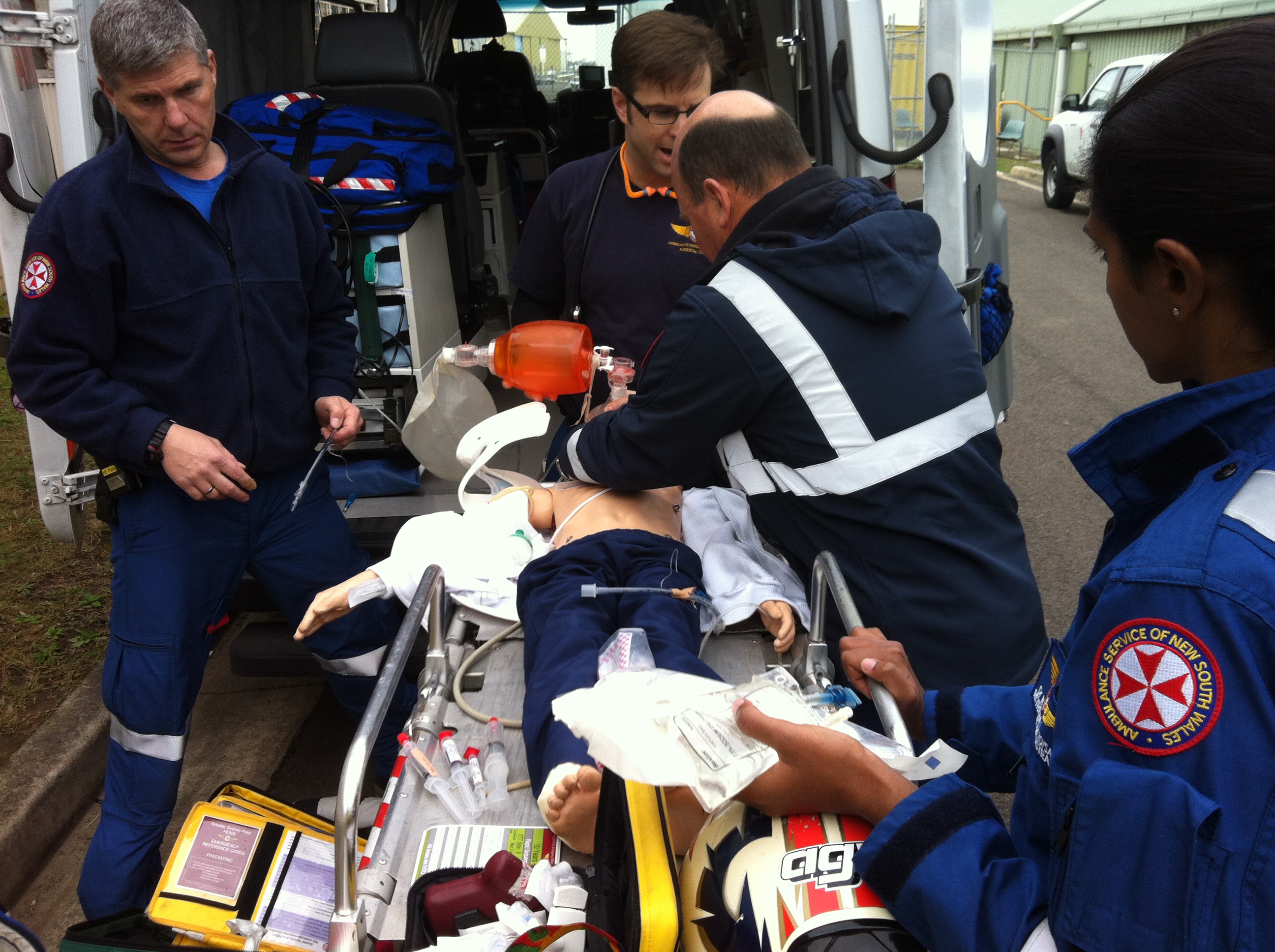
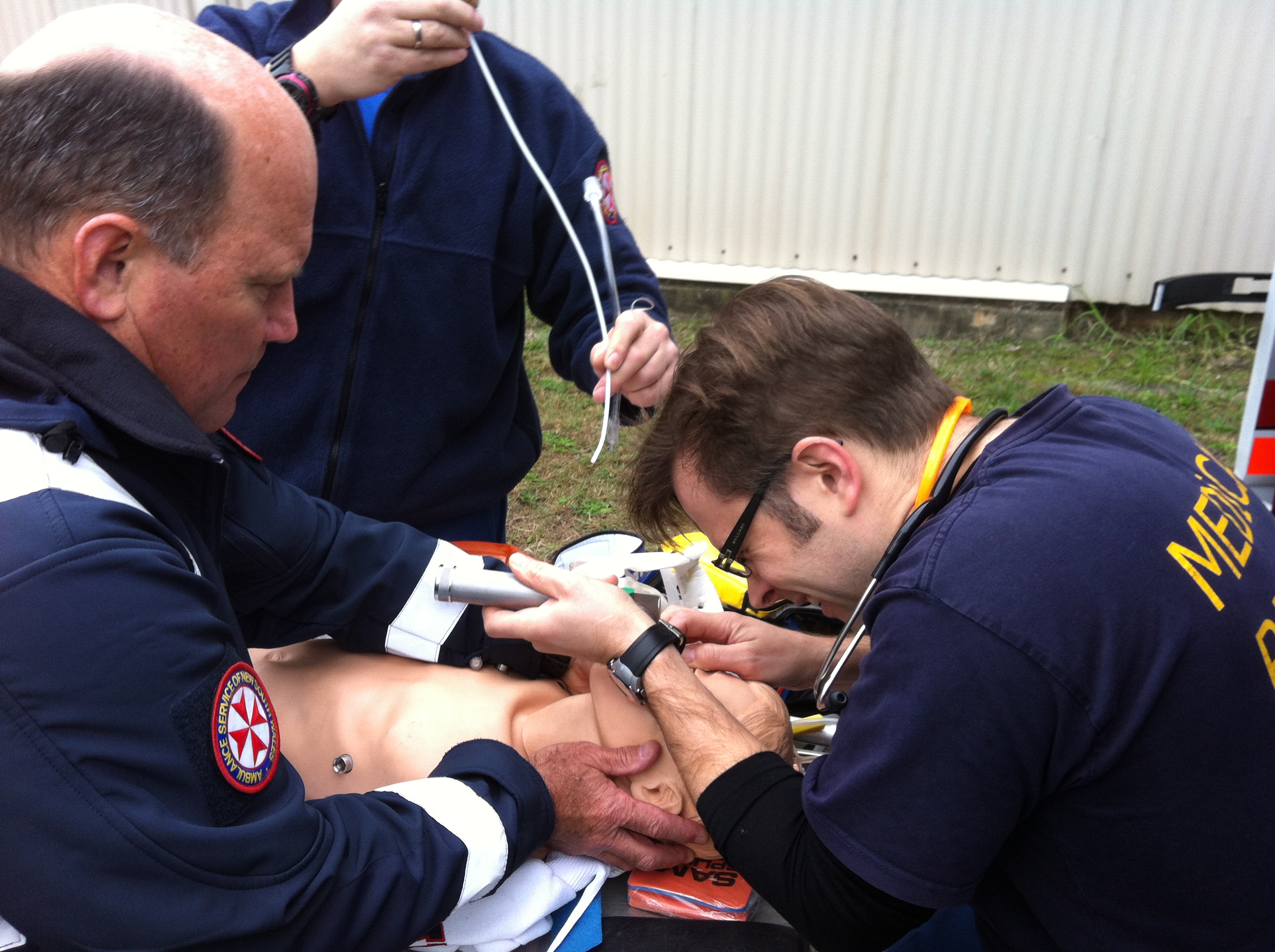
Simulation Debrief 6/6/13 – Challenging paediatric RSI when everything on the right is wrong

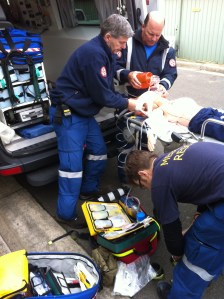
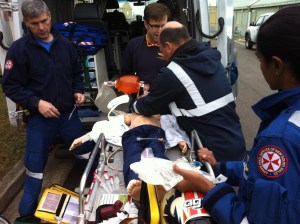
SCENARIO – We have been tasked to a helicopter land-on primary at a motorcross event. A 12 year old male has come off their bike at high speed in a location 30 minutes flight from the nearest paediatric major trauma centre. They have been unresponsive and hypoxic on first assessment by the attending road crew.

SCENE – On our team’s arrival the patient has been removed to the back of an ambulance, where a c-spine collar and IV line have been sited and a local medical practitioner has just passed an endotracheal tube.

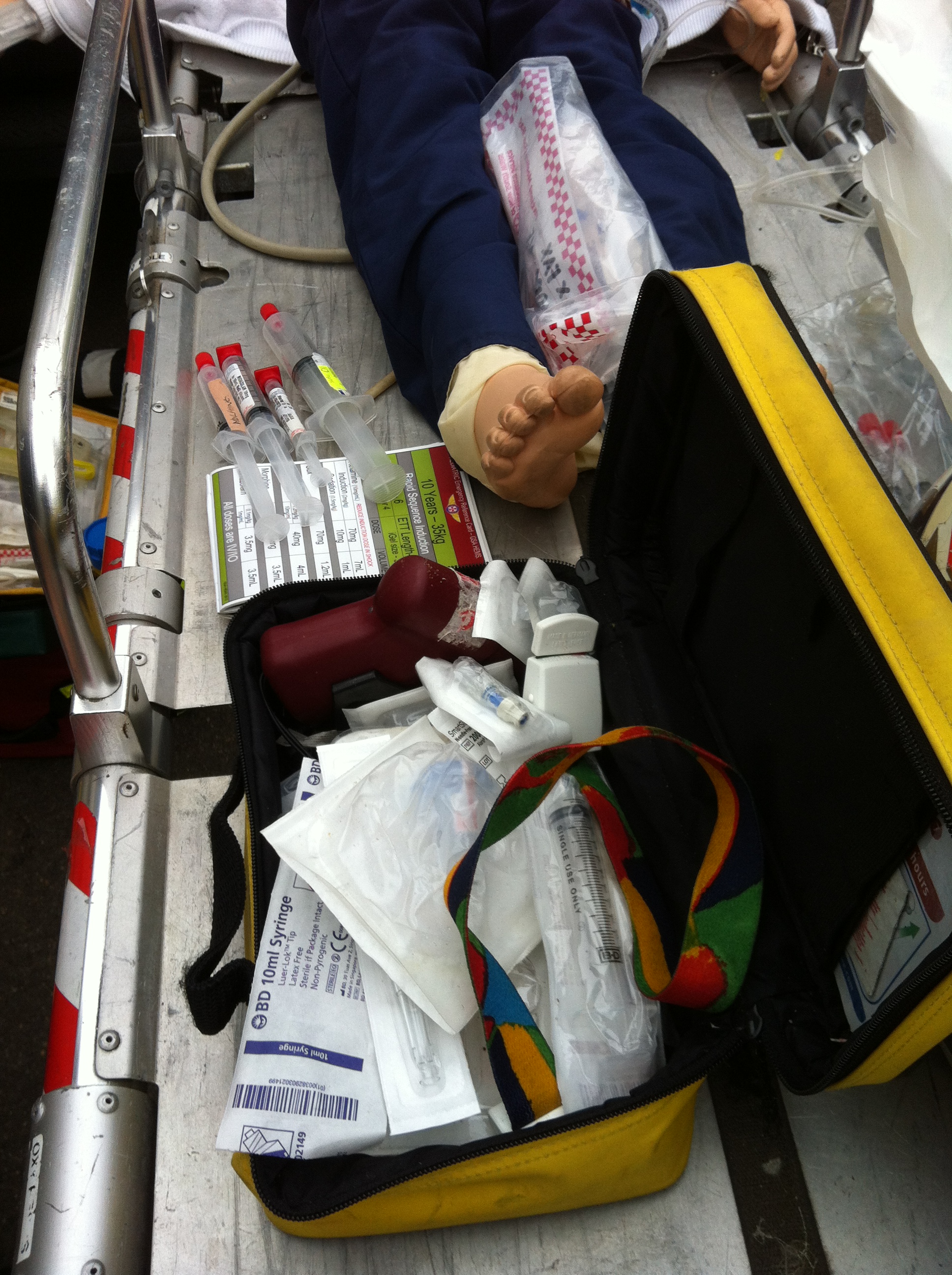
PATIENT – Child is actually 10 years old and projected to weigh c.35kg. They are making gasping breaths with little chest expansion on the left and absent on the right with some right-sided surgical emphysema. Monitoring when applied shows sO2 of 72% and an absent CO2 trace. GCS 4/15 with a fixed dilated right pupil. Right femur appears swollen.
IMG_5211IMG_5213

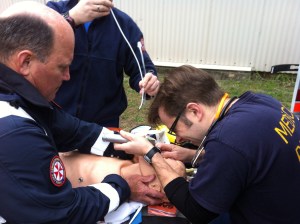
CHALLENGES – How to rapidly negotiate control of the airway from the local physician and correct the oesophageal intubation. Safer to remove tube, apply BVM and adjuncts and assist ventilation, then maneuvering stretcher back out of the vehicle whilst paramedic is setting up for RSI and definitive tracheal intubation.

Correcting the rightsided tension initially with dwellcath decompression but on multiple re-tensionings electing to perform open thoracostomy prior to intubation. Rationale of concurrent positive pressure ventilation with BVM.

Tailoring of the intitial planned drug doses to the obtunded patient who progresses to a low perfusion state.

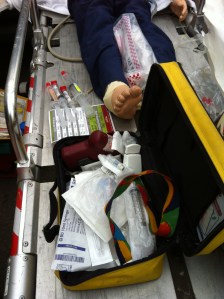
Stabilising the pelvis with adult sling modified. Stabilising the femur with simple figure of eight splinting to expedite departure for the likely time critical neurosurgical injury apparent from the blown pupil.
IMG_5212 IMG_5217

LEARNING POINTS FOR CLINICAL PRACTICE FROM DEBRIEF:

Modifications possible to the SAM Sling Pelvic Binder to adapt to the small paediatric patient

Early attention and ownership of the failing airway

Whilst dwellcath insertion for decompression of a tension pneumothorax is likely to be easier in a child the equipment is still liable to occlusion and kinking over time

The higher the skillset of the team with the patient on your arrival the harder it may be to negotiate ownership of the patient’s care from them…but the more useful they are likely to be once this is done! Diplomacy is key as you need as many skilled allies as possible.

The GSA HEMS paeds dosing guide is invaluable for clearing the mind for other time critical decisions….such as how to modify those same starting doses in response to the individual patient and their pathology!

LEARNING POINTS FROM DEBRIEF FOR SIMULATION PURPOSES:

You can never have too much lubricant in a mannequin’s airway

Option of th ‘poor perfusion’ trace for sats and ‘low output’ state for arterial line tracings gives opportunity for more dynamic interactions and interpretation of the iALS monitoring

Thanks to Toby (doc),  Lindsay (para),  Hugh, Nirosha (actors), Brian (SRC), Luke (STAR)
Posted in General PH&RM | Leave a comment