Pre-hospital / HEMS podcast

I was lucky enough to be interviewed by the amazing Scott Weingart, an emergency medicine intensivist who runs the spectacular EMcrit podcast. We covered some stuff on pre-hospital airway management, physicians in pre-hospital care, and I had a rant about ‘scoop and run’ versus ‘stay and play’. Worryingly, Scott is keeping back some audio footage for a later podcast, probably containing an even bigger rant about things like ATLS.

Click the image to be taken to the EMcrit site where you can listen to the podcast.

Cliff Reid

Posted in General PH&RM | Leave a comment

Heroes commended

Congratulations to Paramedic Harry Gatt and Doctor Roger Bloomer for the commendations received for their brave rescue in the Blue Mountains:

The Ambulance Service of NSW Distinguished Service Medal is the Services highest award. It recognises acts of conspicuous bravery by Paramedics that are deemed to be beyond the line of normal duty. On Friday 11 February at the Ambulance Rescue Helicopter base in Bankstown, this esteemed medal was awarded to highly respected Special Casualty Access Team (SCAT) Paramedic Harry Gatt, by the NSW Deputy Premier and Minister for Health Carmel Tebbutt, for his courageous efforts in saving two rock climbers from a cliff face approximately 400m high.

Paramedic Gatt was part of a specialist rescue team tasked to ‘Pierces Pass’ near Blackheath in the Blue Mountains in May 2010. The rescue team were faced with extremely difficult circumstances having to locate, treat and rescue two patients who had fallen onto small rock ledges 250m from the top of the cliff. This difficult rescue not only involved being winched onto a slippery 60 degree ledge but also a precarious traverse across a 2.5m rocky shelf.

“Everyday Paramedics across NSW work hard to provide care in what are often challenging circumstances,” Ms Tebbutt said. “Mr Gatt is recongnised for his conspicuous bravery as he worked to proved care to two patients who had fallen onto a rock ledge. “I join the Ambulance Service in thanking Mr. Gatt for his commitment and his courage.”

Captain Lachlan Slatyer, Aircrewman Greg Gill and Doctor Roger Bloomer were also presented with commendations of courage for their extraordinary efforts, teamwork and technical skill displayed throughout the incident. Captain Slatyer and Aircrewman Gill positioned the aircraft precariously close to the cliff face to enable the Paramedic and Doctor to be winched onto the small ledge.

The entire team worked tirelessly in very difficult and dangerous conditions. Their efforts in coordinating and executing the rescue ensured the 2 injured patient’s rescue was carried out in a manner that ensured both patients received the highest quality clinical care.

You can see part of the rescue here:

Posted in General PH&RM | Leave a comment

Clinical Governance Day 16th Feb 2011

Next Wednesday’s Clinical Governance Day will include a session on critical appraisal of the pre-hospital literature. Please read the papers that have been emailed and make an attempt appraise them for scientific validity, importance of results, and applicability to our own clinical practice. Further guidance on appraisal will follow.

The highlight of the day will be a talk by Paul Featherstone on the human side of Australian disasters, including the recent tragic floods and cyclone that have hit Queensland.

Posted in General PH&RM | Leave a comment

RSI currency training

RSI currency training every three months is underway for ASNSW consultants on the SRC roster. Please take a look at the video introducing the system of written and practical sessions.

Posted in General PH&RM | Leave a comment

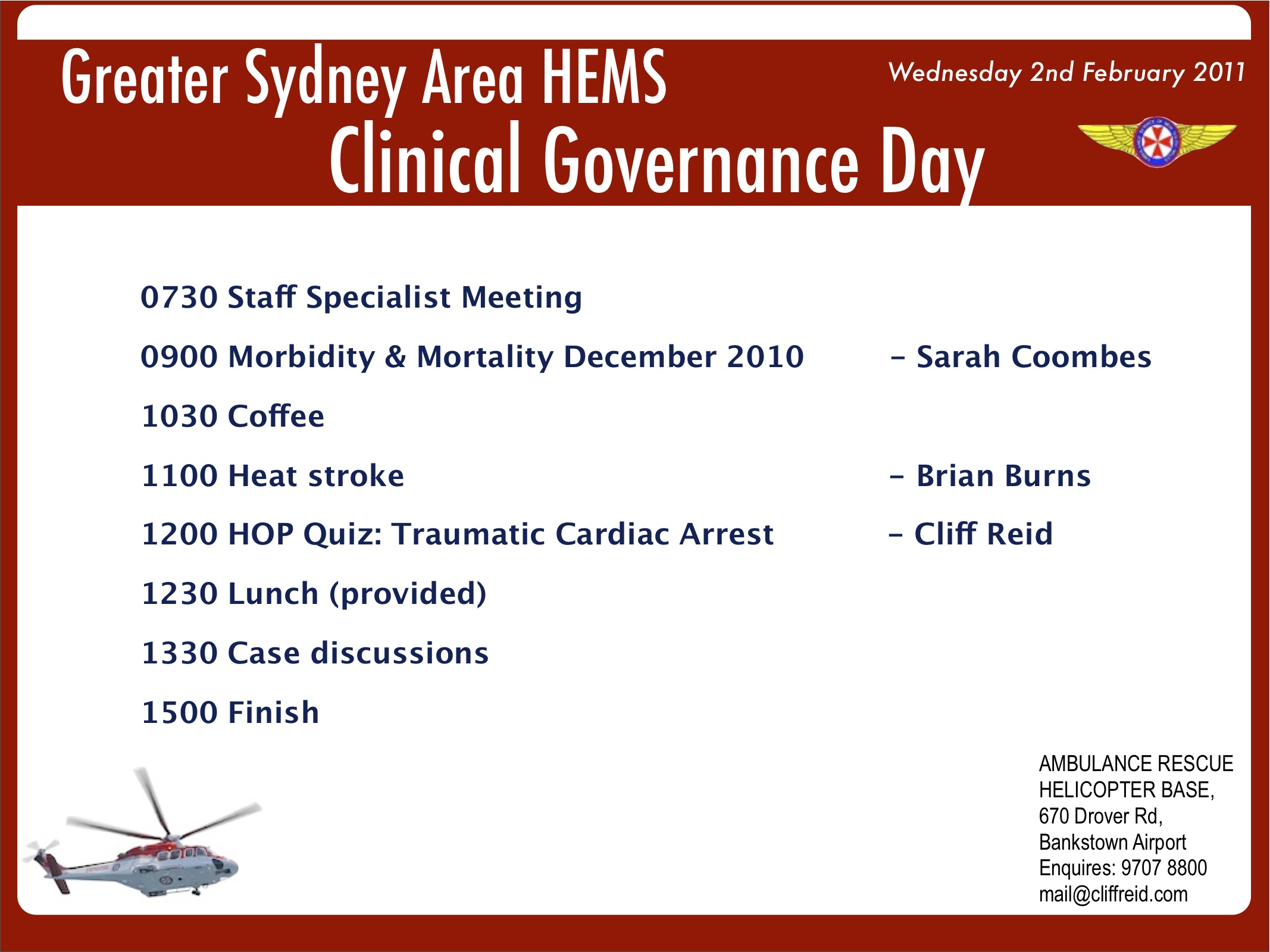
Clinical Governance Day

There will be a Clinical Governance Day at the base this Wednesday 2nd February 2011 at 0900

Posted in General PH&RM | Leave a comment

No CGD this week

Due to induction training for new doctors, we will not be holding a Clinical Governance Day on Wednesday 19th January 2011. CGDs resume in two weeks.

Posted in General PH&RM | Leave a comment

Registrar induction training

Training for new HEMS doctors commences in Monday 17th January 2011.

The training timetable is here. You do NOT need to print this out – a copy will be provided on your arrival.

Please be at the Ambulance Rescue Helicopter Base at Bankstown Airport at 07.30 on Monday. It’s a full week of medical training Monday-Friday and then Helicopter Underwater Escape Training on Saturday.

Address and directions can be found here

Posted in General PH&RM | 2 Comments

Australasian resus guideline

Australian and New Zealand resuscitation councils have now revealed their resuscitation guidelines for adults and children. The index of guidelines can be found here

The Australian Resuscitation Council Online Index of Guidelines December 2010

Posted in General PH&RM | Leave a comment

Paramedic RSI in Australia

A prospective, randomized, controlled trial compared paramedic rapid sequence intubation with hospital intubation in adults with severe traumatic brain injury in four cities in Victoria, Australia. The primary outcome was neurologic outcome at 6 months postinjury.

Training
Paramedics already experienced in ‘cold’ intubation (without drugs) undertook an additional 16-hour training program in the theory and practice of RSI, including class time (4 hours), practical intubating experience in the operating room under the supervision of an anesthesiologist (8 hours), and completion of a simulation-based examination (4 hours).

Methods
Patients included in the study were those assessed by paramedics on road ambulances as having all the following: evidence of head trauma, Glasgow Coma Score ≤9, age ≥15 years, and ‘intact airway reflexes’, although this is not defined or explained. Patients were excluded if any of the following applied: within 10 minutes of a designated trauma hospital, no intravenous access, allergy to any of the RSI drugs (as stated by relatives or a medical alert bracelet), or transport planned by medical helicopter. Drug therapy for intubation consisted of fentanyl (100μg), midazolam (0.1 mg/kg), and succinylcholine (1.5 mg/kg) administered in rapid succession. Atropine (1.2 mg) was administered for a heart rate <60/min. A minimum 500 mL fluid bolus (lactated Ringers Solution) was administered. A half dose of the sedative drugs was used in patients with hypotension (systolic blood pressure <100 mm Hg) or older age (>60 years).

Cricoid pressure was applied in all patients. After intubation and confirmation of the position of the endotracheal tube using the presence of the characteristic waveform on a capnograph, patients received a single dose of pancuronium (0.1 mg/kg), and an intravenous infusion of morphine and midazolam at 5 to 10 mg/h each. If intubation was not achieved at the first attempt, or the larynx was not visible, one further attempt at placement of the endotracheal tube over a plastic airway bougie was permitted. If this was unsuccessful, ventilation with oxygen using a bag/mask and an oral airway was commenced and continued until spontaneous respirations returned. Insertion of a laryngeal mask airway was indicated if bag/mask ventilation using an oral airway appeared to provide inadequate ventilation. Cricothyroidotomy was indicated if adequate ventilation could not be achieved with the above interventions. In all patients, a cervical collar was fitted, and hypotension (systolic blood pressure <100 mm Hg) was treated with a 20 mL/kg bolus of lactated Ringers Solution that could be repeated as indicated. Other injuries such as fractures were treated as required. In the hospital emergency department, patients who were not intubated underwent immediate RSI by a physician prior to chest x-ray and computed tomography head scan.

Follow up
At 6 months following injury, surviving patients or their next-of-kin were interviewed by telephone using a structured questionnaire and allocated a score from 1 (deceased) to 8 (normal) using the extended Glasgow Outcome Scale (GOSe). The interviewer was blinded to the treatment allocation.

Statistical power
A sample size of 312 patients was calculated to achieve 80% power at an alpha error of 0.05. Three hundred twenty-eight patients met the enrollment criteria. Three hundred twelve patients were randomly allocated to either paramedic intubation (160 patients) or hospital intubation (152 patients). A mean Injury Severity Score of 25 indicated that many patients had multiple injuries.

Success of intubation
Of the 157 patients administered RSI drugs, intubation was successful in 152 (97%) patients. The remaining 5 patients had esophageal placement of the endotracheal tube recognized immediately on capnography. The endotracheal tube was removed and the patients were managed with an oropharyngeal airway and bag/mask ventilation with oxygen and transported to hospital. There were no cases of unrecognised esophageal intubation on arrival at the emergency department during this study and no patient underwent cricothyroidotomy.

Outcome
After admission to hospital, both groups appeared to receive similar rates of neurosurgical interventions, including initial CT scan, urgent craniotomy (if indicated), and monitoring of intracranial pressure in the intensive care unit.

Favorable neurologic outcome was increased in the paramedic intubation patients (51%) compared with the hospital intubation patients (39%), just reaching statistical significance with P = 0.046. A limitation is that 13 of 312 patients were lost to follow-up and the majority of these were in the hospital intubation group. The authors do point out that the difference in outcomes would no longer be statistically significant whether one more patient had a positive outcome in the treatment group (P = 0.059) or one less in the control group (P = 0.061). The median GOSe was higher in the paramedic intubation group compared with hospital intubation (5 vs. 3), however, this did not reach statistical significance (P = 0.28).

More patients in the paramedic intubation group suffered prehospital cardiac arrest. There were 10 cardiac arrests prior to hospital arrival in the paramedic RSI group and 2 in the patients allocated to hospital intubation. Further detail on these patients is provided in the paper. The authors state that it is likely that the administration of sedative drugs followed by positive pressure ventilation had adverse hemodynamic consequences in patients with uncontrolled bleeding, and that it is possible that the doses of sedative drugs administered in this study to hemodynamically unstable patients were excessive and consideration should be given to a decreasing the dose of sedation.

Authors’ conclusions
The authors overall conclusion is that patients with severe TBI should undergo prehospital intubation using a rapid sequence approach to increase the proportion of patients with favorable neurologic outcome at 6 months postinjury. Further studies to determine the optimal protocol for paramedic rapid sequence intubation that minimize the risk of cardiac arrest should be undertaken.

Prehospital rapid sequence intubation improves functional outcome for patients with severe traumatic brain injury: a randomized controlled trial.
Ann Surg. 2010 Dec;252(6):959-65.

Victorian Ambulance Service protocols are available here, which include their current paramedic RSI protocol
Posted in General PH&RM | Tagged , , , , , , | Leave a comment

Ketamine update

Anaesthetist Dr Jan Persson from Stockholm has published an updated review of recent ketamine literature. The following interesting facts about our favourite drug are extracted from Dr Persson’s paper:

  • Action on multiple receptors earns it the nickname: ‘the nightmare of the pharmacologist’
  • Recently ketamine has also been shown to inhibit tumor necrosis factor-alpha (TNF- alpha) and interleukin 6 (IL-6) gene expressions in lipopolysaccharide (LPS)-activated macrophages. It has been speculated that these antiproinflammatory effects may be responsible for antihyperalgesic effects of ketamine
  • Ketamine can exist in two forms, or enantiomers; S-ketamine and R-ketamine. The physical properties of the enantiomers are identical, but their interactions with complex molecules, underlying PK/PD parameters, might differ. It has been well established that the elimination clearance of S-ketamine is larger than that of R-ketamine. The S-form has been commercially available for several years, probably based on the perception that it would have a better effect to side-effect ratio. The recent literature calls into question the proposed advantages of the S-enantiomer.

  • Ketamine has been shown to induce neuroapoptosis, or neuronal cell death, in newborn animals. This is obviously a concern in paediatrics, where ketamine plays an important role, both in anaesthesia and for sedation/analgesia during painful procedures. The relevance in humans of these effects, however, is unclear, and as pointed out by Green and Cote it does seem unlikely, for various reasons, that such an effect would be of major importance. It does not seem likely, though possible, that a clinically relevant effect would have passed unnoticed.
  • Another, somewhat unexpected, side effect that has emerged in recent years is bladder dysfunction. In some cases the bladder effects progress to ulcerative cystitis. Although the reported cases have mainly concerned recreational drug users, they are relevant for long-term analgesic use as well. The mechanisms involved are unknown. This side effect might turn out to be the most serious limitation to long-term analgesic treatment with ketamine.

Wherefore ketamine?
Curr Opin Anaesthesiol. 2010 Aug;23(4):455-60

Posted in General PH&RM | Tagged , , , , | Leave a comment