Clinical Governance Day

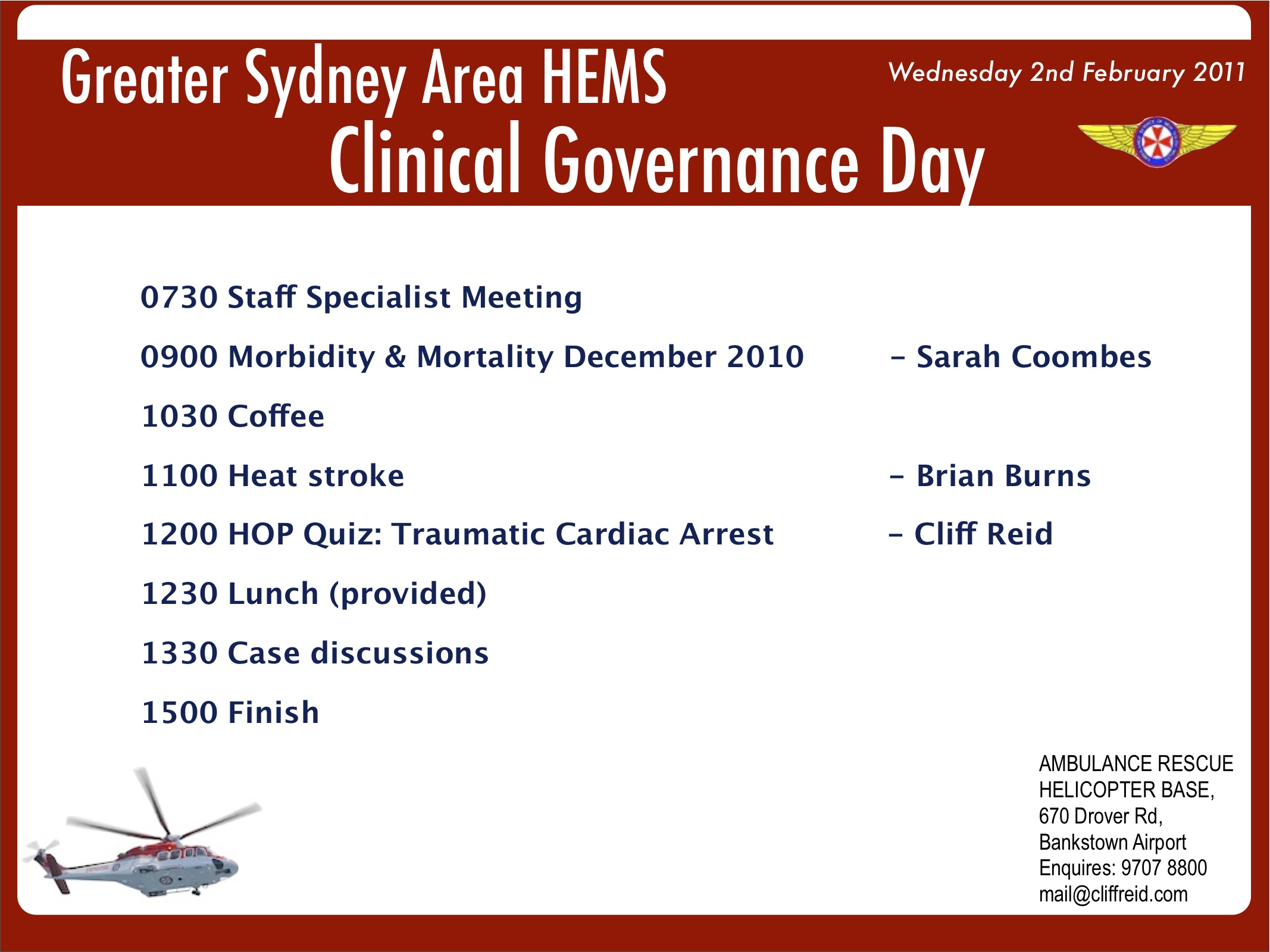
There will be a Clinical Governance Day at the base this Wednesday 2nd February 2011 at 0900

Posted in General PH&RM | Leave a comment

No CGD this week

Due to induction training for new doctors, we will not be holding a Clinical Governance Day on Wednesday 19th January 2011. CGDs resume in two weeks.

Posted in General PH&RM | Leave a comment

Registrar induction training

Training for new HEMS doctors commences in Monday 17th January 2011.

The training timetable is here. You do NOT need to print this out – a copy will be provided on your arrival.

Please be at the Ambulance Rescue Helicopter Base at Bankstown Airport at 07.30 on Monday. It’s a full week of medical training Monday-Friday and then Helicopter Underwater Escape Training on Saturday.

Address and directions can be found here

Posted in General PH&RM | 2 Comments

Australasian resus guideline

Australian and New Zealand resuscitation councils have now revealed their resuscitation guidelines for adults and children. The index of guidelines can be found here

The Australian Resuscitation Council Online Index of Guidelines December 2010

Posted in General PH&RM | Leave a comment

Paramedic RSI in Australia

A prospective, randomized, controlled trial compared paramedic rapid sequence intubation with hospital intubation in adults with severe traumatic brain injury in four cities in Victoria, Australia. The primary outcome was neurologic outcome at 6 months postinjury.

Training
Paramedics already experienced in ‘cold’ intubation (without drugs) undertook an additional 16-hour training program in the theory and practice of RSI, including class time (4 hours), practical intubating experience in the operating room under the supervision of an anesthesiologist (8 hours), and completion of a simulation-based examination (4 hours).

Methods
Patients included in the study were those assessed by paramedics on road ambulances as having all the following: evidence of head trauma, Glasgow Coma Score ≤9, age ≥15 years, and ‘intact airway reflexes’, although this is not defined or explained. Patients were excluded if any of the following applied: within 10 minutes of a designated trauma hospital, no intravenous access, allergy to any of the RSI drugs (as stated by relatives or a medical alert bracelet), or transport planned by medical helicopter. Drug therapy for intubation consisted of fentanyl (100μg), midazolam (0.1 mg/kg), and succinylcholine (1.5 mg/kg) administered in rapid succession. Atropine (1.2 mg) was administered for a heart rate <60/min. A minimum 500 mL fluid bolus (lactated Ringers Solution) was administered. A half dose of the sedative drugs was used in patients with hypotension (systolic blood pressure <100 mm Hg) or older age (>60 years).

Cricoid pressure was applied in all patients. After intubation and confirmation of the position of the endotracheal tube using the presence of the characteristic waveform on a capnograph, patients received a single dose of pancuronium (0.1 mg/kg), and an intravenous infusion of morphine and midazolam at 5 to 10 mg/h each. If intubation was not achieved at the first attempt, or the larynx was not visible, one further attempt at placement of the endotracheal tube over a plastic airway bougie was permitted. If this was unsuccessful, ventilation with oxygen using a bag/mask and an oral airway was commenced and continued until spontaneous respirations returned. Insertion of a laryngeal mask airway was indicated if bag/mask ventilation using an oral airway appeared to provide inadequate ventilation. Cricothyroidotomy was indicated if adequate ventilation could not be achieved with the above interventions. In all patients, a cervical collar was fitted, and hypotension (systolic blood pressure <100 mm Hg) was treated with a 20 mL/kg bolus of lactated Ringers Solution that could be repeated as indicated. Other injuries such as fractures were treated as required. In the hospital emergency department, patients who were not intubated underwent immediate RSI by a physician prior to chest x-ray and computed tomography head scan.

Follow up
At 6 months following injury, surviving patients or their next-of-kin were interviewed by telephone using a structured questionnaire and allocated a score from 1 (deceased) to 8 (normal) using the extended Glasgow Outcome Scale (GOSe). The interviewer was blinded to the treatment allocation.

Statistical power
A sample size of 312 patients was calculated to achieve 80% power at an alpha error of 0.05. Three hundred twenty-eight patients met the enrollment criteria. Three hundred twelve patients were randomly allocated to either paramedic intubation (160 patients) or hospital intubation (152 patients). A mean Injury Severity Score of 25 indicated that many patients had multiple injuries.

Success of intubation
Of the 157 patients administered RSI drugs, intubation was successful in 152 (97%) patients. The remaining 5 patients had esophageal placement of the endotracheal tube recognized immediately on capnography. The endotracheal tube was removed and the patients were managed with an oropharyngeal airway and bag/mask ventilation with oxygen and transported to hospital. There were no cases of unrecognised esophageal intubation on arrival at the emergency department during this study and no patient underwent cricothyroidotomy.

Outcome
After admission to hospital, both groups appeared to receive similar rates of neurosurgical interventions, including initial CT scan, urgent craniotomy (if indicated), and monitoring of intracranial pressure in the intensive care unit.

Favorable neurologic outcome was increased in the paramedic intubation patients (51%) compared with the hospital intubation patients (39%), just reaching statistical significance with P = 0.046. A limitation is that 13 of 312 patients were lost to follow-up and the majority of these were in the hospital intubation group. The authors do point out that the difference in outcomes would no longer be statistically significant whether one more patient had a positive outcome in the treatment group (P = 0.059) or one less in the control group (P = 0.061). The median GOSe was higher in the paramedic intubation group compared with hospital intubation (5 vs. 3), however, this did not reach statistical significance (P = 0.28).

More patients in the paramedic intubation group suffered prehospital cardiac arrest. There were 10 cardiac arrests prior to hospital arrival in the paramedic RSI group and 2 in the patients allocated to hospital intubation. Further detail on these patients is provided in the paper. The authors state that it is likely that the administration of sedative drugs followed by positive pressure ventilation had adverse hemodynamic consequences in patients with uncontrolled bleeding, and that it is possible that the doses of sedative drugs administered in this study to hemodynamically unstable patients were excessive and consideration should be given to a decreasing the dose of sedation.

Authors’ conclusions
The authors overall conclusion is that patients with severe TBI should undergo prehospital intubation using a rapid sequence approach to increase the proportion of patients with favorable neurologic outcome at 6 months postinjury. Further studies to determine the optimal protocol for paramedic rapid sequence intubation that minimize the risk of cardiac arrest should be undertaken.

Prehospital rapid sequence intubation improves functional outcome for patients with severe traumatic brain injury: a randomized controlled trial.
Ann Surg. 2010 Dec;252(6):959-65.

Victorian Ambulance Service protocols are available here, which include their current paramedic RSI protocol
Posted in General PH&RM | Tagged , , , , , , | Leave a comment

Ketamine update

Anaesthetist Dr Jan Persson from Stockholm has published an updated review of recent ketamine literature. The following interesting facts about our favourite drug are extracted from Dr Persson’s paper:

  • Action on multiple receptors earns it the nickname: ‘the nightmare of the pharmacologist’
  • Recently ketamine has also been shown to inhibit tumor necrosis factor-alpha (TNF- alpha) and interleukin 6 (IL-6) gene expressions in lipopolysaccharide (LPS)-activated macrophages. It has been speculated that these antiproinflammatory effects may be responsible for antihyperalgesic effects of ketamine
  • Ketamine can exist in two forms, or enantiomers; S-ketamine and R-ketamine. The physical properties of the enantiomers are identical, but their interactions with complex molecules, underlying PK/PD parameters, might differ. It has been well established that the elimination clearance of S-ketamine is larger than that of R-ketamine. The S-form has been commercially available for several years, probably based on the perception that it would have a better effect to side-effect ratio. The recent literature calls into question the proposed advantages of the S-enantiomer.

  • Ketamine has been shown to induce neuroapoptosis, or neuronal cell death, in newborn animals. This is obviously a concern in paediatrics, where ketamine plays an important role, both in anaesthesia and for sedation/analgesia during painful procedures. The relevance in humans of these effects, however, is unclear, and as pointed out by Green and Cote it does seem unlikely, for various reasons, that such an effect would be of major importance. It does not seem likely, though possible, that a clinically relevant effect would have passed unnoticed.
  • Another, somewhat unexpected, side effect that has emerged in recent years is bladder dysfunction. In some cases the bladder effects progress to ulcerative cystitis. Although the reported cases have mainly concerned recreational drug users, they are relevant for long-term analgesic use as well. The mechanisms involved are unknown. This side effect might turn out to be the most serious limitation to long-term analgesic treatment with ketamine.

Wherefore ketamine?
Curr Opin Anaesthesiol. 2010 Aug;23(4):455-60

Posted in General PH&RM | Tagged , , , , | Leave a comment

Swimming the Channelopathy

Drowning is one of the leading causes of accidental death in children. Some apparent drownings may be related to sudden cardiac death, in particular to unidentified channelopathies, which are known to precipitate fatal arrhythmias during swimming-related events.

The majority of cases of sudden cardiac death in children and adolescents are secondary to either hypertrophic or right ventricular cardiomyopathy with coronary artery abnormalities also prevalent, and reports have demonstrated these cardiac abnormalities on autopsy following sudden swimming-related deaths.

However, the majority of autopsies in swimming-related sudden deaths are normal suggesting causation at molecular level, in particular ion channel defects such as type 1 long-QT syndrome (LQT1) and catecholaminergic polymorphic ventricular tachycardia (CPVT).

The gene deletion in LQT1 (KCNQ1) leads to a reduction in the repolarising potassium current (IKs) and prolongation of repolarisation. This lengthens the QT interval (which may be lengthened further by facial immersion in cold water). A premature ventricular contraction (PVC) again which may be initiated by swimming occurring during the vulnerable part of repolarisation leads to establishment of polymorphic ventricular tachycardia (torsades de pointes).

The ryanodine receptor gene mutation (RyR2) in catecholaminergic polymorphic ventricular tachycardia leads to defective closure of the receptor on the surface of the sarcoplasmic reticulum during diastole. This leads to increased calcium (Ca2+) leakage from the sarcoplasmic reticulum and increased potential for delayed afterdepolarisations and subsequent ventricular tachycardia.

Some recommendations are made in an article in Archives of Disease in Childhood:

Proposed implementations to improve detection and appropriate management of apparent drownings secondary to cardiac channelopathies

  1. Improving awareness in the coronial service of the possibility of a cardiac cause for poorly explained drownings.
  2. Education of lifeguards and provision of automated defibrillators in swimming pools.
  3. Molecular autopsy for non-survivors to look for potential channelopathies.
  4. Screening for survivors and family members of non-survivors to identify those with a channelopathy.
  5. Proper counselling for those identified to have a channelopathy on family screening.

Drowning and sudden cardiac death
Arch Dis Child 2011;96:5-8

Posted in General PH&RM | Tagged , , , , , , | Leave a comment

Seasonal humour

Posted in General PH&RM | Leave a comment

Merry Christmas!

Have a great one, and thanks to you all for your hard work this year.

There will be no Clinical Governance Day on 5th January, so for some of the registrars today was the last CGD of the term.

CGD presentations appopriate for web distribution can be found here

Posted in General PH&RM | Leave a comment

HEMS transport may be predictor of survival

Helicopters are controversial in EMS circles, particularly in the United States, which seems to have a high number of Helicopter Emergency Medical Services (HEMS) crashes. Although this may in part be a reflection of a large increase in HEMS missions, and the factors contributing to crash fatalities have been studied, it makes sense to limit HEMS missions to those that are likely to make a difference to the patient. Advantages of HEMS services may include the ability to deliver a patient more rapidly to the most appropriate facility, as well as being able to convey a highly skilled team more rapidly to the scene.

Analysis of patients from the National Trauma Databank identified 258,387 subjects transported by either helicopter (HT) (16%) or ground ambulance (GT) (84%). HT subjects were younger (36 years ± 19 years vs. 42 years ± 22 years; p < 0.01), more likely to be male (70% vs. 65%; < 0.01), and more likely to have a blunt mechanism (93% vs. 88%; < 0.01) when compared with GT subjects.

For every dead-on-arrival (DOA) subject in the HT group, there were 498 survivors compared with 395 survivors for every DOA subject in the GT group. When comparing indicators of injury severity, patients transported by helicopter were more severely injured (mean ISS and percentage with ISS > 15), were more likely to have a severe head injury, and were more likely to have documented hypotension or abnormal respiratory when compared with those transported by ground ambulance. Furthermore, HT subjects also had longer length of stay, higher rates for ICU admission, and mechanical ventilation, as well as an increased requirement for emergent surgical intervention.

interestingly, this study shows that <15% of HT patients nationally are discharged within 24 hours. This is much lower than the 24.1% reported previously, suggesting that the degree of over-triage may not be as significant on the national level as reported in smaller studies.

Overall survival was lower in HT subjects versus GT subjects on univariate analysis (92.5% vs. 95.6%; < 0.01). Stepwise univariate analysis identified all covariates for inclusion in the regression model. HT became an independent predictor of survival when compared with GT after adjustment for covariates (OR, 1.22; 95% CI, 1.18– 1.27; < 0.01).

Helicopters and the Civilian Trauma System: National Utilization Patterns Demonstrate Improved Outcomes After Traumatic Injury
J Trauma. 2010 Nov;69(5):1030-4

National Transportation Safety Board HEMS data

Posted in General PH&RM | Tagged , , | Leave a comment