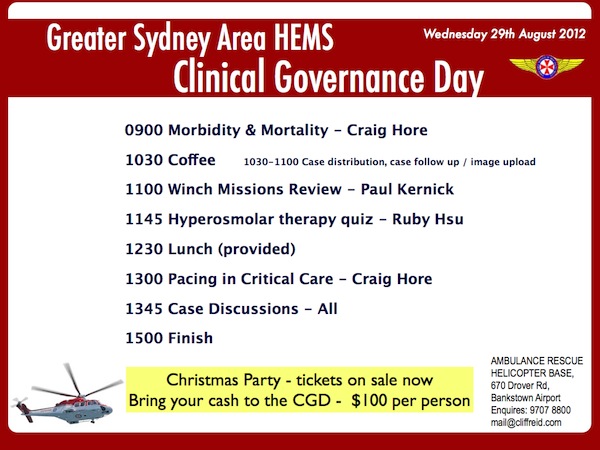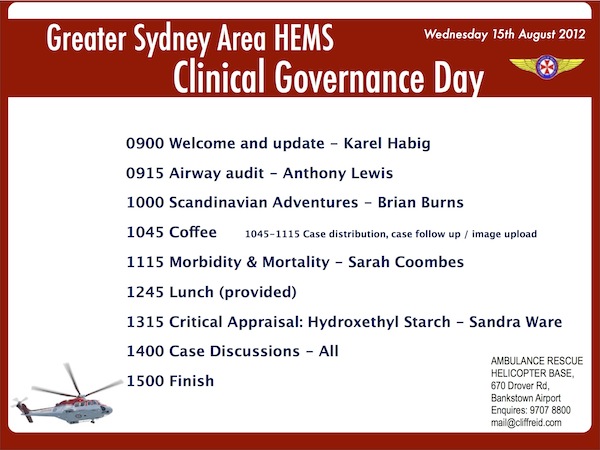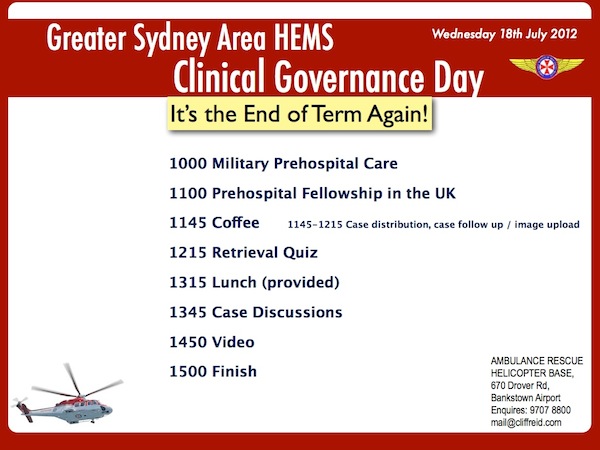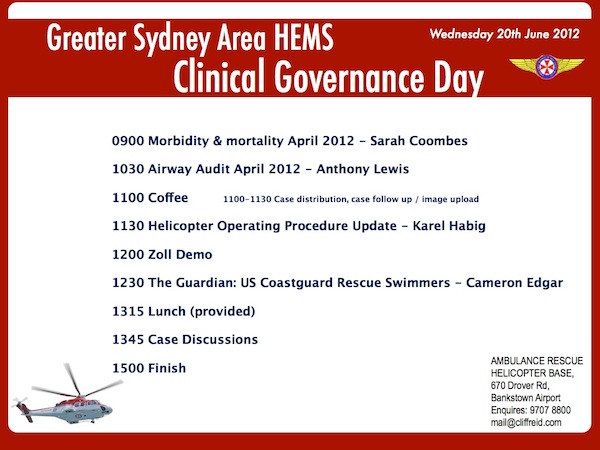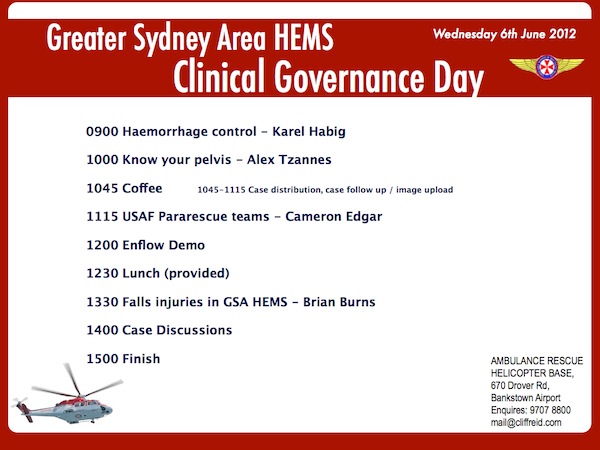
Clinical Governance Day 18th July 2012

Posted in General PH&RM | Leave a comment

OXY’s LOG – ‘Between shock and a hard place…’

Cardiogenic shock – occurs in 10% of uncomplicated myocardial infarctions, suggests greater than 40% loss of functional left ventricule and has an 85% mortality.1, 2 

John Hunter, a famous London surgeon during the 18th century, described his personal experience of myocardial infarction. His cardiac problems stemmed from an experiment where he inoculated himself with gonorrhoea. Unfortunately he unknowingly gave himself syphilis at the same time from the contaminated needle. He suffered his final infarction at work and went into cardiogenic shock secondary to a ruptured papillary muscle. Sadly balloon pumps and bypass machines hadn’t been invented and so he died in the corridors of St George’s Hospital, UK.3

Case: Our retrieval team was tasked to a rural hospital where a 60yr old was in cardiogenic shock with florid pulmonary oedema. The patient had already arrested five times despite full medical therapy and was now on double-strength adrenaline. The ED team had difficulties ventilating him and were struggling to improve his sats above 80%. The mission brief was to transfer the patient to a centre capable of revascularisation and/or supplementary balloon counter-pulsation.

The retrieval team reviewed the resuscitative and supportive treatment and assessed for potentially reversible causes. A bedside echocardiogram revealed a big floppy poorly contracting left ventricle. During transfer hypotension, hypoxia and acidosis eventually resulted in an unrecoverable arrest rhythm. It is believed that a further infarct, on the back of long standing cardiomyopathy, reduced the patient’s left ventricular muscle mass to a critical level and this ultimately lead to his demised.

Challenge: To understand the pathophysiology of cardiogenic shock and the treatments are available.

Pathophysiology: Cardiogenic shock can occur with any disease that inhibits the cardiac contractile mechanism.4

Cardiogenic shock is characterized by decreased cardiac output and evidence of tissue hypoxia. It is accompanied by decreased coronary perfusion pressure and increased myocardial oxygen demand.Pulmonary artery cathertization demonstrates; high CVP, high PAP, high peripheral resistance, low cardiac output and low mixed venous saturations.5 ,6

Ischaemia may be reversible, i.e. stunned or hibernating, and may even recover completely with restoration of myocardial blood flow.7 Although dysfunctional, damaged myocardium does maintain a latent capacity to contract and is responsive to positive inotropic stimulation.8

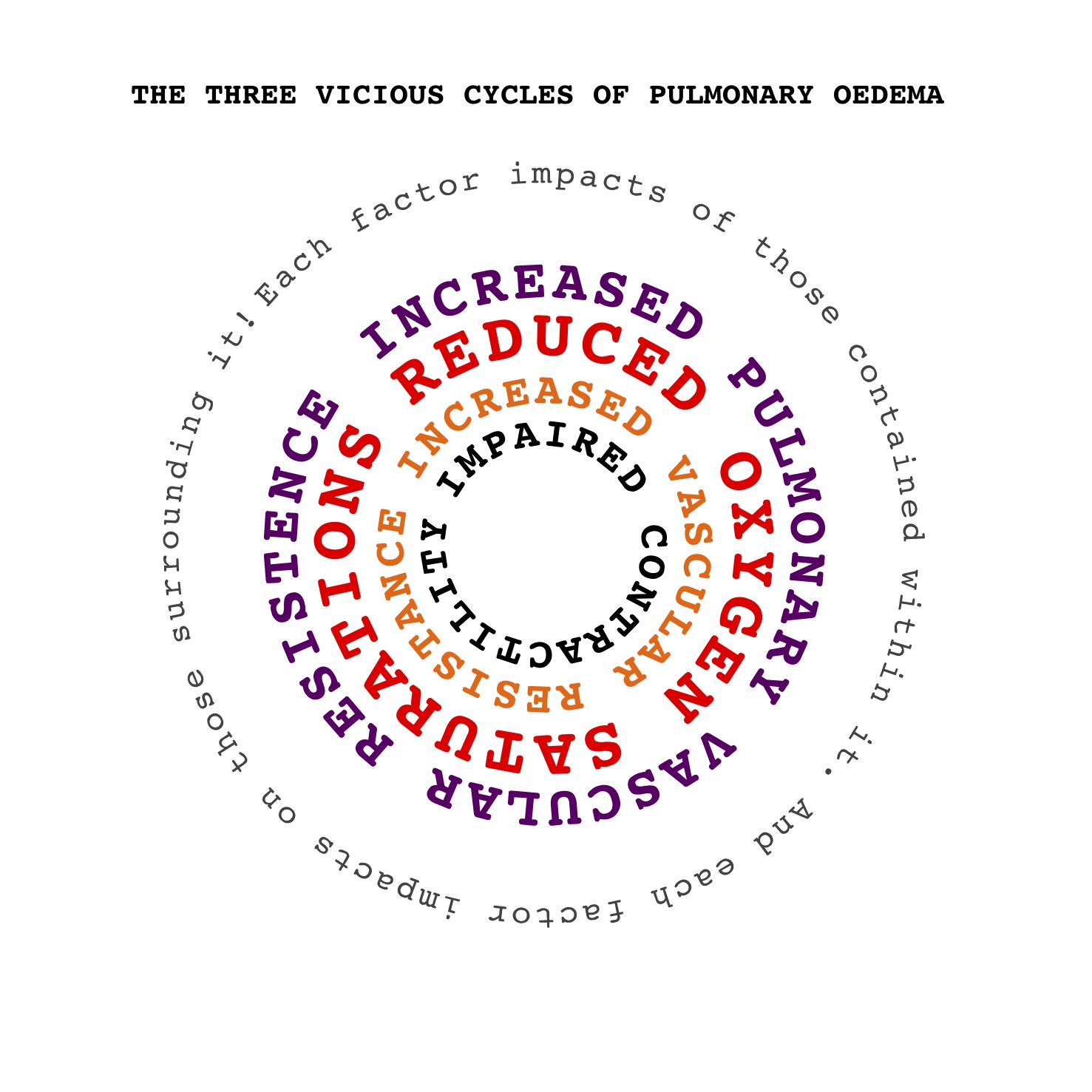
Pulmonary oedema and 3 vicious cycles:9 reduced myocardial contractility leads to impaired myocardial diastolic function and increased left ventricular filling pressure. This increased pressure is transferred backwards to the pulmonary veins leading to pulmonary oedema.10
Treatment: Initiate resuscitative and supportive efforts while implementing diagnostic evaluation. Hospitals without facilities for angioplasty, surgical intervention or capacity to place a balloon pump should make a rapid decision about transfer during the initial resuscitation phase.

Therapeutic goals are aimed at optimizing myocardial oxygenation and improving peripheral tissue perfusion. 

Improve myocardial oxygenation

  • Reduce myocardial oxygen demand – decrease afterload and HR.
  • Increase coronary perfusion
    • Adequate flow – revascularisation, e.g. thrombolytics, CABG, angioplasty, stenting.
    • Adequate pressure – MAP 60-80mmHg, e.g. inotropes, balloon pump.

Improve tissue perfusion

  • Pre-load optimisation – intravascular volume increase (until PAP 18mmHg).
  • Contractility – inotropic agents generally increase myocardial oxygen requirements by their chronotropic rather than inotropic action. Aim is to use that which causes the least increase in HR.
  • Afterload optimisation – use vasodilators. Balloon pump may be effective if MAP low.
(Optimising pre-load and afterload can increase peripheral perfusion without increasing myocardial oxygenation requirements or reducing coronary blood flow. Agents that increase myocardial contractility do increase peripheral tissue perfusion but also increase myocardial oxygen requirements).11, 12 
 

Intra-aortic balloon pump (IABP): Improves coronary perfusion during diastole and reduces afterload during systole, thereby augmenting cardiac output and coronary blood flow. Myocardial oxygen demand is decreased by the increase in left ventricular stroke volume and reduction in PAP.

Indictations: (Bridging measure until…)

  • Mechanical defect can be corrected.
  • Prior to revascularisation.
  • In reversible cardiogenic shock, e.g. from drugs.13 14 

Of note: NSW-HEMS have a helo-compatible balloon pump. This enables balloon pump transfers by helicopter but also initiation of treatment at a ‘referring’ hospital when indicated.15

Summary: Confirm the diagnosis of cardiogenic shock during the initial resuscitation phase. Rule out mechanical defects (with US) and correct any reversible conditions. Optimise pre-load, contractility and afterload; by correction of hypovolaemia (especially if right ventricle affected), use of vasodilators (where tolerated) and commencing inotropes (taking care to limit any detrimental increase in heart rate). Decide early if transfer is required to offer revascularisation, surgical intervention or access to balloon counter-pulsation. 

References:

1. Krone, R.J., Geha, A.S., Avioli, L.V., 1976. Surgical correction of cardiogenic shock. Arch Int Med;136:1186-1192.

2. Greenberg, M.A., Menegus, M.A., 1989. Ischemia-induced diastolic dysfunction: new observations, new questions. J Am Coll Cardiol;13:1071-1072.

3. http://www.rcseng.ac.uk/museums/history/johnhunter.html/

4. Califf, R.M., Bengtson, J.R., 1994. Cardiogenic shock. N Engl J Med;330:1724-1730.

5. Forrester, J.S., Diamond, G., Chatterjee, K., et al. 1976. Medical therapy of acute myocardial infarction by application of hemodynamic subsets (first of two parts). N Engl J Med;295:1356-1362.

6. Forrester, J.S., Diamond, G., Chatterjee, K., et al. 1976. Medical therapy of acute myocardial infarction by application of hemodynamic subsets (second of two parts). N Engl J Med;295:1404-1413.

7. Hollenberg, S.M., Kavinsky, C.J., Parrillo, J.E. 1999. Cardiogenic shock. Ann Intern Med;131:47-59.

8. Patel B, Kloner RA, Przyklenk K. 1988. Post-ischemic myocardial “stunning” a clinically relevant problem. Ann Intern Med;108:626-628.

9. Kasper, D. L., E. Braunwald, et al. 2005. Harrison’s principles of internal medicine, McGraw-Hill.

10. Gandhi, S.K., Powers, J.C., Nomier, A.M., et al. 2001. The pathogenesis of acute pulmonary edema associated with hypertension. N Engl J Med, 344:17–22.

11. Vatner, S.F., Baig, H., 1979. Importance of heart rate in determining the effects of sympathomimetic amines on regional myocardial function and blood flow in conscious dogs with acute myocardial ischemia. Circ Res;45:793-806.

12. Rude, R.E., Izquierdo, C., Buja, L.M., et al. 1982. Effects of inotropic and chronotropic stimuli on acute myocardial ischemic injury. I. Studies with dobutamine in the anesthetized dog. Circulation; 65:1321-1328.

13. Hendry, P.J., Masters, R.G., Mussivand, T.V., et al. 1999. Circulatory support for cardiogenic shock due to acute myocardial infarction: A Canadian experience. Can J Cardiol;15:1090-1094.

14. Freedberg, R.S., Friedman, G.R., Palu, R.N., Feit, F. 1987. Cardiogenic shock due to antihistamine overdose. reversal with intra-aortic balloon counterpulsation. JAMA;257:660-661.

15. Burns, B., Habig, K., Reid, C., 2012. Review of Intra-aortic balloon pump in medical retrieval. Eur J Emerg Med (in press).

“non omnis moriar”

.


Posted in Cases, Interhospital | Tagged | 1 Comment

PEEP SHOW – ‘CARDIOGENIC SHOCK’

CARDIOGENIC SHOCK (summary)
.
  • Confirm the diagnosis during the initial resuscitation phase.
  • Rule out mechanical defects (with US) and correct any reversible conditions.
  • Optimise pre-load, contractility and afterload by:
    • correction of hypovolaemia (especially if right ventricle affected),
    • use of vasodilators (where tolerated) and,
    • commencing inotropes (taking care to limit any detrimental increase in heart rate).
  • Decide early if transfer is required to offer; revascularisation, surgical intervention or access to balloon counter-pulsation.

Today’s brain teaser:

What is the topic for this week’s blog? …Did you guys all work it out? 

To learn more about cardiogenic shock see this week’s OXY’s LOG…

Posted in General PH&RM | Leave a comment

PEEP SHOW – (New to NSW-HEMS)

“Due to popular demand…ok it was just one guy…but he did mention that there was not enough time in his day to read the whole of each OXY’s LOG. So I figured I would release a summary called ‘PEEP SHOW’ prior to each blog for those busy saving lives, and hopefully to wet your pre-hospital appetites and entice you to read the full article. Oh and there’s gonna be a ‘brain teaser’ thrown in for the cryptic junkies amongst you.”

Posted in General PH&RM | Leave a comment

Clinical Governance Day 20th June 2012

Posted in General PH&RM | Leave a comment

Clinical Governance Day 6th June 2012

Posted in General PH&RM | Leave a comment

OXY’s LOG – ‘Anisocoria and Stardust…’

Take caution if you ever get tasked to a pre-hospital trauma at David Bowie’s house. His reduced level of consciousness and blown pupil might just be due to a copious amount of mind-bending drugs and the accident as a school-boy which left him with a unilateral pupillary defect.1  In my mind he still gets a tube and the paramedic can do it, but he only gets “one shot“?!?2

Anisocoria is characterised by unequal pupil sizes, but not necessarily as a consequence of mydriasis; a dilated pupil. There are also many pre-hospital causes of a unilateral miosis; a constricted pupil.3

A “blown” pupil is the colloquial term used by medics to refer to a fixed unilateral mydriasis.4

Case: Our HEMS team was called to a rural trauma involving two motocross riders. The more seriously injured victim had obvious right-sided facial and thoracic injuries, had a blown right pupil and a GCS 3 (with no external signs of head trauma). He received an RSI and bilateral thoracostomies. His pupillary signs did not improve with a bolus of hypertonic saline bolus and hyperventilation in transit.

The head CT performed at the trauma centre revealed no gross intracranial pathology requiring neurosurgical intervention, but did show a right-sided retrobulbar haematoma, which was thought to account for his unilateral fixed dilated pupil.

Challenge: To understand the pathophysiology of pupillary signs and when a “blown” pupil might not be a consequence of uncal herniation.

Pathophysiology: Pupillary size is governed by the balance of actions of two opposing muscle groups of the iris: the dilator and sphincter pupillae controlled by the autonomic nervous system.

Constriction of the size of the pupil is mediated via parasympathetic (cholinergic) nerve fibers that travel superficially with the third cranial nerve. The pupil will respond to circulating catecholamines but dilation is controlled by sympathetic fibres originating from the superior cervical ganglia.5,6

Each eye’s sensory pathway is linked with its counterpart by partial crossover of fibers in the Edinger-Westphal nuclei which accounts for the consensual response to light.7

Learning points: Obvious direct trauma and fake eyeballs aside, below is Fig 1. summarising the pre-hospital causes of anisocoria.

Fig 1. Summary of the pathophysiology of anisocoria. 

Summary: A fixed dilated pupil in the pre-hospital setting is presumed to be a sign of uncal herniation until proven otherwise and should be treated accordingly. However it is useful to understand the anatomy and physiology and the other possible causes of unequal pupils. 

References:

1.  http://www.davidbowie.com/

2. http://www.youtube.com/watch?v=HeJziedSijM

3. “Anisocoria.” Stedman’s Medical Dictionary, 27th ed. (2000).

4. “Traumatic Brain Injury”. American Association of Neurological Surgeons. Retrieved 27 March 2012.

5. Biousse, V., Newman, N.J., 2009. Neuro-Ophthalmology Illustrated, Thieme Verlag, Germany.

6. Kardon, R. 2005. Anatomy and physiology of the autonomic nervous system. In: Walsh and Hoyt Clinical Neuro-ophthalmology, 6th ed, Miller, NR, Newman, NJ, Biousse, V, Kerrison, JB (Eds), Williams & Wilkins, Baltimore. p.649.

7.http://upload.wikimedia.org/wikipedia/commons/a/a3/Eye_dilate.gif

8.  http://eyevideos.blogspot.com.au/

Claude os, aperi oculos!

Posted in Cases, Interhospital, Neurological | Tagged | 4 Comments

OXY’s LOG – ‘Tourner sur une nouvelle feuille de route…’

The term tourniquet originated from the French ‘‘tourner’’ meaning ‘‘to turn”. The first reported use of a tourniquet for haemorrhage control after wounding was by a french army surgeon called Etienne Morel in 1674.

.

.

Tourniquets: villain or hero?

.

Christian thrash heavy metal band formed in 1989. Their first album was called ‘Stop the bleeding’…

.

Case: The team are called to a freeway scene where a motorcyclist has hit a tree. The victim is obviously shocked and has a reduced GCS. His left leg has been severed just below the knee and the stump is bleeding profusely. The amputated portion of his limb is 10 metres away in the grass verge. The HEMS team apply a MAT* to the left thigh and then intubate and ventilate the victim. They perform bilateral thoracostomies prior to transfer by helicopter to a trauma centre. He is taken straight to theatre where the orthopods perform an above knee amputation. Before the HEMS team leave, the Crewie is asked to pick up the severed portion of the left leg. When they ask what they should do with it, the paramedic suggests he put it in the ‘boot’?!!?

Challenge: When, why and how to correctly apply a pre-hospital tourniquet.

Tourniquets fall from grace: (Not the rock band!?!)

  • Majority of external haemorrhage can be controlled by direct pressure.
  • Previously tourniquets have been used inappropriately when not clinically indicated.
  • Preventing arterial blood flow to a limb will result in ischaemia.
  • Continuous application > 2hrs can result in permanent nerve injury, muscle injury, vascular injury and skin necrosis.

The general conclusion is that a tourniquet can be left in place for up to 2hrs with little risk of permanent ischaemic injury. However the majority of the literature looks at pneumatic tourniquets in elective theatre cases with normovolaemic patients.2

Lakstein found a 5% complication rate in 110 applications of a pre-hospital tourniquet and identified a mean ischaemic time of 78 minutes with no complications.None of the complications resulted in limb loss.

Learning Points: Tourniquets are an effective means of arresting life-threatening external haemorrhage from limb injury.4 The new military trauma paradigm teaches; control of catastrophic haemorrhage takes priority over airway and breathing assessment.5

Indications:

  • Extreme life-threatening limb haemorrhage or limb amputation/ mangled limb.
  • Life-threatening limb haemorrhage not controlled by simple methods.
  • To allow immediate management of airway or breathing problems. (then reassess need in circulatory assessment).
  • Point of significant haemorrhage not peripherally accessible, e.g. entrapment.
  • Major incident or multiple casualties with extremity haemorrhage and lack of resources.
  • When benefits of preventing death from hypovolaemic shock by cessation of ongoing external haemorrhage is greater than the risk of limb damage or loss from ischaemia caused by tourniquet use.6

Pit-falls:

  • Re-perfusion injury: inflammation induced injury of previously hypo-perfused areas and organ damage from systemically released mediators.
  • Increased bleeding from distal tissues when venous outflow is obstructed but arterial blood flow is inadequately occluded.
  • After resuscitation of the hypotensive patient, a higher systolic pressure may re-start bleeding.
  • Periodical loosening, in an attempt to reduce limb ischaemia, has lead to incremental exsangination.
  • A properly applied tourniquet is painful and this has led to inadequate tightening or premature removal.

Application:

  • Familiarise yourself with your own kit. In our case, the *Mechanical Advantage Tourniquet by Pyng Medical.
  • The tourniquet must completely and consistently occlude arterial blood flow.
  • The pressure required to occlude blood flow in a limb increases exponentially with the circumference of the limb.7
  • Placement of the tourniquet as distal as possible, but at least 5 cm proximal to injury.
  • Spare joints as much as possible, ideally onto exposed skin.
  • Effectiveness determined by cessation of external haemorrhage, not by presence or absence of a distal pulse.
  • Slight oozing may still occur especially if there is medullary bone blood flow.
  • If ineffective, tighten or reposition.
  • Still ineffective, consider a second tourniquet placed just proximal to the first.
  • Application time should be recorded and device should be removed in theatre.

Consider exposing the tourniqueted limb to the environment to allow cooling or artificially trying to achieve local hypothermia.8

Summary: Use a commercial tourniquet in specific pre-hospital situations.9 Make sure the intervention has been effective and document the application time. Get the victim to a trauma theatre as soon as possible.

References:

1. Mabry, R. L. 2006. “Tourniquet use on the battlefield.” Military medicine 171(5): 352-356.

2. Wakai, A., Winter, D. C., Street, J. T., et al. 2001 Pneumatic tourniquets in extremity surgery. J Am Acad Orthop Surg;9:345–51.

3. Lakstein, D., Blumenfield, A., Sokolov, T., et al. 2003. Tourniquets for hemorrhage control on the battlefield: 4 year accumulated experience. J Trauma;54(5 Suppl):S221–5.

4. Champion, H. R., Bellamy, R. F., Roberts, P., et al. 2003. A profile of combat injury. J Trauma;54:S13–19.

5. Hodgetts, T. J., Mahoney, P. F., Russell, M. Q., et al. 2006. ABC to ,C.ABC: redefining the military trauma paradigm. EMJ;23:745–6.

6. Lee, C., Porter, K. M., Hodgetts, T. J., 2007. Tourniquet use in the civilian prehospital setting Med. J. Emerg;24;584-587.

7. Walters, T. J., Mabry, R. L., 2005. Issues related to use of tourniquets on the battlefield. Mil Med;170:770–5.

8. Irving, G.A., Noakes, T.D. 1985. The protective role of local hypothermia in tourniquet-induced ischaemia of muscle. J Bone Jt Surg;67:297–301.

9. Navein, J., Coupland, R., Dunn, R. 2003. The tourniquet controversy. J Trauma: 54(5 Suppl):S219–20.

“Sentio aliquos togatos contra me conspirare”

Posted in Cases, Interhospital, Neurological | Tagged | 3 Comments

Clinical Governance Day 23rd May 2012

Posted in General PH&RM | Leave a comment

OXY’s LOG – ‘Blue-lights and Sirens…’

In Greek mythology, the Sirens were dangerous creatures, portrayed as femme fatales who drowned sailors with their enchanting music and voices.1

Drowning is a process resulting in primary respiratory impairment from submersion /immersion in a liquid medium.2

.

A liquid/air interface at the entrance to the airway prevents the victim from breathing air. The victim may live or die after this process.2

Case: A 15 yr old was playing with his brother outside by a dam. Their mother was unaware of the childrens’ location for 10 minutes. The alarm was raised by the brother. The teenager was found by his mother face down in the water, blue and apnoiec. She gave rescue breaths, and the boy started to breath spontaneously.

On arrival of the HEMS team, the boy is cold and smells of vomitus. His saturations are in the 80s and he is agitated with a GCS 5/15. His pupils are large and minimally reactive to light.

He receives IO access and an RSI for airway and neurological protection. During his transfer to a trauma centre, his observations steadily improved. His made a rapid recovery in the ICU and he was discharged neurologically intact.

Challenge: How do we optimise the drowning victim’s chances of a full neurological recovery?

Pathophysiology: From the point at which the airway lies below the surface of the liquid, the victim voluntarily holds his or her breath. Breathholding is usually followed by an involuntary period of laryngospasm secondary to the presence of liquid in the oropharynx or larynx.The victim then becomes hypercarbic, hypoxemic, and acidotic.

During this time the victim will frequently swallow large quantities of water. As the victim’s arterial oxygen tension drops further, laryngospasm abates, and the victim actively breathes liquid. Surfactant washout, pulmonary hypertension, and shunting also contribute to development of hypoxaemia.4

Modern day sirens or the antidote?

Learning Points: The most important and detrimental consequence of drowning is hypoxia. Oxygenation, ventilation, and perfusion should be restored as rapidly as possible. Ideally this should be initiated by the first responder.4

The reported incidence of cervical spine injury in drowning victims is low (0.009%).Unnecessary cervical spine immobilization could impede initiation of adequate oxygenation. Routine stabilization of the cervical spine in the absence of circumstances that suggest a spinal injury is not recommended in the AHA guidelines.

In a 10-year study in Australia, 66% of victims who received rescue breathing and 86% of those who required compressions and ventilations, vomited.So have the suction at the ready and be prepared to roll the patient if necessary.

V/Q mismatch, reduced compliance and acidosis lead to reduced O2 delivery and anoxic brain injury. This is the leading cause of death or morbidity in drowning victims.

Many of the other sequelae are actually related to the hypothermia that often accompanies drowning. Water that is <10°C has pronounced cardiovascular effects, including increased blood pressure and ectopic tachyarrhythmias. Please see a future blog for more on this topic….

Summary: Like our trusted HEMS team in the above scenario, doing the simple things well, can lead to a favourable outcome.

References:

1. Prescott, J. 1942. “Homer’s Odyssey and Joyce’s Ulysses.” Modern Language Quarterly 3(3): 427-444.

2. Idris, A., R. Berg, et al. 2003. “Recommended guidelines for uniform reporting of data from drowning.” Circulation 108(20): 2565-2574.

3. Miller, R. D., 2000. Ed. Anesthesia. 5th ed. Philadelphia, Pa: Churchill Livingstone: 1416–1417.

4. Circulation. November 2, 2010, Volume 122, Issue 18 suppl 3.

5. Weinstein, M.D., Krieger, B. P., 1996. Near-drowning: epidemiology, pathophysiology, and initial treatment. J Emerg Med;14:461–467.

6. Watson, R. S., Cummings, P., Quan, L., Bratton, S., Weiss, N. S., 2001. Cervical spine injuries among submersion victims. J Trauma;51:658–662.

7. Manolios, N., Mackie, I. 1988. Drowning and near-drowning on Australian beaches patrolled by life-savers: a 10-year study, 1973–1983. Med J Aust;148:165–167, 170–171.

“Periculum in mora”

Posted in Cases, Interhospital, Neurological | Tagged | 3 Comments