AiR – Learning from the Airway Registry [April 2018]

Intubations this month:          34

Airway Registry learning points reflect the challenges described and wisdom shared by Sydney HEMS personnel and guests at the Clinical Governance Airway Registry presentation for April 2018. Cases are discussed non-contemporaneously, anonymised and amalgamated over a time period to draw together unifying take-home messages. Details of specific cases are removed and/or changed, such that any similarity to real-life patients or scenarios is coincidental.

All CMAC videos are shared under a Creative Commons Licence: Attribution 2.0 Generic. Please familiarise yourself with the terms of the licence before reusing our videos.

To view these videos, you will need this password: AiRblogVideos

Focus on: Blunt Neck Trauma

Our main discussion focused around the management of patients with potential/known upper airway injury. The majority of our potential laryngotracheal injuries are in multiply injured patients where the other injuries dictate patient management, including intubation, and the airway injury becomes an interesting (sometimes unexpected) finding on the hospital CT scan.

Occasionally we attend patients with isolated neck/laryngeal injuries. Examples include:

  • strangulation
  • motorbike rider crossing wire fences
  • direct front of neck blunt trauma.

Laryngotracheal injuries can be challenging anywhere and as a retrieval team we are often faced with early presentations in non-tertiary institutions with the added challenges of an unfamiliar team & environment, limited investigations, and the need for long distance transport to tertiary care.

Potential for further harm to the patient comes from worsening the injury (e.g. turning a partial tracheal tear into total tracheal disconnection), creation of false passages (by blind instrumentation of the airway), loss of effective spontaneous negative pressure ventilation, generation/worsening air leak from positive pressure ventilation with failure of ventilation.

Principles of management for these patients are therefore:-

  • Assess need for intubation as urgency varies between patients, and they may be best transported without RSI.
  • Cervical spine collars or other constrictions around the neck may be best avoided
  • Maintain spontaneous ventilation where possible
  • Avoid positive pressure ventilation above the injury (e.g. BVM, LMA)
  • Avoid instrumenting the injury (e.g. bougie/ETT) as it may complete a partial tracheal transection, or create a false passage
  • Small ETT e.g. 6.0mm I.D in adults is prudent
  • Place cuff of ETT below injury (visualization of defect ideal)
  • Perform any surgical airway below the level of injury (e.g. tracheostomy rather than cricothyroidotomy for neck injury). Placing an ETT through the defect has been performed but is not without risk of completing a transection.
  • Visualised actions preferable to blind interventions

Our clinical practice standard for Prehospital Intubations recommends using a bougie for every intubation. Despite visualizing the larynx above the vocal cords with laryngoscopy, the bougie is not seen as it passes below the cords where further damage to tracheal injuries is possible. There is an argument for not using a bougie in easy intubations. It is advisable to place the ETT deep so placing the cuff below likely injury level (which carries an endobronchial injury).

In smaller hospitals, the options for intubation increase and decision making can be less clear. A prehospital approach to intubation is not contra-indicated and could be used in lower resource settings alongside preparation for a surgical airway approach. Intubation under a spontaneous breathing general anaesthetic technique (gas induction or total intravenous technique) is most familiar. Awake fibreoptic intubation is an option though care needs to be taken to ensure a cough/struggle-free experience; remember also that the subsequent railroading of the ETT will be blind so the same risks apply.

Articles have described a two-operator technique involving spontaneous breathing anaesthesia with videolaryngoscopy and flexible intubating scope to assess tracheal injury at time of intubation and avoid creating a false passage. This is likely to need prior practice and a strong team.

The best plan of action may be both resource-dependent and context-dependent and we strongly recommend discussion with local staff and/or Duty Retrieval Consultant at the time.

Video Focus: Epiglottis

This video shows how adjusting the position of the tip of the laryngoscope in the vallecula can improve your view at laryngoscopy.

This video shows how we can sometimes use our Mac blade as a Miller blade by picking up the epiglottis: you may not have intended to pick up the epiglottis but if you get a good view as the one shown here, you might decide to proceed with passing the bougie or ETT rather than trying to get into the vallecula (especially as the earlier part of the video shows this might have been challenging).

This video appears to show a mass below the epiglottis when the laryngoscope is in the vallecula. This is, in fact, a normal variant – an epiglottic tubercle (see this anatomy diagram from this site).

In this video, the epiglottis appears swollen (this may be a result of local trauma caused by the use of an oropharyngeal airway or related to drug use). You can also see an issue with control of the coude (curved) tip of the bougie. This occurs because of the way we transport the bougie in our airway packs: we cannot transport the bougie without bending it and this case reminds us to ensure that the bending occurs along the plane of the coude tip curve during our pack checks.

You can see all the AiR videos here on our Vimeo page or here on the blog.

Posted in Airway, Airway Registry, General PH&RM | Tagged , , , , , , , | Leave a comment

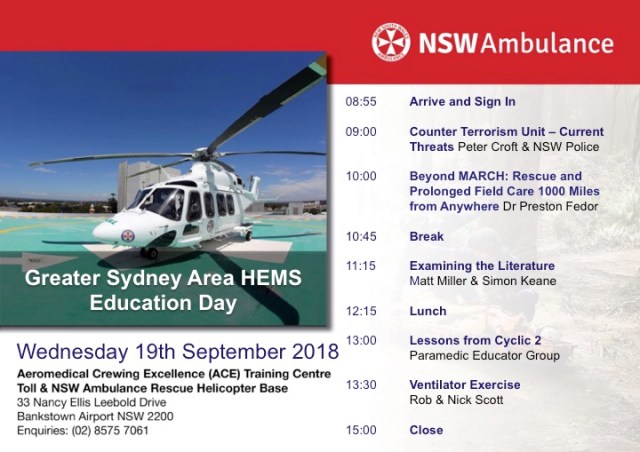
Education Day 25th July

Posted in General PH&RM | Leave a comment

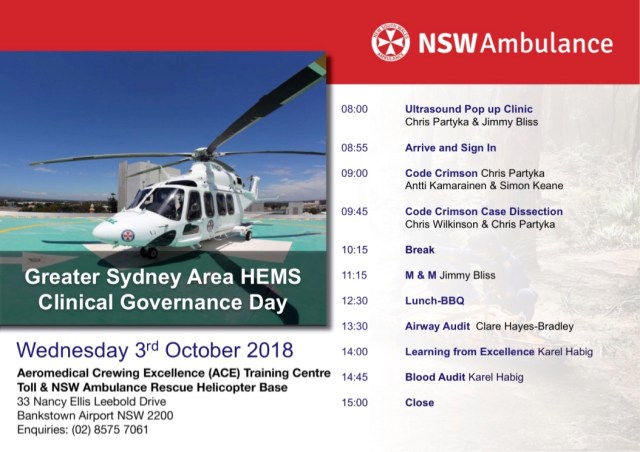
Clinical Governance Day – July 11th 2018

Slide1

Posted in General PH&RM | Leave a comment

AiR – Learning from the Airway Registry [March 2018]

Intubations this month:          21

Airway Registry learning points reflect the challenges described and wisdom shared by Sydney HEMS personnel and guests at the Clinical Governance Airway Registry presentation for March 2018. Cases are discussed non-contemporaneously, anonymised and amalgamated over a time period to draw together unifying take-home messages. Details of specific cases are removed and/or changed, such that any similarity to real-life patients or scenarios is coincidental.

All CMAC videos are shared under a Creative Commons Licence: Attribution 2.0 Generic. Please familiarise yourself with the terms of the licence before reusing our videos.

To view these videos, you will need this password: AiRblogVideos

Focus on: Airway Management in the Septic, Hypotensive Patient

We have previously discussed the guidelines for intubation of the critically ill from December 2017.

The authors suggest that peri-intubation haemodynamic management and the prevention of hypotension/cardiac arrest at induction can include:

  • Addressing causes of hypotension in the patient
  • Drug choices – Ketamine & Rocuronium
  • Rapid volume replacement available with institution of IPPV
  • Vasopressor/inotrope boluses available
  • Vasopressor infusion before induction

It is prudent to increase the noradrenaline infusion rate on any septic, hypotensive patient with noradrenaline running before RSI drugs are administered. Likewise, adrenaline boluses (10mcg/ml & 100mcg/ml) should be prepared before RSI drugs are given. A rapidly flowing IV access line is useful to ensure drugs reach the circulation but also to be able to offset the physiology change of reduced preload with IPPV.

Video Focus: Other Things You Might See in the Airway

Burns

These two videos [password: AiRblogVideos] show some laryngoscopy findings in burns patients.

The first (very short!) shows soot, on the face as the CMAC is inserted and on the cords at laryngoscopy.

The second shows very mildly sooty snot in the airway of a patient with 35% TBSA burns just before the epiglottis is visualised. Sooty snot on nose-blowing was part of the rationale for intubation in this patient.

Other Things You Might See

This video shows the appearance of a single (right sided) NPA during passage of the CMAC laryngoscope through the oropharynx.

This video shows the appearance of bilateral NPAs during passage of the CMAC laryngoscope through the oropharynx.

This video shows the appearance of a denture plate during passage of the CMAC laryngoscope through the oropharynx. This is not secured and should be removed; it’s easy to see how it could cause a complete airway obstruction.

In this video, the presence of blood in the airway in combination with the use of the LUCAS device to provide CPR means that the view is totally lost when the blood hits the camera.

You can see all the AiR videos here on our Vimeo page or here on the blog.

Posted in Airway, Airway Registry, General PH&RM | Tagged , , , , , , , | Leave a comment

Diploma in Retrieval and Transfer Medicine

Posted in General PH&RM | Leave a comment

GSA HEMS Education Day Wed 27th June

PHOTO-2018-06-14-14-35-21

Posted in General PH&RM | Leave a comment

Institute of Trauma & Injury Management (ITIM) Trauma Education Evening

itim-logo

It’s just one week til Sydney HEMS will proudly host the ITIM Trauma Education Evening at the ACE Training Centre at our Bankstown Base.

How Much?

It’s FREE but places are limited so you must register – do so here. Do not turn up without registering, we won’t be able to let you in!

When & Where

Wed. 20 June 2018, 4:30 pm – 9:00 pm AEST (that’s Sydney time)

Auditorium, ACE Training Centre (Bankstown Airport)

33 Nancy Ellis Leebold Dr

Condell Park, NSW 2200

What’s On?

1630 – Registration and coffee

1700 – Welcome and opening – Clare Richmond (Retrieval Consultant, Sydney HEMS & ED Staff Specialist)

1705 – Statewide Aeromedical Retrieval – speaker TBC

1725 – Code Crimson – Karel Habig (Medical Director, GSA HEMS)

1740 – The role of RLTC – Andrew MacDougall (RLTC & Aeromedical Operations Officer)

1755 – Paediatric trauma – Natalie May (Staff Specialist, Sydney HEMS & Emergency Medicine)

1815 – Straight to theatre – Geoff Healy (Staff Specialist, Sydney HEMS & Anaesthetist)

1835 – On the ground – packaging – Sam Immens (Critical Care Paramedic, NSW Ambulance)

1850 – Supper break & ACE/Toll facility video

1940 – The hospital primary – Simulation and Panel Discussion – Clare Richmond and Rob Scott (Retrieval Consultant, Sydney HEMS)

2045 – Close

What If I Can’t Make It?

You’re in luck! ITIM events are livestreamed for free too. You’ll be able to find the livestream here on the night, or here in the archive if you’ve come across this after the event.

Posted in General PH&RM, Presentations, Trauma | Tagged , , | Leave a comment

Clinical Governance Day, June 13th 2018

Slide1

Posted in General PH&RM | Leave a comment

Prehospital Regional Anaesthesia

At the HEMS Education Day on 30th May 2018, we had two great presentations on regional anaesthesia from guest speakers Andrew Lansdown and Ananth Kumar.

Ex-Sydney HEMS registrar and current consultant anaesthetist Andrew Lansdown gave us an excellent presentation on regional anaesthesia of the hip, thigh and knee. He has kindly shared his slides below.


Fellow anesthetist Dr Ananth Kumar then covered the Serratus Anterior Plane (SAP) block, perfect for anterior / lateral rib fractures. First described in 2013, this ultrasound-guided approach is simple, safe, and very effective, although its exact mechanism of action is still somewhat mysterious.


Here’s a video of the SAP block being done:

 
The talks were followed by practical stations, in which the retrieval Sonosite iViz devices were used to identify sonoanatomy in volunteers.

Posted in General PH&RM, Presentations | Tagged , , , , | Comments Off on Prehospital Regional Anaesthesia

Sydney HEMS Education Day 30th May 2018

CGD - Education Day Flyer Final

Posted in General PH&RM | Leave a comment