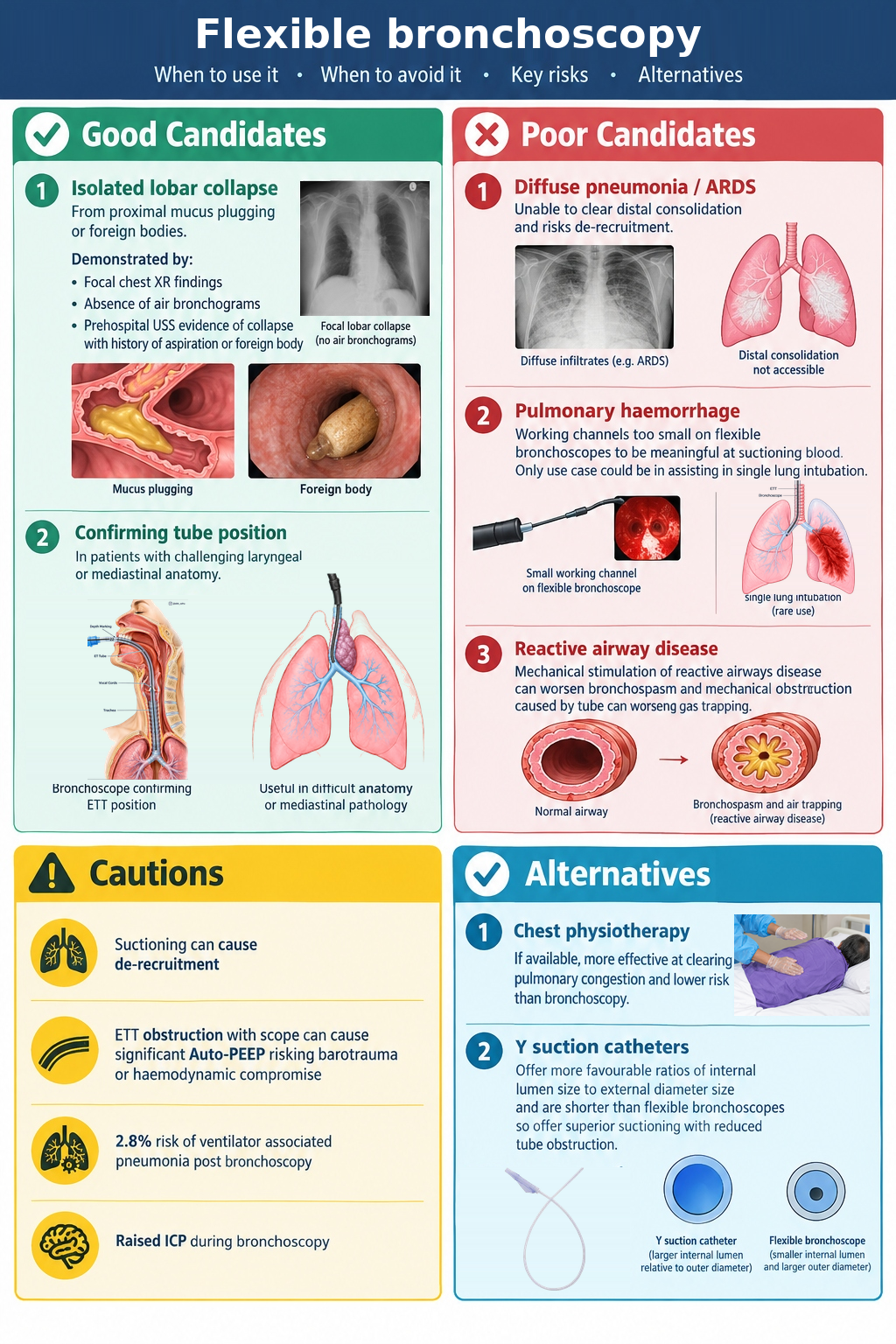
Many retrieval services carry single-use flexible endoscopes for anticipated challenging airways, mainly in controlled interhospital settings. In the presentation below, Dr. Jaime Henry discusses the benefits and drawbacks of pre-hospital and retrieval bronchoscopy. (Presented during a Sydney HEMS education day September 2026).
Disclaimer: The only endoscopes referred to here will be the Ambu aScope4 line. This is simply due to organisational familiarity and there is no financial conflicts of interest.
What size to use?
Different historical sizing conventions exist for appropriate sizing of Y suction catheters and bronchoscopes. NSW guidelines suggest no greater than 50% of the airway lumen diameter should be taken up by a suction catheter, whereas sizing for bronchoscopy most commonly discusses adding 2mm to the scope external diameter. Neither of these correlate proportionally to the remaining cross sectional area available for air flow.
Bench modelling, in volume control with tidal volumes at 500mls and PEEP of 0, demonstrates sharply increasing Auto-PEEP during bronchoscopy when the effective remaining diameter falls below approximately 5 mm. The implication of this is shown in the table below with the ETT : suction catheter/bronchoscope combinations with less than 5mm effective diamter coloured in red. https://pmc.ncbi.nlm.nih.gov/articles/PMC12712257/
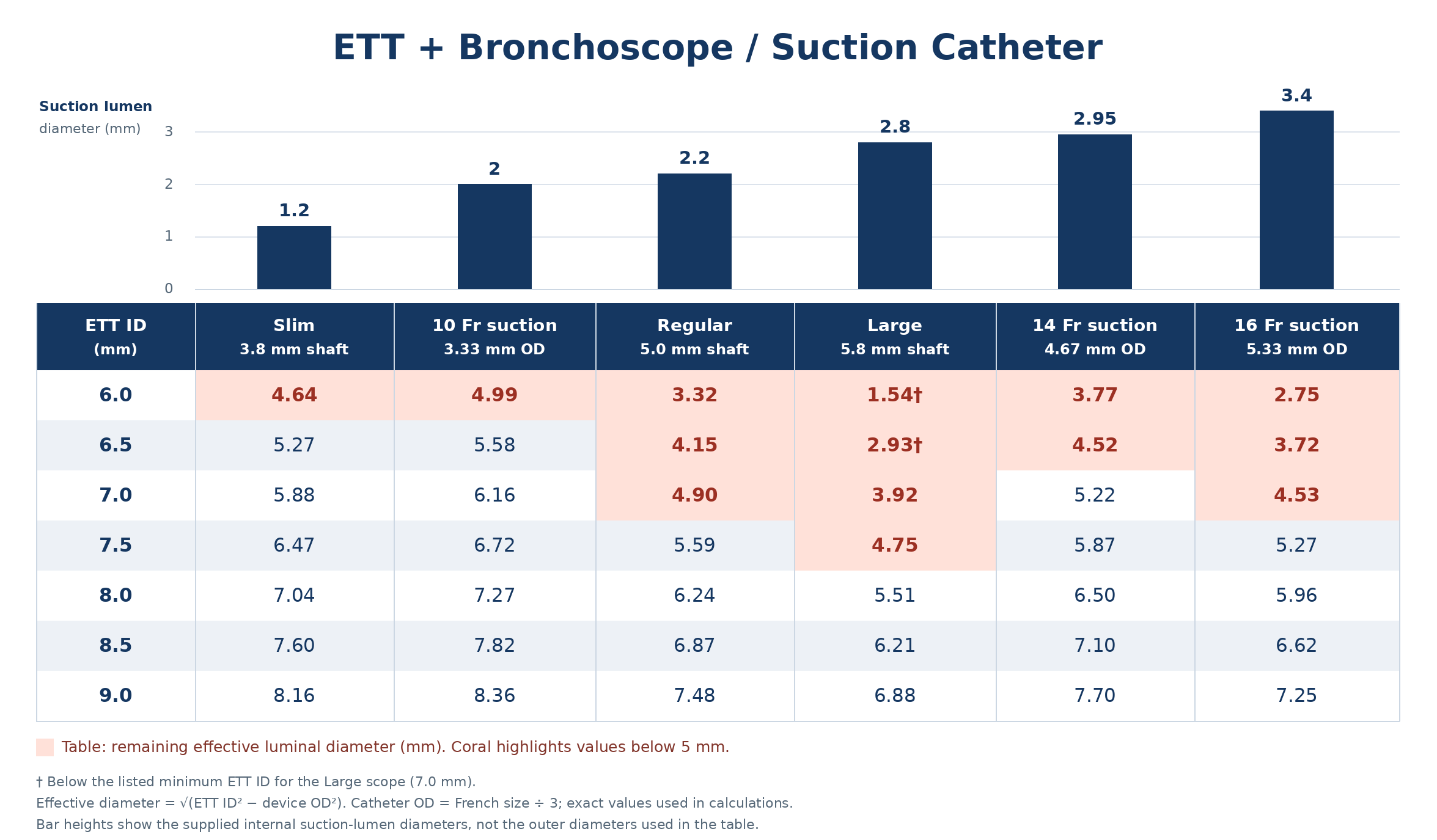
Of note, the only bronchoscope suitable to avoid excessive Auto-PEEP in a commonly used size 7 ETT is the Ambu scope slim. As the 14Fr suction catheter is also compatible at this size, but has ~2.5x the suction lumen, careful consideration towards which is the best tool is warranted.
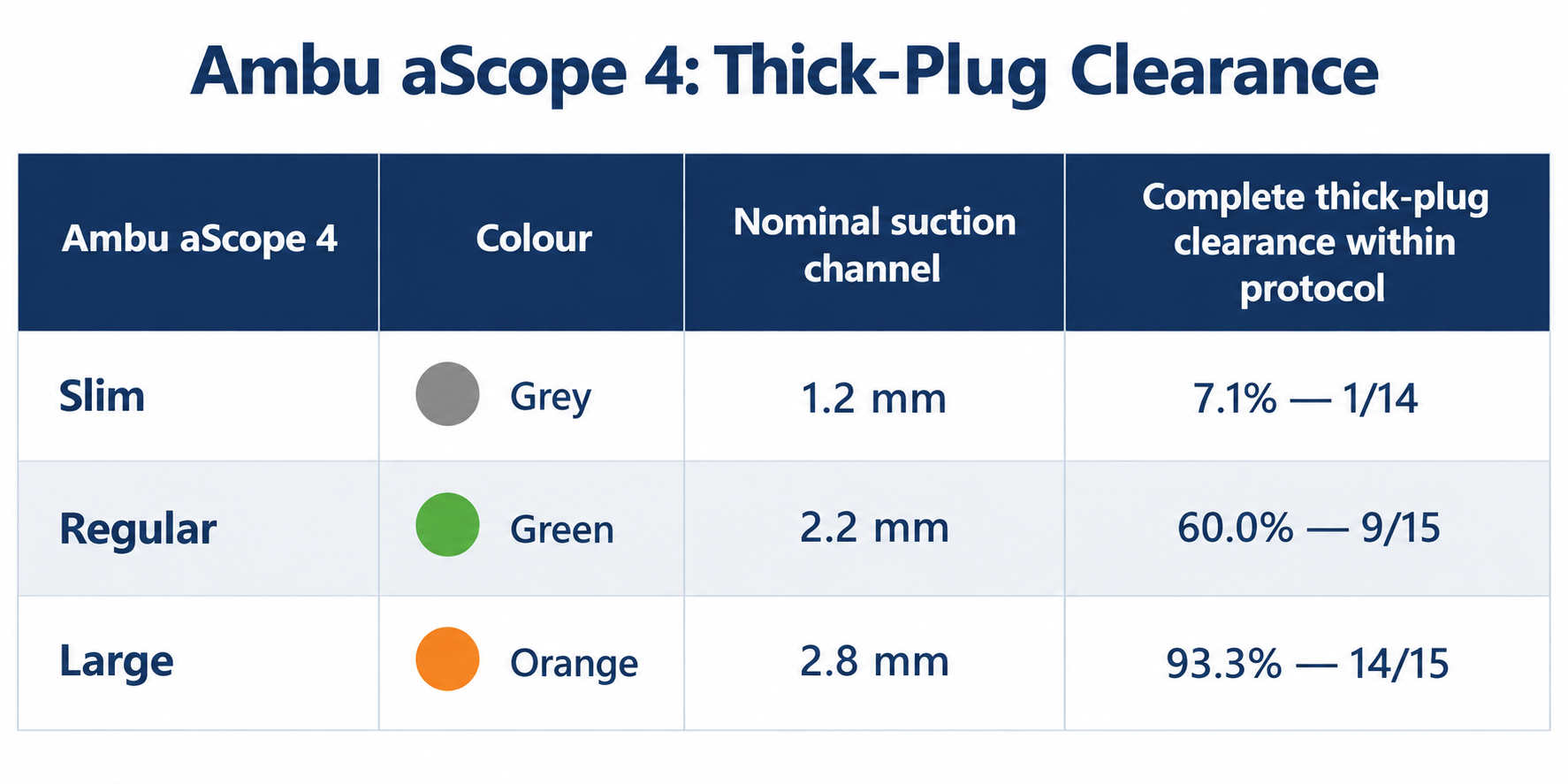
This is especially pertinent when you consider that improvements in suction flow are non-linear with respect to increasing diameter. This was demonstrated in an another bench study with a 1% Guar gum “mucous” suction test and 3% Guar gum “mucous plug” clearance test.