Pearls from Education Day – 19/9

Courtesy of Nick Scott:

Our education day commenced with an update on the current terrorism threat, delivered by the NSW’s Counter Terrorism & Emergency Management Department. Ambulance service NSW’s role is key in being the “eyes and ears” – if you witness something suspicious report it using the national security hotline 1800 1234 00. Further information can be found at https://www.secure.nsw.gov.au/what-you-can-do/.

We had the pleasure of inviting one of our previous Registrars back – Dr Preston Fedor to deliver a fascinating talk. Preston is an Emergency Physician, Assistant Medical Program Director for Clark County EMS and a Captain, USAF, MC – 304th Rescue Squadron.

Picture1

This lecture centered on a case, which involved not only complex and prolonged medical care, but also a complex rescue mission. The United State Air Force Pararescuemen (PJs) were tasked to access and care for two critically burned men aboard a ship more than 1000 miles out to sea, halfway between New York and Portugal. They flew out in an HC-130, parachuted into sea at night, boarded the ship from Zodiacs, and met their patients. Over the course of 32 hours the men cared for these patients, who required airway management (ETI for one, cricothyrotomy for another), escharotomies, continuous pain control and sedation, regular wound debridement and dressing changes, ventilator management, and more. All were eventually hoisted off the ship by a Portuguese coast guard helicopter.

As complicated as this all sounds (and it was a massive effort), the medical care was based on the adaptation of a relatively straightforward tactical medicine construct – MARCH. This is an acronym for the main priorities when caring for a patient in a tactical environment:

Massive Hemorrhage – Control it!

Airway – Open and maintain it by whatever means necessary

Respirations – Support ventilations if needed. Cover any holes in the chest. Make holes if needed.

Circulation – Access and fluids, blood, TXA

Head injury / Hypothermia – Think of head injury and avoid hypoxia/hypotension. Control the environment: get the patient off the ground, keep warm.

Over the years of wartime experience, the PJs learned that in order to fully use their paramedic skillset and better care for their patients in the tactical and prolonged care environment, that an addition to MARCH was needed. In comes MARCH / PAWS.

The PAWS stands for:

Pain control – early and often

Antibiotics (and) – antibiotics for battlefield wounds, and other meds as needed (think antiemetics)

Wounds – irrigate and debride battlefield wounds, burns as soon as feasible

Splinting – splint fractures, c-collars, spinal protection, eye shields

This framework as written is great in a tactical or prehospital environment when you can run through it, address the major issues, and then head right off to a trauma center. In the case of a prolonged care scenario (as in this case), when you may be with the patient for hours or days, MARCH / PAWS must necessarily become a cycle – continue to reassess, continue to manage these issues throughout the time you are caring for the patient. Keep going back to that airway, verify no tension pneumo is re-accumulating, tweak the vent as needed, continue sedation and pain control, clean and redress wounds, etcetera.

Picture2

More important than memorizing and using these acronyms is to anticipate that these prolonged care scenarios will happen to you. This could be your next mission. So train for these situations, prepare yourself and your team for this eventuality. Find a way to stay organized and calm, and not miss any important elements of your patient’s care in the complexity and stress of these scenarios. MARCH / PAWS is one excellent way to not only keep it together, but excel.

Additional references, videos, podcast links, and other resources for this talk can be found at operationalems.com/lecturenotes.

Examining the literature:

We critiqued two papers on the day – Gavrilovski et al https://www.ncbi.nlm.nih.gov/pubmed/29706249 article regarding isolated head injuries and their association with cardiovascular instability and  Rehn et al https://www.ncbi.nlm.nih.gov/pubmed/29141907 emergency vs standard response driving.

Have a read of the papers yourself – a few points brought out of our discussion was when does correlation imply causation and the use of DAG’s – Directed acyclic graphs (DAGs) are visual representations of causal assumptions and they can help to identify the presence of confounding.

Lessons from Cyclic 2:

Cyclic training had been very successful with abundant amounts of learning for the individuals taking part. One of the exercises was a night winch involving a big sick 45 yo male dirt bike rider accident, complicated by having his 12 yo son on scene. This was an unsupported scene 4 hours by foot.

These were just a few of the learning points to take away:

Before you set off on such a mission use the PEEP tool to assist mission planning:

Personnel

Environment

Equipment (CAMS -comms, access, medical, survival)

Plan B

These types are jobs are challenging with cold, dark, dirty and confined conditions. So, make sure you’ve the right PPE/clothing. Eye protection when walking through the Bush and don’t wear your torch hanging around the neck – think about illuminating what you’re doing!

You should mentally rehearse workflows with the team before you arrive on scene. Make decisions early about space creation, gear management, moving your patient vs temporising in sit u.

These are difficult conditions- don’t overlook optimizing the patient before interventions such as RSI. Consider using basket and immobilization equipment to help prep your patient for RSI e.g. combining the KED and basket creates a patient head up position -great for RSI but may limit access for thoracostomy. Utilize the bystanders.

All this and much more needs to be considered if the patient is to be effectively and safely treated and scene times are kept to a minimum.

The day concluded with ventilator groupwork designed to share learning about some of the finer nuances around our Oxylog 3000+ and Medumat Standard 2.

Posted in General PH&RM | Leave a comment

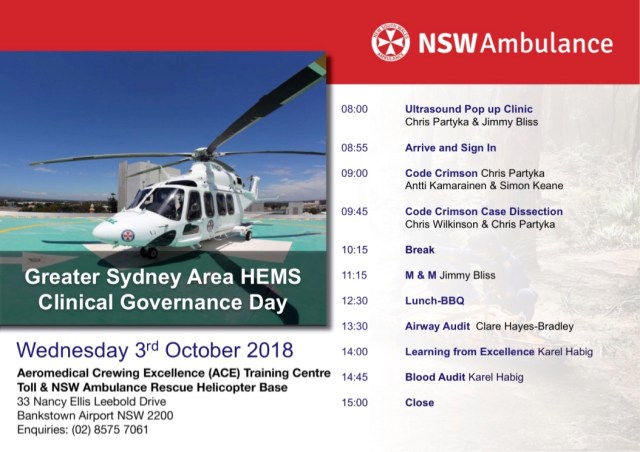
Clinical Governance Day – Wednesday 3rd October

CGD Oct

Posted in General PH&RM | Leave a comment

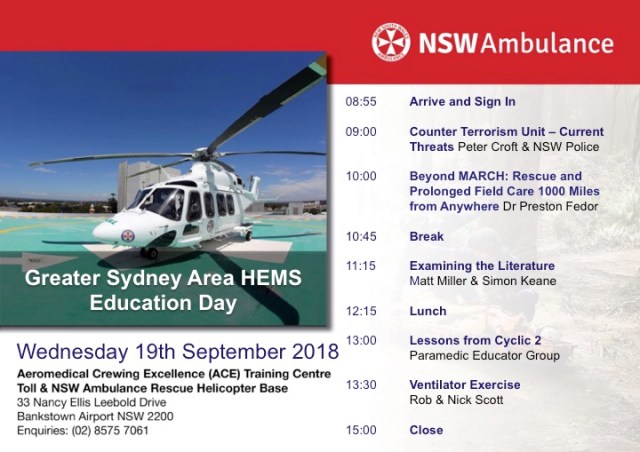
Education Day – Wednesday 19th September

Slide1

Posted in General PH&RM | Leave a comment

Clinical Governance Day – Weds 5th Sept 2018

CGD 5th Sept 2018

Posted in General PH&RM | Leave a comment

Education Day Wrap Up – CBRN, Tactical Medicine and Major Incident Management…

(Courtesy of JP Favero)

CBRN

Associate Professor Dr David Heslop kicked off the day with a talk on CBRN Issues explaining the characteristics of these type of threats – usually deliberate, sometimes accidental, often used to kill or incapacitate military and/or civilian targets. They an be engineered to defeat defences with strategic and political effects. We noted the 5 Pillars of CBRN-D: Warning and Reporting; Detection, Identification and Monitoring; Physical Protection; Medical countermeasures and supports; Hazard management.

There was explanation of Mission Oriented Protective Posture (MOPP), types and levels of Personal Protective Equipment. We touched on the effectiveness of decontamination and principles to employ both pre and post this type of terrible event. Our senior doctors, many of whom lead major Sydney emergency departments, appealed for advice on who to call in real time.

The Grenfell Fire Experience

Laurence Ioannou gave us a first hand run down of his Grenfell Tower Fire experience as Ambulance Scene Commander. You probably know the story… A 24 storey block of flats in North Kensington, West London, went up in flames early on the morning of 14 June 2017. It took 60 hours to put it out. There were sadly 72 deaths, about 80 people were treated on the scene, 70 transported. At the peak there were 71 ambulance vehicles in play and approximately 30 patients had intensive care post the event.

The value of Joint Emergency Services Interoperability Principles (JESIP) was emphasised – 5 important principles for joint working in major incidents – Co-Locate, Communicate, Coordinate, Jointly understand risk, Shared situation awareness. Laurence found it was vital to brief and share info between agencies every 45 mins or so. He also explained the value of Pre-Determined Attendance. London Ambulance has PDA for ‘Significant’ and ‘Major’ Incidents – early declaration and resource activation saves lives. Simple things make a huge difference – disposable carry sheets / frameless transport devices for patients and coloured tarpolines on the ground for casualty clearing stations, weather allowing.

There’s a great deal of trust in managers and peers during this type of response. Paper log books and a scribe are a must if you find yourself in charge, and don’t forget it takes a long time to complete formal handover, an important consideration in a protracted incident alongside fatigue. Oversight is difficult. Delegate another senior colleague to walk through the casualty ‘journey’, optimise and report back. Control can do a lot to offload scene commander(s), determine hospital destinations and streamline communications – it’s next to impossible to receive information on multiple channels and properly monitor the radio when you’re the on scene boss.

Tactical Medicine

Later in the morning Oli Ellis and Scott McNamara had a chat about Tactical Medicine and the need to practice it in any incident that involves the risk of imminent physical harm to the responder(s).

Remember Rule No 1: Manage your own trauma and don’t willingly expose yourself to these environments without proper training

We know it’s about the correct intervention at the correct time, and that there’s a continuum of BLS to ALS dependent on threat. Unfortunately, when in the hot zone, a medically correct intervention at an incorrect time can lead to further injury. And it’s worth remembering a threat can shift, capturing you and your team in what may have been a previously clear or apparently benign environment. Increased Threat = Decreased Treatment

It was a shame Ben Roberston wasn’t there – he was probably out saving lives in the place where he lives, the danger zone. Meanwhile we noted its all about:

Hot – Danger – Threat suppression
Warm – Not Secure – Haemorrhage control, Rapid extrication
Cold – Safe – Assess and treat patient, Transport to Hospital

The boys made Tactical Emergency Casualty Care (TECC) look HOT, ready to rapidly treat or exclude the 3 big preventable causes of death Haemorrhage, Obstruction of the airway and Tension pneumothorax. They touched on RAMP Triage (Rapid Assessment of Motor and Pulse) and utility in predicting mortality from US military data.

Workshops

Our afternoon workshops covered off HEMS Team PPE, mask application, Tyvec suits and a real tasking cased based discussion. There were examples of PPE carried by the Special Operations Team, SOT tactical apparel and equipment. Scott gave us a demonstration of wound packing, great fish hook, tourniquet application and labelling. Oli provided an excellent look at patient assessment – radial pulse and simple assessment of level of motor function RAMP style along with a ‘sweep’ in the hostile environment. Integrating “tactical breathing” into the primary survey is something we can all do. We spoke a little about the utility of posturing expectant and deceased patients in a mass casualty scenario and sharing that with other services or those accessing the scene later. Positioning, maintenance of situational awareness, scanning, tactical breathing and great commentary were all on show.

IMG_2103

Oli demonstrating a primary survey in a tactical setting.

IMG_2101

Scott “fish-hooking” a wound prior to packing.

Posted in General PH&RM | Tagged , | Leave a comment

AiR – Learning from the Airway Registry [April 2018]

Intubations this month:          34

Airway Registry learning points reflect the challenges described and wisdom shared by Sydney HEMS personnel and guests at the Clinical Governance Airway Registry presentation for April 2018. Cases are discussed non-contemporaneously, anonymised and amalgamated over a time period to draw together unifying take-home messages. Details of specific cases are removed and/or changed, such that any similarity to real-life patients or scenarios is coincidental.

All CMAC videos are shared under a Creative Commons Licence: Attribution 2.0 Generic. Please familiarise yourself with the terms of the licence before reusing our videos.

To view these videos, you will need this password: AiRblogVideos

Focus on: Blunt Neck Trauma

Our main discussion focused around the management of patients with potential/known upper airway injury. The majority of our potential laryngotracheal injuries are in multiply injured patients where the other injuries dictate patient management, including intubation, and the airway injury becomes an interesting (sometimes unexpected) finding on the hospital CT scan.

Occasionally we attend patients with isolated neck/laryngeal injuries. Examples include:

  • strangulation
  • motorbike rider crossing wire fences
  • direct front of neck blunt trauma.

Laryngotracheal injuries can be challenging anywhere and as a retrieval team we are often faced with early presentations in non-tertiary institutions with the added challenges of an unfamiliar team & environment, limited investigations, and the need for long distance transport to tertiary care.

Potential for further harm to the patient comes from worsening the injury (e.g. turning a partial tracheal tear into total tracheal disconnection), creation of false passages (by blind instrumentation of the airway), loss of effective spontaneous negative pressure ventilation, generation/worsening air leak from positive pressure ventilation with failure of ventilation.

Principles of management for these patients are therefore:-

  • Assess need for intubation as urgency varies between patients, and they may be best transported without RSI.
  • Cervical spine collars or other constrictions around the neck may be best avoided
  • Maintain spontaneous ventilation where possible
  • Avoid positive pressure ventilation above the injury (e.g. BVM, LMA)
  • Avoid instrumenting the injury (e.g. bougie/ETT) as it may complete a partial tracheal transection, or create a false passage
  • Small ETT e.g. 6.0mm I.D in adults is prudent
  • Place cuff of ETT below injury (visualization of defect ideal)
  • Perform any surgical airway below the level of injury (e.g. tracheostomy rather than cricothyroidotomy for neck injury). Placing an ETT through the defect has been performed but is not without risk of completing a transection.
  • Visualised actions preferable to blind interventions

Our clinical practice standard for Prehospital Intubations recommends using a bougie for every intubation. Despite visualizing the larynx above the vocal cords with laryngoscopy, the bougie is not seen as it passes below the cords where further damage to tracheal injuries is possible. There is an argument for not using a bougie in easy intubations. It is advisable to place the ETT deep so placing the cuff below likely injury level (which carries an endobronchial injury).

In smaller hospitals, the options for intubation increase and decision making can be less clear. A prehospital approach to intubation is not contra-indicated and could be used in lower resource settings alongside preparation for a surgical airway approach. Intubation under a spontaneous breathing general anaesthetic technique (gas induction or total intravenous technique) is most familiar. Awake fibreoptic intubation is an option though care needs to be taken to ensure a cough/struggle-free experience; remember also that the subsequent railroading of the ETT will be blind so the same risks apply.

Articles have described a two-operator technique involving spontaneous breathing anaesthesia with videolaryngoscopy and flexible intubating scope to assess tracheal injury at time of intubation and avoid creating a false passage. This is likely to need prior practice and a strong team.

The best plan of action may be both resource-dependent and context-dependent and we strongly recommend discussion with local staff and/or Duty Retrieval Consultant at the time.

Video Focus: Epiglottis

This video shows how adjusting the position of the tip of the laryngoscope in the vallecula can improve your view at laryngoscopy.

This video shows how we can sometimes use our Mac blade as a Miller blade by picking up the epiglottis: you may not have intended to pick up the epiglottis but if you get a good view as the one shown here, you might decide to proceed with passing the bougie or ETT rather than trying to get into the vallecula (especially as the earlier part of the video shows this might have been challenging).

This video appears to show a mass below the epiglottis when the laryngoscope is in the vallecula. This is, in fact, a normal variant – an epiglottic tubercle (see this anatomy diagram from this site).

In this video, the epiglottis appears swollen (this may be a result of local trauma caused by the use of an oropharyngeal airway or related to drug use). You can also see an issue with control of the coude (curved) tip of the bougie. This occurs because of the way we transport the bougie in our airway packs: we cannot transport the bougie without bending it and this case reminds us to ensure that the bending occurs along the plane of the coude tip curve during our pack checks.

You can see all the AiR videos here on our Vimeo page or here on the blog.

Posted in Airway, Airway Registry, General PH&RM | Tagged , , , , , , , | Leave a comment

Education Day 25th July

Posted in General PH&RM | Leave a comment

Clinical Governance Day – July 11th 2018

Slide1

Posted in General PH&RM | Leave a comment

AiR – Learning from the Airway Registry [March 2018]

Intubations this month:          21

Airway Registry learning points reflect the challenges described and wisdom shared by Sydney HEMS personnel and guests at the Clinical Governance Airway Registry presentation for March 2018. Cases are discussed non-contemporaneously, anonymised and amalgamated over a time period to draw together unifying take-home messages. Details of specific cases are removed and/or changed, such that any similarity to real-life patients or scenarios is coincidental.

All CMAC videos are shared under a Creative Commons Licence: Attribution 2.0 Generic. Please familiarise yourself with the terms of the licence before reusing our videos.

To view these videos, you will need this password: AiRblogVideos

Focus on: Airway Management in the Septic, Hypotensive Patient

We have previously discussed the guidelines for intubation of the critically ill from December 2017.

The authors suggest that peri-intubation haemodynamic management and the prevention of hypotension/cardiac arrest at induction can include:

  • Addressing causes of hypotension in the patient
  • Drug choices – Ketamine & Rocuronium
  • Rapid volume replacement available with institution of IPPV
  • Vasopressor/inotrope boluses available
  • Vasopressor infusion before induction

It is prudent to increase the noradrenaline infusion rate on any septic, hypotensive patient with noradrenaline running before RSI drugs are administered. Likewise, adrenaline boluses (10mcg/ml & 100mcg/ml) should be prepared before RSI drugs are given. A rapidly flowing IV access line is useful to ensure drugs reach the circulation but also to be able to offset the physiology change of reduced preload with IPPV.

Video Focus: Other Things You Might See in the Airway

Burns

These two videos [password: AiRblogVideos] show some laryngoscopy findings in burns patients.

The first (very short!) shows soot, on the face as the CMAC is inserted and on the cords at laryngoscopy.

The second shows very mildly sooty snot in the airway of a patient with 35% TBSA burns just before the epiglottis is visualised. Sooty snot on nose-blowing was part of the rationale for intubation in this patient.

Other Things You Might See

This video shows the appearance of a single (right sided) NPA during passage of the CMAC laryngoscope through the oropharynx.

This video shows the appearance of bilateral NPAs during passage of the CMAC laryngoscope through the oropharynx.

This video shows the appearance of a denture plate during passage of the CMAC laryngoscope through the oropharynx. This is not secured and should be removed; it’s easy to see how it could cause a complete airway obstruction.

In this video, the presence of blood in the airway in combination with the use of the LUCAS device to provide CPR means that the view is totally lost when the blood hits the camera.

You can see all the AiR videos here on our Vimeo page or here on the blog.

Posted in Airway, Airway Registry, General PH&RM | Tagged , , , , , , , | Leave a comment

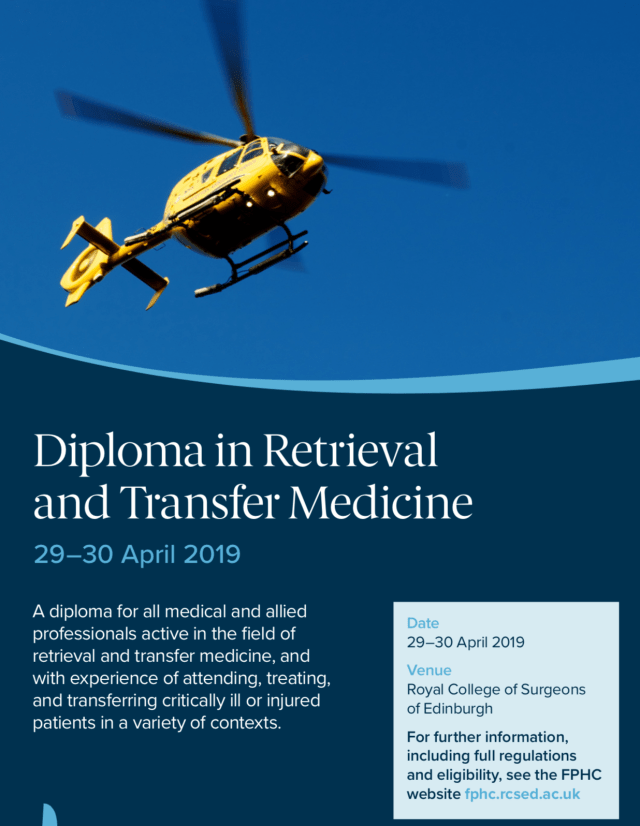
Diploma in Retrieval and Transfer Medicine

Posted in General PH&RM | Leave a comment