
It’s 1am at a motor vehicle accident. RSI is complete; the patient is being loaded to the ambulance and established on the Hamilton ventilator. What rates should we start the sedative infusions at? And with everything else going on, how do we quickly individualise this between a 60 kg patient with internal bleeding and a 90 kg patient with burns?
A busy night shift, it’s now 3am and we’re with a septic patient who urgently needs transfer for source control. The isolated referring hospital has done an excellent job, but the patient is no longer fluid-responsive and the metaraminol infusion isn’t cutting the mustard. We want to start peripheral noradrenaline—what rate should we use, and when should we consider adding agents like adrenaline or vasopressin?
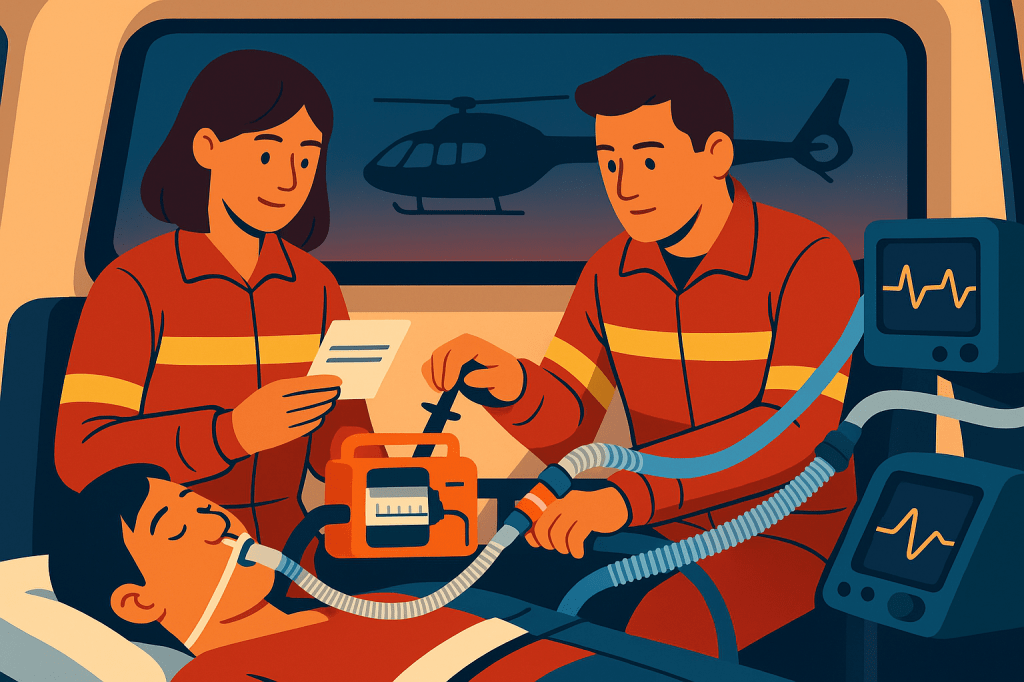
The next night, we’re on a fixed-wing transfer with an awake subarachnoid haemorrhage patient who’s becoming progressively more hypertensive. There’s no mobile signal, but we should know how to prepare and start a labetalol infusion… what’s the dose again? It’s been a while.
We are only human. Sometimes it’s about knowing where to find the right information fast rather than trying to hold it all in memory. We should also aspire to individualised care for our pre-hospital and inter-hospital patients, not a one-size-fits-all approach. We already accept this in paediatrics, where the beloved paediatric drugs aide-mémoire is never far away. For the same reasons, we’ve developed a concise adult drug infusions aide-mémoire to support informed, tailored decisions—especially when cognitive bandwidth is tight.
The aide-mémoire is designed to be printed at A5, laminated, and it fits snugly inside the front pouch of our current drug thigh-pouch. Of course, an electronic copy can also be saved offline to your device—but consider how handy that will be at a genuinely time-critical moment.


We’d be very grateful for Greater Sydney Area HEMS staff feedback on the utility of this aide-mémoire—what helps, what doesn’t, and constructive suggestions. We’re keen to keep it concise and easy to use in urgent situations. Please provide feedback via the QR code on the printed card or by clicking this link: https://tinyurl.com/adultiviaidememoire
Disclaimer: This aide-mémoire is designed to support, not replace, clinical judgement. It does not constitute a protocol. Final decisions, including drug choice, dosing and monitoring, remain the responsibility of the treating clinicians, who must consider the individual patient, context and local guidelines. As always, our posts do not constitute clinical advice,


 Greater Sydney Area HEMS