Please note that some flexibility is required regarding the handover process, as some trauma centres would prefer handover with the patient still on the stretcher.
This recommendation has come from ITIM‘s Trauma Team Training course.
If you have concerns over the stability of the patient, oxygen supplies etc, then please state your preference to transfer prior to handover – and the reasons why – politely to the team leader. Otherwise kindly comply with the team’s preferred sequence.
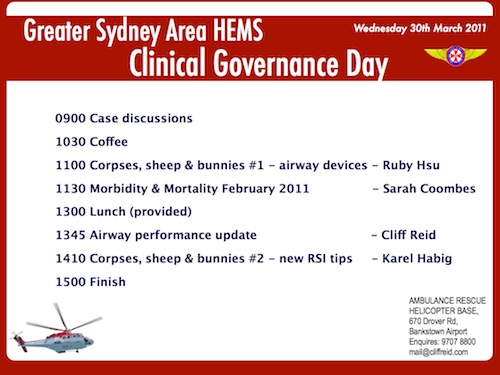
The Clinical Governance Day on Wednesday will include a discussion and critical appraisal of one of the most famous and quoted papers in pre-hospital care – Bickell’s trial of fluids which was a major contributor to the move towards ‘hypotensive resuscitation’. The paper is here – please have a read and a think prior to Wednesday.
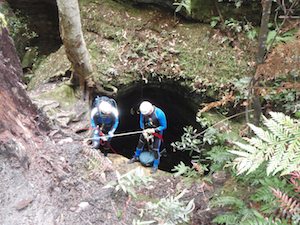
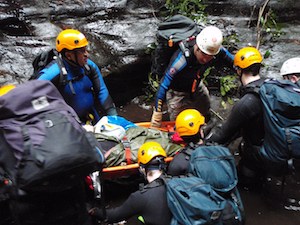
Doctors planning on attending the Canyon Training Days in April – don’t forget the list of goodies you need to prepare (bought your Dunlop Volleys from K-Mart yet?) and let Noel know your wetsuit sizes.
The Canyon Training is awesome, and will stretch you mentally and physically. But you should be used to that by now.
In addition, Roger Bloomer’s case report of a pre-hospital resuscitative hysterotomy has been accepted by European Journal of Emergency Medicine.
These contributions provide a nice demonstration of the breadth of our practice. In due course I’ll put a page of our publications with links to the full text articles.
I was lucky enough to be interviewed by the amazing Scott Weingart, an emergency medicine intensivist who runs the spectacular EMcrit podcast. We covered some stuff on pre-hospital airway management, physicians in pre-hospital care, and I had a rant about ‘scoop and run’ versus ‘stay and play’. Worryingly, Scott is keeping back some audio footage for a later podcast, probably containing an even bigger rant about things like ATLS.
Click the image to be taken to the EMcrit site where you can listen to the podcast.
Congratulations to Paramedic Harry Gatt and Doctor Roger Bloomer for the commendations received for their brave rescue in the Blue Mountains:
The Ambulance Service of NSW Distinguished Service Medal is the Services highest award. It recognises acts of conspicuous bravery by Paramedics that are deemed to be beyond the line of normal duty. On Friday 11 February at the Ambulance Rescue Helicopter base in Bankstown, this esteemed medal was awarded to highly respected Special Casualty Access Team (SCAT) Paramedic Harry Gatt, by the NSW Deputy Premier and Minister for Health Carmel Tebbutt, for his courageous efforts in saving two rock climbers from a cliff face approximately 400m high.
Paramedic Gatt was part of a specialist rescue team tasked to ‘Pierces Pass’ near Blackheath in the Blue Mountains in May 2010. The rescue team were faced with extremely difficult circumstances having to locate, treat and rescue two patients who had fallen onto small rock ledges 250m from the top of the cliff. This difficult rescue not only involved being winched onto a slippery 60 degree ledge but also a precarious traverse across a 2.5m rocky shelf.
“Everyday Paramedics across NSW work hard to provide care in what are often challenging circumstances,” Ms Tebbutt said. “Mr Gatt is recongnised for his conspicuous bravery as he worked to proved care to two patients who had fallen onto a rock ledge. “I join the Ambulance Service in thanking Mr. Gatt for his commitment and his courage.”
Captain Lachlan Slatyer, Aircrewman Greg Gill and Doctor Roger Bloomer were also presented with commendations of courage for their extraordinary efforts, teamwork and technical skill displayed throughout the incident. Captain Slatyer and Aircrewman Gill positioned the aircraft precariously close to the cliff face to enable the Paramedic and Doctor to be winched onto the small ledge.
The entire team worked tirelessly in very difficult and dangerous conditions. Their efforts in coordinating and executing the rescue ensured the 2 injured patient’s rescue was carried out in a manner that ensured both patients received the highest quality clinical care.
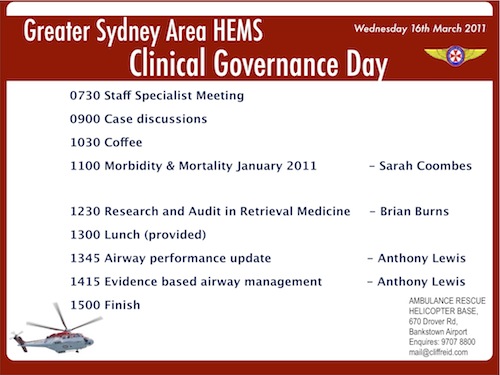
Next Wednesday’s Clinical Governance Day will include a session on critical appraisal of the pre-hospital literature. Please read the papers that have been emailed and make an attempt appraise them for scientific validity, importance of results, and applicability to our own clinical practice. Further guidance on appraisal will follow.
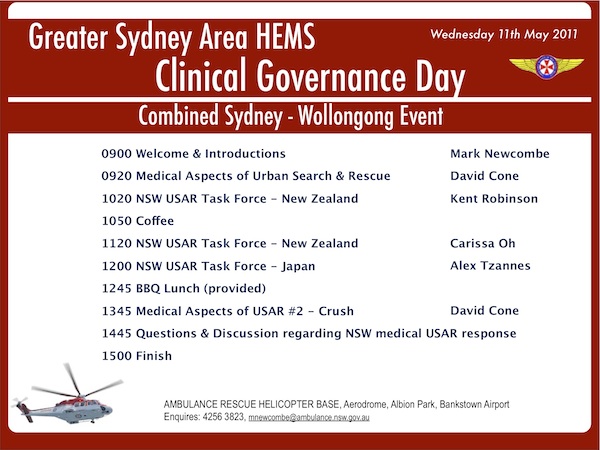
The highlight of the day will be a talk by Paul Featherstone on the human side of Australian disasters, including the recent tragic floods and cyclone that have hit Queensland.
RSI currency training every three months is underway for ASNSW consultants on the SRC roster. Please take a look at the video introducing the system of written and practical sessions.
Sydney HEMS acknowledges the Australian Aboriginal and Torres Strait Islander peoples as the first inhabitants of the nation and the traditional custodians of the lands where we live, learn and work.